Earlier quoted context omitted.
If by ‘explore’ you mean ‘visit’ then sure. Otherwise, we pretty much know what to expect - astronomy and astrophysics are no joke. On a human scale, visiting another galaxy means just seeing more of the same, so why even bother. Diversity of life forms? I think we have a better chance to invent and explore it in labs here on earth.
We haven't even finished discovering the diversity in life forms on this planet. I'm an astronomy nutter, with all of the possibilities it brings. However, I'm continually amazed when I remember that our little planet is covered 70% by water that we truly have not explored. We keep finding some new species when they do go looking. The diversity of life in water compared to on land is impressive.
2.5 Gigapixel Image of the Orion Constellation Took 5 Years to Complete
31–40 of 68 posts
Re: 2.5 Gigapixel Image of the Orion Constellation Took 5 Years to Complete
#32The thing that surprises me is how stationary everything in space seems to be, in order for this to have been possible. But everything is moving, right? So how could a series of pictures over this long of a time work out to be so clear?
Re: 2.5 Gigapixel Image of the Orion Constellation Took 5 Years to Complete
#33The thing that surprises me is how stationary everything in space seems to be, in order for this to have been possible. But everything is moving, right? So how could a series of pictures over this long of a time work out to be so clear?
Re: 2.5 Gigapixel Image of the Orion Constellation Took 5 Years to Complete
#34The thing that surprises me is how stationary everything in space seems to be, in order for this to have been possible. But everything is moving, right? So how could a series of pictures over this long of a time work out to be so clear?
The earth is also orbiting the sun pretty fast, but it's my understanding (I'm not an expert) that you don't need to account for error here, since the Orion nebula is so far away. Think about how the sun stays in the same place in the sky even as you're driving fast on the highway. The nebula is unimaginably far away compared to the sun, and relative movement between the earth, the solar system, and Orion are all undetectable at these scales.
I've read that even the Hubble telescope doesn't need to account for parallax error for such far-away objects during long exposures, which can last up to 20 minutes. Maybe someone here on HN can do (or point to) the math for us.
Re: 2.5 Gigapixel Image of the Orion Constellation Took 5 Years to Complete
#35Earlier quoted context omitted.
How big of a wall would that require to display at 1:1? I have a wall I'm willing to donate to the cause.
Assuming a 50,000^2 pixel image at 600 dpi it’s just under 7 foot by 7 foot. You can likely play around with the DPI to fit most any wall, but I don’t know the aspect ratio.
There are some really nice printing processes for images of this magnitude, such as https://www.whitewall.com/us/metal-prints/aluminum-mounted-p... and https://www.whitewall.com/us/acrylic-prints/masterprint (the exact same processes are available from many printing companies; I have no idea how good this one is but it was easy to find).
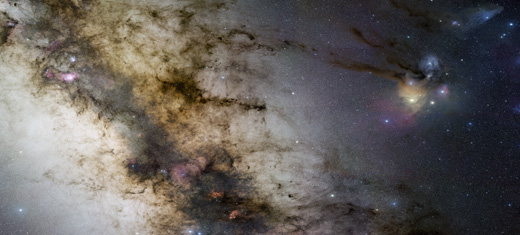
I have a print on this scale of the center of the Milky Way, and it's amazing: http://sguisard.astrosurf.com/Pagim/GC.html
Re: 2.5 Gigapixel Image of the Orion Constellation Took 5 Years to Complete
#36Earlier quoted context omitted.
Assuming a 50,000^2 pixel image at 600 dpi it’s just under 7 foot by 7 foot. You can likely play around with the DPI to fit most any wall, but I don’t know the aspect ratio.
It's 65k×35k pixels: https://space4everybody.com/about-the-image/ There are some really nice printing processes for images of this magnitude, such as https://www.whitewall.com/us/metal-prints/aluminum-mounted-p... and https://www.whitewall.com/us/acrylic-prints/masterprint (the exact same processes are available from many printing companies; I have no idea how good this one is but it was easy to find). I have a print…
Welcome back 1999. Holy cow. Comments in good humor: 1) No preview image of what you are selling. 2) Several links are broken. One is a Flash based website!?!? Others are just no longer hosted. 3) Owww, my eyes!!! Also, Yay! Tables!
I get it. If it's not broken, don't fix it. However, you are making it difficult for an interested person to make an informed purchase. I am looking exactly for this kind of art to fill up my astronomy room, so this has piqued my interest. It's not like I don't know what the galactic center looks like, but not buying something sight unseen
Re: 2.5 Gigapixel Image of the Orion Constellation Took 5 Years to Complete
#37Re: 2.5 Gigapixel Image of the Orion Constellation Took 5 Years to Complete
#38Earlier quoted context omitted.
It's 65k×35k pixels: https://space4everybody.com/about-the-image/ There are some really nice printing processes for images of this magnitude, such as https://www.whitewall.com/us/metal-prints/aluminum-mounted-p... and https://www.whitewall.com/us/acrylic-prints/masterprint (the exact same processes are available from many printing companies; I have no idea how good this one is but it was easy to find). I have a print…
> http://sguisard.astrosurf.com/Pagim/GC.html Welcome back 1999. Holy cow. Comments in good humor: 1) No preview image of what you are selling. 2) Several links are broken. One is a Flash based website!?!? Others are just no longer hosted. 3) Owww, my eyes!!! Also, Yay! Tables! I get it. If it's not broken, don't fix it. However, you are making it difficult for an interested person to make an informed purchase. I am…
I have the 70"×40" print on my wall right now, and it's worth it.
Re: 2.5 Gigapixel Image of the Orion Constellation Took 5 Years to Complete
#39The thing that surprises me is how stationary everything in space seems to be, in order for this to have been possible. But everything is moving, right? So how could a series of pictures over this long of a time work out to be so clear?
https://www.lesswrong.com/posts/noBKApHwFm8aMuvnw/link-the-g...
Re: 2.5 Gigapixel Image of the Orion Constellation Took 5 Years to Complete
#40The thing that surprises me is how stationary everything in space seems to be, in order for this to have been possible. But everything is moving, right? So how could a series of pictures over this long of a time work out to be so clear?
The Earth is rotating, but it's easy to compensate for that so that the stars don't turn into streaks. You just mount the telescope and camera on a motorized mount that turns slowly to counteract the rotation of the Earth. That's cheap and easy to do, so everyone does it unless they specifically want to show off the rotation of the Earth.
Every star in that image has some proper motion, usually dozens or hundreds of km/s, and there's no way to counteract that. For any single exposure that's not large enough velocity to turn the stars into a streak, but it is enough for the stars to be in different positions relative to each other from year to year. Since different panels of the image were captured in different years, the overlaps between those panels won't match perfectly. When stitching the panels together, the photographer will probably have edited the photograph so that each star is taken from only one panel. That will prevent any stars from being cut in half or blurred together from both panels, but there could be stars that moved fast enough to have crossed the boundary between the panels and they could show up in the full image twice. Good luck spotting them though.
The Earth is also moving around the Sun, so there is an additional apparent motion, but it's smaller in magnitude to than the proper motion and won't cause any extra problems.
The gas clouds are also moving. Some of them are expanding, some of them are being pushed by stellar winds, etc. Stars can form in dense clouds, and then the stellar wind from the new star pushes all the remaining dust away to create a bubble. You can see these motions over the course of years, so presumably they caused some minor mismatches between panels that were photographed at different times. Since these features are fuzzy, it's not hard to blend neighboring panels together even when they're taken years apart.
https://www.youtube.com/watch?v=ofCooIkIwvQ is a great explanation with good visuals, and it has photographs taken by the New Horizons probe that directly show stellar parallax when compared with photographs taken at the same time from Earth. Even that is only visible on the nearest stars; none of the other stars in those photographs were close enough to move at all.