Live data from Hacker News

United States vs. Google

stratechery.com

201–210 of 353 posts

Re: United States vs. Google

#201
post #170
post #117

Earlier quoted context omitted.

I think most Americans are unhappy with this situation. But we feel powerless to change it. We may have the right to vote, but we don't have options to vote for anyone that is incentivized to change the status quo.

Except we do have people willing to challenge the status quo. Go listen to Tulsi Gabbard’s responses in the DNC debate. Talk to any Trump hating republican who at this point would betray their party for a principled person like Sanders. People just don't vote for them and don’t participate locally where it counts. I believe America is desperately in need of voting reform. And I believe the only way to achieve that is…

A third party vote is a spoiler unless you change the voting system. RCV/IRV is an absolute minimum.

Re: United States vs. Google

#202
post #9
post #4

Earlier quoted context omitted.

The reason Google is because of their AI. And the reason their AI is good is because of the massive amount of data they collect by violating privacy. No other company can start right now. Their search engine is years of efforts of collecting every user's data in Chrome for determining 'freshness', page rank and other related stuff.

You are making the same flawed argument that the DOJ complaint is making: that Microsoft, Apple, Facebook, and Amazon, some of the largest companies Earth has ever seen, somehow can't afford to compete in search, which is plainly ridiculous.

This is not what the DOJ is complaining about. The case is that companies that aren't huge can't compete, because they can't scale.

Re: United States vs. Google

#203

Earlier quoted context omitted.

Actually yes, this is a good point, a large part of it can be attributed to the FPTP system enforcing two parties that can endlessly justify themselves by being marginally better on some issues (in this case, social issues). Do you see a possible path for something like IRV nationwide?

FPTP doesn’t enforce two parties. Canada uses FPTP and has 5 major parties (Conservatives, Liberals, NDP, Bloc Québécois and Greens) that end up with seats. One of the first two ends up in power for the most part but minority governments often lead to de facto coalitions, the way the NDP is currently propping up the Liberal minority while the conservatives form the official opposition. I would love to see IRV in both…

When it matters, FPTP inevitably eventually whittles away all but two parties.

Canada once had at least 18 active parties, and is now down to five, even with a system that encourages more coalition-building than its neighbor to the south. Eventually it will become two.

Re: United States vs. Google

#204

At least Google's monopoly isn't based on coercion and threats of violence. I with the US Government didn't have a monopoly on coercion and threats of violence. It's hard for me to give a sh*t about the Department of Justice's take on _anything_ when they still prosecute drug possession. Repeat after me: - Google cannot legally kill people or put them in boxes. - The DoJ and it's subsidiaries kills people and puts th…

That's a nice soapbox you've got there. I wonder who wants to see this type of discussion under a Google antitrust lawsuit article...

Re: United States vs. Google

#205
post #162

Earlier quoted context omitted.

Yea - but the majority of Americans want a policy like what Sanders was offering (Medicare for All) and neither major political party is on board with it - that's sort of par for the course of how US policy decisions look like - generally the US has gone with policies that don't actually gain majority support instead favoring the will of special interest groups.

Why do you think the majority of Americans want Sanders' policy? If neither major party are onboard with medicare for all, then that would be a strong indication that the majority of Americans do NOT want what he is offering.

A majority do seem to support the general idea of "Medicare For All".

https://www.cnbc.com/2018/08/28/most-americans-now-support-m...

https://www.kff.org/slideshow/public-opinion-on-single-payer...

Re: United States vs. Google

#206

Earlier quoted context omitted.

Actually yes, this is a good point, a large part of it can be attributed to the FPTP system enforcing two parties that can endlessly justify themselves by being marginally better on some issues (in this case, social issues). Do you see a possible path for something like IRV nationwide?

FPTP doesn’t enforce two parties. Canada uses FPTP and has 5 major parties (Conservatives, Liberals, NDP, Bloc Québécois and Greens) that end up with seats. One of the first two ends up in power for the most part but minority governments often lead to de facto coalitions, the way the NDP is currently propping up the Liberal minority while the conservatives form the official opposition. I would love to see IRV in both…

Just a note - in Canada there is a party generally called the Liberal party and another called the Conservative party - I've been careful in the text below to differential Liberal from liberal and Conservative from conservative - it can get a bit confusing (especially when the Liberals aren't liberal) but that's just Canada being confusing.

As a Canadian - Canada is slipping into a two party system. There are, weirdly, regional variations of parties - that tends to lead toward the appearance of wider representation. I'm in BC and our conservative party is the Liberals while our liberal party is the NDP - with the greens eeking out a few seats on the sunshine coast and occasionally vancouver island in most elections - it's basically a two horse race provincially between the Liberals and the NDP. Since the Conservatives have essentially no chance of winning all their voters jumped on the Liberal bandwagon and made that party conservative (as evidenced by the pro-life Liberal candidate who recently described contraception as a form of eugenics).

BQ is an interesting party that mostly exists because QC still kinda wants to be independent, and the greens essentially don't exist. The same is essentially true of the NDP when it comes to the national elections - please just look at these results[1] with the Liberal party at 157, the conservatives at 121 and the next most represented party at 32 (up 22 seats over the last election) - Canadian elections are essentially a two horse race and a lot of Canadians that aren't already in "safe" NDP, BQ or Green districts end up voting strategically for Conservatives or Liberals - whichever they hate less.

Oh also there's the PPC but honestly they're a joke - I still think they should have a few MPs though (technically, five seats) - they did carry 1.62% of the national vote in a country where an MP represents .3% of the country. Here's a graphic demonstrating the full skew of voting in Canada, it's not nearly as minor as you might think[2].

1. https://en.wikipedia.org/wiki/2019_Canadian_federal_election

2. https://www.fairvote.ca/wp-content/uploads/2019/12/Canada-vo...
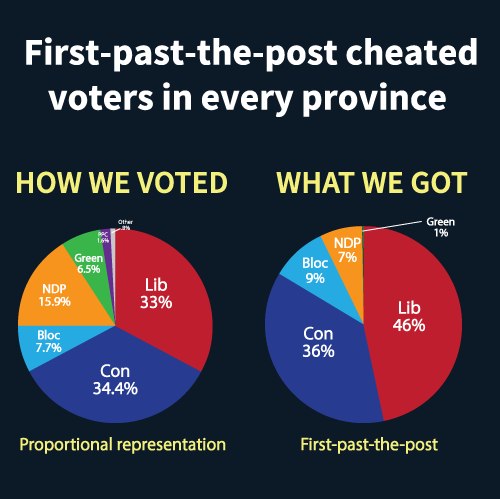
Re: United States vs. Google

#207
post #194
post #171

Earlier quoted context omitted.

> I think most Americans are unhappy with this situation. But we feel powerless to change it. BS. Americans will happily send half their disposable income to Amazon in the name of convenience.

Name another company _that is not Walmart_ that can deliver most of the items I want or need (or, hell, anything that I can think of) next day without paying exorbitant shipping fees and I'll switch to them right now.

The only replacement for centralized market dominance you're willing to accept is centralized market dominance with another brand?

Re: United States vs. Google

#208

Earlier quoted context omitted.

Can you point me to that wonderful time when the populace was informed and educated? The average IQ is 100 - do you consider the capabilities of a person with less than 100 IQ (half the population) to be capable of being informed by your definition of informed? Does a person with less than 100 IQ want to be educated by your definition of educated? --- Alternative theory regarding power/politics: The only thing that's…

I do not believe IQ is a relevant metric to determine ones ability to be informed politically.

You don't 'believe' an IQ range of 20-34, labelled as 'severely retarded' [0] is relevant to one's ability to be informed?

https://paulcooijmans.com/intelligence/iq_ranges.html

Re: United States vs. Google

#209

Earlier quoted context omitted.

I'm just grappling with the question. How can we call this democracy if most Americans want many extremely important things for decades and they don't happen? Isn't the point of democracy that the people have power?

Democracy only works well with an informed and educated populace and we have been defunding education for a decade. Add in the power of lobbyists and the newfound power of tech giants to inflict misery on humanity and you get the current “corporate rule” we are experiencing. https://www.cbpp.org/research/state-budget-and-tax/a-punishi...

This is a tired cliche that needs to die: Americans of voting age are the most educated they have ever been in history.

The problem is corruption and collusion between the parties to maintain the two party tyranny.

You can educate everyone to a PhD in political philosophy or political science for free and it would not noticeably change things unless they're willing to coordinate to vote for a third party (assuming that they can get the votes to change the system everywhere, which they probably can't) or pick up a rifle to break up the two party tyranny by threat (or enactment, should the powers that be not go peacefully) of force.

Re: United States vs. Google

#210
post #162

Earlier quoted context omitted.

Yea - but the majority of Americans want a policy like what Sanders was offering (Medicare for All) and neither major political party is on board with it - that's sort of par for the course of how US policy decisions look like - generally the US has gone with policies that don't actually gain majority support instead favoring the will of special interest groups.

Why do you think the majority of Americans want Sanders' policy? If neither major party are onboard with medicare for all, then that would be a strong indication that the majority of Americans do NOT want what he is offering.

It's just a simple fact of polling. Your conclusion also completely ignores the influence of money and lobbying in setting party platform and policy.
Post reply on HN