Live data from Hacker News

Einstein's description of gravity just got much harder to beat

phys.org

41–50 of 78 posts

Re: Einstein's description of gravity just got much harder to beat

#41
post #29

Earlier quoted context omitted.

Rather it is the belief that they fundamentally must be compatible that is driving this research. Currently we don't know how to answer questions like "what is the gravitational field around a photon?".

Photons have zero mass so we know them to produce zero gravity, no?

As I understand it (not a physicist), according to GR the Einstein field equations equate the curvature of spacetime to the stress-energy tensor, of which mass is just one component. Photons, having energy, should produce a gravitational field.
Re: Einstein's description of gravity just got much harder to beat

#42
post #2

Actually, it just got easier to beat. What happened was scientists found a new way to measure the effects of gravity that can substantially distinguish between different proposals to unify general relativity with quantum mechanics. The article says it got "harder" because the theory of general relativity wins every measurement, and that means the search space for potential solutions is much smaller - you have more co…

It's more like the haystack got smaller but we still don't know where the haystack is. The unknown unknowns got even harder to touch. This is all a good thing.

Re: Einstein's description of gravity just got much harder to beat

#43
post #12
post #5

During brainstorming sessions, I often think about why/how medieval artists couldn't quite grasp how to depict depth in their paintings (as a lateral thinking technique). Being humans living in the world, they obviously experienced and understood that depth existed all around them, but had a hard time grasping the concept as a whole. I feel like we're kind of in a "medieval depth" phase of gravity/spacetime understan…

Here's a possible explanation that I'd seen somewhere. Up until very recently, humans had had weak ability to think, especially abstract thoughts, and the phrase common today "just think about it", would be meaningless just a few centuries ago. Perhaps the concept of depth in those times would be similar in complexity to 4-dimensional structures today.

Humans were actually incapable of abstract thought until hacker news invented it.

Re: Einstein's description of gravity just got much harder to beat

#45
post #5

During brainstorming sessions, I often think about why/how medieval artists couldn't quite grasp how to depict depth in their paintings (as a lateral thinking technique). Being humans living in the world, they obviously experienced and understood that depth existed all around them, but had a hard time grasping the concept as a whole. I feel like we're kind of in a "medieval depth" phase of gravity/spacetime understan…

As others have said, I believe the lack of depth in medieval art is much more a matter of conventions than a matter of lack of theory or physical abilities (see [0]).

The one thing that convinced me of that is the sudden jump in realism in Egyptian art during the reign of Akhenaten (Amarna period, see the famous Nefertiti bust for a great example). The new king asked for more realism and he received it, it just took a reset in conventions.

[0]: https://en.wikipedia.org/wiki/Perspective_(graphical)#Early_...

Re: Einstein's description of gravity just got much harder to beat

#46
post #6

Can some knowledgable person articulate why physicists are so sure that QM and GR are incompatible?

Quantum mechanics deals with very small particles interacting with very strong forces. Gravity is so weak it can be ignored. Relativity deals with so much gravity that spacetime is warped. Neither is appropriate for the other and they are on opposite sides of the spectrum. Classical physics is useful in the middle at "human" scale. What would be nice is a simple theory that covers it all. Nothing we currently have is…

That comes across as bollocks to me. They're on the same side of "understanding how a star works" for example.

QM applies to weak forces too.

The gravitational field of a neutrino may be small but it's not zero.

Meh.

Re: Einstein's description of gravity just got much harder to beat

#47
post #12
post #5

During brainstorming sessions, I often think about why/how medieval artists couldn't quite grasp how to depict depth in their paintings (as a lateral thinking technique). Being humans living in the world, they obviously experienced and understood that depth existed all around them, but had a hard time grasping the concept as a whole. I feel like we're kind of in a "medieval depth" phase of gravity/spacetime understan…

Here's a possible explanation that I'd seen somewhere. Up until very recently, humans had had weak ability to think, especially abstract thoughts, and the phrase common today "just think about it", would be meaningless just a few centuries ago. Perhaps the concept of depth in those times would be similar in complexity to 4-dimensional structures today.

There are mathematics texts from 8th century BCE: https://en.wikipedia.org/wiki/Baudhayana_sutras

Re: Einstein's description of gravity just got much harder to beat

#48
post #6

Can some knowledgable person articulate why physicists are so sure that QM and GR are incompatible?

It's mostly because math prevents them from expressing gravity as a quantum field. The exactly opposite idea of adjusting QM to directly work in geometry of strongly curved space-time is not pursued much. Not sure why. Maybe because it's hard. Maybe because it would just be an extension of business as usual which isn't attractive. Maybe for some other reason.

The exactly opposite idea of adjusting QM to directly work in geometry of strongly curved space-time is not pursued much.

You can do QM on curved backgrounds, see eg https://ncatlab.org/nlab/show/AQFT+on+curved+spacetimes

That's not a theory of quantum gravity, though.

Re: Einstein's description of gravity just got much harder to beat

#49
post #6

Can some knowledgable person articulate why physicists are so sure that QM and GR are incompatible?

Not all physicists think they are incompatible. Mark Hadley [0][1] for example suggests that: "On spacetimes that are not time orientable we construct a U(1) bundle [model of a particle as an asymptotically flat spacetime manifold with a region of non trivial topology where time is not orientable] to measure the twisting of the time axis. This single assumption, and simple construction, gives rise to Maxwell’s equati…

In your quote of the abstract, you conveniently left out the last sentence:

"The treatment is purely classical, but motivated by links between acausal structures and quantum theory."

This is not unification of QM and GR, it's a classical construction which the author speculates might lead to such a thing. Such things have been around for a long time; the obvious (and far more progressed) example is string theory.

Re: Einstein's description of gravity just got much harder to beat

#50
post #18
post #17

Earlier quoted context omitted.

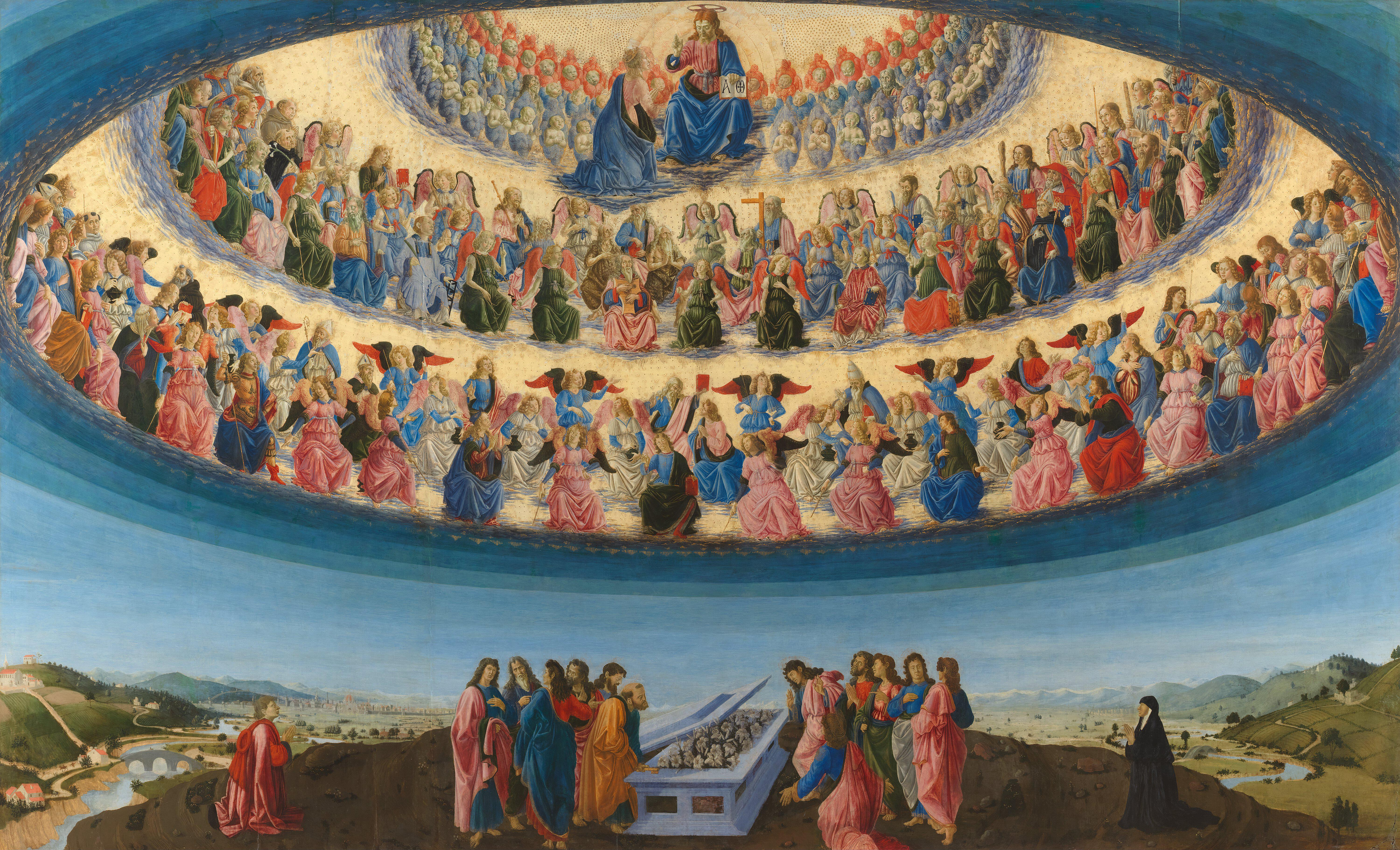
> I often think about why/how medieval artists couldn't quite grasp how to depict depth in their paintings (as a lateral thinking technique). The explanation for that is generally agreed on to have more to do with the aesthetics of early Christianity influencing Medieval practices, more than changes to human perception (source: I have a masters degree in Art History).

could you give more on that ? i can imagine how religious dogmas can influence a lot of things, but representation of depth ??

This [1] is a painting from 1476. Notice how architecture and landscape has depth, but people are all +- the same size except for Mary and God.

You wouldn't want to draw mere mortals bigger than saints just because they happen to be closer. Peasants (which couldn't read and were the main target of these paintings) could get wrong ideas.

https://upload.wikimedia.org/wikipedia/commons/f/ff/Francesc...

Post reply on HN