Out of Fuel: Why Hasn't Innovation Provided a Reliable Alternative to Oil?
knowledge.wharton.upenn.edu
Out of Fuel: Why Hasn't Innovation Provided a Reliable Alternative to Oil?
1–10 of 66 posts
Re: Out of Fuel: Why Hasn't Innovation Provided a Reliable Alternative to Oil?
#2Because nothing else is as massively profitable?
I mean oil is insanely, massively profitable, nothing else can touch it, so why would big industry bother until they actually run out of it?
BP alone made nearly $2 BILLION the same quarter they had to pay for the deephorizon cleanup That's AFTER paying for it. Normally they make close to $10 billion per quarter.
Instead they can just run commercials before PBS shows telling us how they will "keep researching alternatives". Much cheaper.
Re: Out of Fuel: Why Hasn't Innovation Provided a Reliable Alternative to Oil?
#3We (the people involved in making decisions on behalf of politicians and the people who buy IP for tech that greatly improves energy efficiency so they can prevent everyone from using it) would rather keep using oil.
If we (people more generally) wanted to, we could do this - http://market-ticker.org/akcs-www?singlepost=2491667
Re: Out of Fuel: Why Hasn't Innovation Provided a Reliable Alternative to Oil?
#4The answer to the why we have not found an alternative is simply that we value volumetric and mass energy density, and this graph on Wikipedia:
http://upload.wikimedia.org/wikipedia/commons/c/c6/Energy_de...
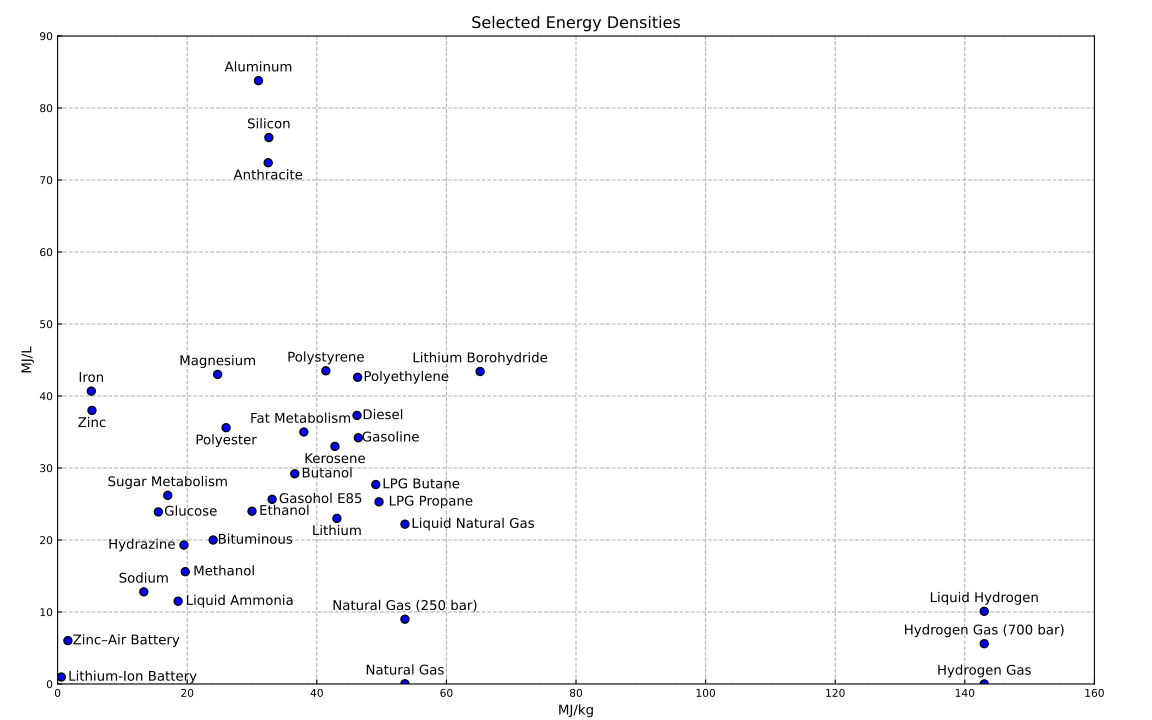
shows that gasoline has both of these, along with good resistance to premature ignition, and other favourable ignition characteristics. The solution will not be in finding something new, which is superior in every aspect to oil, but instead to be willing to sacrifice in some areas, (maybe volumetric energy density and total thermal efficiency,) in order to find an achievable solution. Using a plentiful energy source (nuclear?) to perform hydrolysis, and distributing the hydrogen as a fuel seems like the most likely endgame to me, but the material properties of hydrogen are not favourable to storage and small scale use.
Re: Out of Fuel: Why Hasn't Innovation Provided a Reliable Alternative to Oil?
#5Because nothing else is as massively profitable? I mean oil is insanely, massively profitable, nothing else can touch it, so why would big industry bother until they actually run out of it? BP alone made nearly $2 BILLION the same quarter they had to pay for the deephorizon cleanup That's AFTER paying for it. Normally they make close to $10 billion per quarter. Instead they can just run commercials before PBS shows t…
Because the market prefers oil, is why. And it's easy to see why: oil packs an awful lot of kilojoules of energy into a given volume. That matters whether you are a motorbike or a cargo ship. And its price per KJ is pretty low too - remember that most "electric" solutions simply burn fuel in power stations instead of in engines, and use that to charge batteries, losing energy at every step of the conversion.
We will go battery/fuel cell/whatever - but the cold hard fact is, that technology just isn't ready yet.
Re: Out of Fuel: Why Hasn't Innovation Provided a Reliable Alternative to Oil?
#6Because nothing else is as massively profitable? I mean oil is insanely, massively profitable, nothing else can touch it, so why would big industry bother until they actually run out of it? BP alone made nearly $2 BILLION the same quarter they had to pay for the deephorizon cleanup That's AFTER paying for it. Normally they make close to $10 billion per quarter. Instead they can just run commercials before PBS shows t…
Because the market prefers oil, is why. And it's easy to see why: oil packs an awful lot of kilojoules of energy into a given volume. That matters whether you are a motorbike or a cargo ship. And its price per KJ is pretty low too - remember that most "electric" solutions simply burn fuel in power stations instead of in engines, and use that to charge batteries, losing energy at every step of the conversion. We will…
The market prefers it because there is a 100-year head start on distribution networks and standards to the consumer for gasoline.
The only thing that could compete with that is the ability to plug it into the wall yourself. But battery technology has not improved much in that same 100 years and there's no universal battery standard to swap out for a new one during roadtrips.
In a half-dozen generations there will be complaints from gas station owners as they go the way of slide-rule manufacturers and have to get government subsidies to stay open.
Re: Out of Fuel: Why Hasn't Innovation Provided a Reliable Alternative to Oil?
#7Earlier quoted context omitted.
Because the market prefers oil, is why. And it's easy to see why: oil packs an awful lot of kilojoules of energy into a given volume. That matters whether you are a motorbike or a cargo ship. And its price per KJ is pretty low too - remember that most "electric" solutions simply burn fuel in power stations instead of in engines, and use that to charge batteries, losing energy at every step of the conversion. We will…
The market prefers it because there is a 100-year head start on distribution networks and standards to the consumer for gasoline. The only thing that could compete with that is the ability to plug it into the wall yourself. But battery technology has not improved much in that same 100 years and there's no universal battery standard to swap out for a new one during roadtrips. In a half-dozen generations there will be…
Not to mention the convenience of refuelling in minutes rather than hours.
If there's any sense in the world, one would hope that the existing infrastructure will complement any new energy source; we'll still need rest breaks and the odd sandwich at least, it would make sense if they could also recharge the fuel source, economies of scale and all that jazz.
Re: Out of Fuel: Why Hasn't Innovation Provided a Reliable Alternative to Oil?
#8Earlier quoted context omitted.
Because the market prefers oil, is why. And it's easy to see why: oil packs an awful lot of kilojoules of energy into a given volume. That matters whether you are a motorbike or a cargo ship. And its price per KJ is pretty low too - remember that most "electric" solutions simply burn fuel in power stations instead of in engines, and use that to charge batteries, losing energy at every step of the conversion. We will…
The market prefers it because there is a 100-year head start on distribution networks and standards to the consumer for gasoline. The only thing that could compete with that is the ability to plug it into the wall yourself. But battery technology has not improved much in that same 100 years and there's no universal battery standard to swap out for a new one during roadtrips. In a half-dozen generations there will be…
Yes and no. In the medium term, we can expect hybrids to play a bigger role, whilst we wait for battery technology to cover the energy density gap. In less than 20 years, simple economics are going to force us to a solution of full electric cars for urban use, and hybrids for longer trips, with the hybrid normally being charged from the wall, but using oil-based fuels for longer trips (or when the owner forgot to charge the car overnight). That should reduce oil consumption enough to make alternate sources, such as algae-derived diesel, a viable alternative.
Re: Out of Fuel: Why Hasn't Innovation Provided a Reliable Alternative to Oil?
#9It has, biofuel companies are even hotter than startups which huge amounts of money getting pumped into them. As the price of biofuels drop and the price of oil rises it's inevitable they'll cross-over and people will start buying biofuels because they're cheaper.
Re: Out of Fuel: Why Hasn't Innovation Provided a Reliable Alternative to Oil?
#10Earlier quoted context omitted.
Because the market prefers oil, is why. And it's easy to see why: oil packs an awful lot of kilojoules of energy into a given volume. That matters whether you are a motorbike or a cargo ship. And its price per KJ is pretty low too - remember that most "electric" solutions simply burn fuel in power stations instead of in engines, and use that to charge batteries, losing energy at every step of the conversion. We will…
The market prefers it because there is a 100-year head start on distribution networks and standards to the consumer for gasoline. The only thing that could compete with that is the ability to plug it into the wall yourself. But battery technology has not improved much in that same 100 years and there's no universal battery standard to swap out for a new one during roadtrips. In a half-dozen generations there will be…
Oh, and whilst we are on the subject, Does anyone here have their favourite theory for where the next big advance in energy tech is going to come from? Personally I'm surprised by the lack of government investing in nano-tech. Battery tech, fuel cells and solar panels all seem like prime candidates to benefit from a better understanding of how to construct materials at the molecular scale.