Live data from Hacker News

Really Atari ST?

os2museum.com

21–30 of 95 posts

Re: Really Atari ST?

#21
post #7

The one thing I like the most about the ST (when compared to, say, the Amiga) is its simplicity. It's vastly less capable, of course, but, in the end, the simplicity pays back by allowing easier expansion. The Amiga was a hard machine to evolve, something that cost Commodore a lot.

I'd love to hear more about your thoughts on this because I'm not sure if I understand what you mean. My take is that both the Amiga and the Atari had a plethora of expansions and, without having any numbers to show, I think the Amiga won out in the expansion race, from 040 cards for the A500 (AFAIK no 040 was available for any Atari until much later) to the Video Toaster. Both machines were hard to evolve because bo…

Well, that was the problem. Atari had the MIDI (pro music) and DTP from the start. The mono 640x400 monitor - ultra sharp was a great gig.

Amiga went the road of being console turned computer, and the expansions only created havok with support. Even A500 Plus had issues.

Sadly - it also affects community - the IP rights for Amiga are mess, the recent issue with Terrible Fire extensions - for some reason a lot of bad blood in a very bold and interesting system made by Atari engineers.
Re: Really Atari ST?

#22

Earlier quoted context omitted.

As someone who didn’t grow up with many floppy disks, how was one able to format a floppy to have a different capacity? I know there’s different “formats” such as DOS, C64, etc, but I don’t understand why ? I have heard about how formatting a floppy involved placing the tracks and how modern hard drives have “hard sectors”, but for some reason, it’s not “computing.”

Basically your floppy disk is formatted on each side with a number of tracks, each containing a number of sectors of a given size. [1] The standard 720KB 3.5' floppy disk as used by the Atari ST used 80 tracks of 9 sectors. With these tools you could format with, say 11 sectors instead of 9 and boost capacity to 880KB (I think the Amiga was doing that as standard). [1] https://en.wikipedia.org/wiki/List_of_floppy_dis…

On top of that some tools (I used fdformat) shifted the sectors to speed up sequential reads, i.e. have the first sector of the next track rotate in under the r/w head right as the head arrives.

Edit: another unrelated practice was buying up cheap(er) single-density disks, which were distinguished by the lack of a marker hole opposite the r/o protection slider, and used only one side of the medium for data. By drilling it out, one could trick the drives into using both sides, which usually worked out just fine. Mentioned here [1]

[1] https://en.wikipedia.org/wiki/Double-sided_disk

Re: Really Atari ST?

#23
post #2

I vaguely recall that people used to get their atari floppies and format in a MSDOS machine as it would yield a slightly bigger capacity - something to do with default format on DOS using more tracks. That was until alternative floppy formatting tools came about on the Atari scene and there was one that was also great for copying discs - going to bug me to recall it's name, but was one of those utils that had a cult…

I remember seeing a tool that could be used to punch a hole in floppy disks in order to double the capacity. I didn't have such a tool, but I did have a cheap soldering iron. I ended up with a bunch of 3.5" floppy disks with holes melted through them.

Thinking back on it now, I'm surprised that I didn't damage the disk with the heat of the iron. Then again, maybe I did and didn't notice because I was 12.

Re: Really Atari ST?

#24
post #7

The one thing I like the most about the ST (when compared to, say, the Amiga) is its simplicity. It's vastly less capable, of course, but, in the end, the simplicity pays back by allowing easier expansion. The Amiga was a hard machine to evolve, something that cost Commodore a lot.

I'd love to hear more about your thoughts on this because I'm not sure if I understand what you mean. My take is that both the Amiga and the Atari had a plethora of expansions and, without having any numbers to show, I think the Amiga won out in the expansion race, from 040 cards for the A500 (AFAIK no 040 was available for any Atari until much later) to the Video Toaster. Both machines were hard to evolve because bo…

The Amiga was much more closely tied to the hardware than the ST, by dint of it's bus system sharing between the blitter and CPU for chip RAM.

Additionally, having the copper, sprites, scrolling, HAM and planar graphics modes meant that backwards compatibility is harder - just look at the difficulty of emulation for both of them.

The Amiga graphics layout is also (slightly) more difficult to work with, there's a trick for the ST to do quick chunky-to-planar (C2P) conversion, check out the texture mapping in Thunderdome demo (http://www.pouet.net/prod.php?which=64503)

All said, yes the Amiga had more expansion cards for it, but the central bus system was a bottleneck as for the majority of Amigas, you had to use the built-in graphics, if you look at the a1200, the AGA chipset was a poor upgrade over the original chipset, hampered by backwards compatibility and the expense to needing to add a separate (fastram) bank to bypass the system bus for speed.

As far as retargetable graphics goes (ie. VGA-style cards), the ST was ahead as GEM allowed this from the start. That combined with the much simpler design allows a newer machine to be much more powerful as it has to worry about backwards compatibility less.

The Atari Falcon bears this out, a stock Falcon can manage to run Quake2 at 10FPS odd, a stock a1200 even with fastram can't get close. The Falcon was actually developed using an ST with a processor socket, bearing out the simpler architecture could be abused more :)

TBH the Falcon could have been much more, but Atari were broke and cheaped out on the 16bit bus, could've had 24bit VIDEL at 800x600 and run Quake2 at 15-20FPS for £500 in 1992. Add a cdrom with multiTos (effectively unix with a GEM frontend) and you'd have a competitive machine even against the PC of the time.

Re: Really Atari ST?

#25
post #2

I vaguely recall that people used to get their atari floppies and format in a MSDOS machine as it would yield a slightly bigger capacity - something to do with default format on DOS using more tracks. That was until alternative floppy formatting tools came about on the Atari scene and there was one that was also great for copying discs - going to bug me to recall it's name, but was one of those utils that had a cult…

I remember seeing a tool that could be used to punch a hole in floppy disks in order to double the capacity. I didn't have such a tool, but I did have a cheap soldering iron. I ended up with a bunch of 3.5" floppy disks with holes melted through them. Thinking back on it now, I'm surprised that I didn't damage the disk with the heat of the iron. Then again, maybe I did and didn't notice because I was 12.

Flip-it?

Re: Really Atari ST?

#26

There are so many things the ST does badly - weak sound chip, screen memory laid out like a Venetian blind (to quote Jeff Minter I think), and a mouse that was designed in a universe where ergonomics did not exist. But I still love it. Without the ST I wouldn't have discovered programming and all the highs (and lows) that it brings. Looking back now, I'm surprised people were able to get as much out of it as they did…

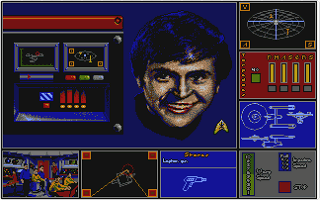
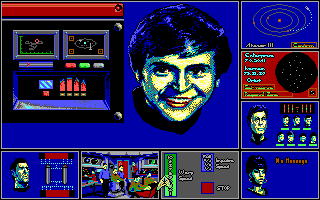
Star Trek: The Rebel Universe looked far better on an ST than on a PC.

[edit]

Compare:

http://www.atarimania.com/st/screens/star_trek_the_rebel_uni...

https://www.myabandonware.com/media/screenshots/s/star-trek-...

Re: Really Atari ST?

#27
Every time we talk of hardware from this era I'm reminded that I was absolutely set on getting a Commodore 64 or even better, a ColecoVision Adam computer, and my dad 'made me' get a Tandy instead. Ugly tan box. Yuck.

My dad and I don't have what you might call compatible decision making processes, so there were many times I was disappointed by his decisions growing up. But that machine taught me DOS, the next one got me onto Windows (answering the question, "How could I possible fill up a 43 Megabyte hard drive?") and those got me my foot in the door at one of the best jobs I ever had.

I'm still a little jealous of all of the Atari and Commodore fans out there, that I didn't get to participate. But if I'd had my way I would probably be worse off and still not be able to participate because I don't think anyone but me has ever mentioned the Adam unless I fished for it. Kids are dumb.

Re: Really Atari ST?

#28
post #25

Earlier quoted context omitted.

I remember seeing a tool that could be used to punch a hole in floppy disks in order to double the capacity. I didn't have such a tool, but I did have a cheap soldering iron. I ended up with a bunch of 3.5" floppy disks with holes melted through them. Thinking back on it now, I'm surprised that I didn't damage the disk with the heat of the iron. Then again, maybe I did and didn't notice because I was 12.

Flip-it?

[deleted]

Re: Really Atari ST?

#29
post #25

Earlier quoted context omitted.

I remember seeing a tool that could be used to punch a hole in floppy disks in order to double the capacity. I didn't have such a tool, but I did have a cheap soldering iron. I ended up with a bunch of 3.5" floppy disks with holes melted through them. Thinking back on it now, I'm surprised that I didn't damage the disk with the heat of the iron. Then again, maybe I did and didn't notice because I was 12.

Flip-it?

https://www.computerhistory.org/collections/catalog/10271130...

Might have been that brand. I remember seeing what it did and then figuring out how to get a hole in the 3.5" disk without cracking the plastic.

Post reply on HN