This kind of crap is why I hate shopping for computer hardware.
Western Digital is trying to redefine the word “RPM”
41–50 of 140 posts
Re: Western Digital is trying to redefine the word “RPM”
#42The German-language forum that the article mentions has been doing some great detective work: https://www.hardwareluxx.de/community/threads/crystaldiskinf... The conclusion on page 4 of the above thread: > Non-Pro RED = 5400rpm according to data sheet > Pro Red = 7200rpm according to data sheet > Internal both 7200rpm and 120Hz. > Apparently all WD / HGST helium plates have real 7200rpm, no matter what it says. Simpl…
60 watt equivalent light bulb
That's a useful metric though, it means "produces about as much light as a 60W incandescent light bulb"
And if you're buying products with Energy Star certification, they have to meet a specific output requirement to claim an equivalent wattage: https://www.energystar.gov/products/lighting_fans/light_bulb...
If you're buying no-name brands off Amazon with no certification, they may very well be lying to you. But "60W equivalent" is still a metric with a specific meaning, whether or not a particular shitty company is lying to you about it.
Maybe we need an independent "this spec sheet isn't full of bullshit" certification for hard drives.
Re: Western Digital is trying to redefine the word “RPM”
#43The German-language forum that the article mentions has been doing some great detective work: https://www.hardwareluxx.de/community/threads/crystaldiskinf... The conclusion on page 4 of the above thread: > Non-Pro RED = 5400rpm according to data sheet > Pro Red = 7200rpm according to data sheet > Internal both 7200rpm and 120Hz. > Apparently all WD / HGST helium plates have real 7200rpm, no matter what it says. Simpl…
60 watt equivalent light bulb
"Equivalent RPM" would make sense for something where there was actually an equivalence. Like if a drive had two sets of heads (halving the seek time), or if an SSD called itself a 20krpm equivalent or something. This is just straight up lying about a standard metric.
Re: Western Digital is trying to redefine the word “RPM”
#44The German-language forum that the article mentions has been doing some great detective work: https://www.hardwareluxx.de/community/threads/crystaldiskinf... The conclusion on page 4 of the above thread: > Non-Pro RED = 5400rpm according to data sheet > Pro Red = 7200rpm according to data sheet > Internal both 7200rpm and 120Hz. > Apparently all WD / HGST helium plates have real 7200rpm, no matter what it says. Simpl…
DAT Tape nTB (uncompressed data)
Re: Western Digital is trying to redefine the word “RPM”
#45After all this news of false advertisement and lower quality drives from WD, I'm glad I bought Seagate drives, even if only because Amazon had a big fat discount on Barracudas the day I was shopping for some spinning rust.
I wouldn't touch a Barracuda with a WD SMR drive duct taped to a 50' pole. The only way to get good hard drives these days is to buy from the enterprise lines e.g. WD Gold or Seagate Exos. They're extremely expensive, but this is the only way to get the kind of quality that used to be standard a few years ago.
You fell directly in line with what they wanted.
It's reasonable to expect companies to honour their spec sheets, and to not lie in their firmware.
Once they're caught doing otherwise it's important to hold them accountable, not throw our hands up and pay up anyway.
Re: Western Digital is trying to redefine the word “RPM”
#46After all this news of false advertisement and lower quality drives from WD, I'm glad I bought Seagate drives, even if only because Amazon had a big fat discount on Barracudas the day I was shopping for some spinning rust.
I wouldn't touch a Barracuda with a WD SMR drive duct taped to a 50' pole. The only way to get good hard drives these days is to buy from the enterprise lines e.g. WD Gold or Seagate Exos. They're extremely expensive, but this is the only way to get the kind of quality that used to be standard a few years ago.
Weirdly some Seagate Exos is inexpensive.
Re: Western Digital is trying to redefine the word “RPM”
#47Earlier quoted context omitted.
There's a solid technical reason for that though, as ISPs have no control over the performance of your connection's remote part. Sure, it leaves plenty of room for abuse, but this is a necessary disclaimer, not some slippery marketing.
Does anyone in the US actually get the “up to” even plugging directly into the ISP provided modem at off peak times?
Yes, I do. I have lived in several different areas where I had no problems getting the full advertised speed at any given time (on peak, off peak, etc.).
I think the biggest reason they say "up to" is because a lot of poeple get a cheap $40 router that can't support that the advertised speed. Heck, I just moved into a new place that gives symmetric gigabit speeds. I had to replace my router to actually get one that can handle the advertised speeds (I had an APU1d4 with realtek ethernet ports that saturated at 300 Mb/s). My older laptop does not even have wired nor wireless speeds that can handle the connection.
So while I am no fan of a lot of ISPs, I completely understand why they say "up to", they don't want to deal with folks who say they don't get their advertised speeds while using a $200 laptop and a $40 router.
Re: Western Digital is trying to redefine the word “RPM”
#48"By doing so, we are able to leverage our economies of scale and pass along those savings to our customers."
So it sounds like the reason behind it is that they can save money by eliminating the 5400rpm production line.
Re: Western Digital is trying to redefine the word “RPM”
#49Earlier quoted context omitted.
There's a solid technical reason for that though, as ISPs have no control over the performance of your connection's remote part. Sure, it leaves plenty of room for abuse, but this is a necessary disclaimer, not some slippery marketing.
Does anyone in the US actually get the “up to” even plugging directly into the ISP provided modem at off peak times?
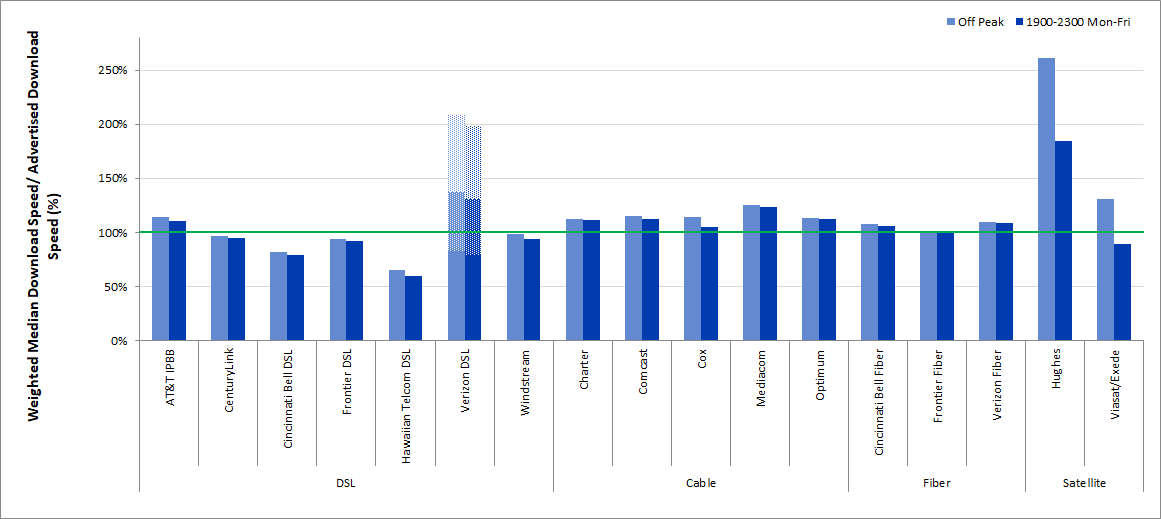
Many ISPs provide that level (or more) of performance, even during peak hours.
https://transition.fcc.gov/oet/mba/images/2018/chart1.png https://www.fcc.gov/reports-research/reports/measuring-broad...
Re: Western Digital is trying to redefine the word “RPM”
#50I think the TLDR is that Western Digital are selling faster drives marketed as being slower than they actually are, presumably due to lack of supply for the demand of the slower drives part of the market or something like that. You'd think nobody would mind until you remember some people want lower power and noise. Ideally these people would be buying based on those actual metrics, rather than the RPM as a proxy for…
Couldn’t they just software limit the speed? I’m sure they thought of it but it seems on the surface like an easy problem to solve for.
Drives don't support this; they're designed to operate at a single fixed RPM.