Live data from Hacker News

Italian Ruby

github.com

71–80 of 178 posts

Re: Italian Ruby

#71
post #23

Also, sometimes, translations have a different (perceived) meaning. A pet peeve of mine is "by default". In Italian it is translated (correctly) "per difetto", and it is "fine" when other people already know the term, but otherways "difetto" is also the translation of "defect", and you will have a tough time explaining to a layman that it is not a "defect" in that other sense. Another "queer" word (I found it in the…

  As a native speaker I would never read - in context - "ometti" as little men. IE: "Se ometti un parametro...". Every language is context sensitive.

  Same for "moda", when I read: "moda, mediana e media..." I would never - ever - think that "moda" is, in the context, "fashion".

  "resto" - as used in: "Here is your change" - "Ecco il tuo resto" - would never be read as such in context. IE: the nursery song [1] "Quarantaquattro gatti, in fila per sei col *resto* di due" is an example of unambiguous use in the context of maths.

  So: in context all these words make sense, as it's the case with many words in many languages.

  
  [1] https://youtu.be/2jDOj0Xhcc8
Re: Italian Ruby

#72
post #23

Also, sometimes, translations have a different (perceived) meaning. A pet peeve of mine is "by default". In Italian it is translated (correctly) "per difetto", and it is "fine" when other people already know the term, but otherways "difetto" is also the translation of "defect", and you will have a tough time explaining to a layman that it is not a "defect" in that other sense. Another "queer" word (I found it in the…

On the other hand, "moda" is the correct translation, and the function "resto" gives you... "il resto della divisione" (the remainder).

It's probably just a matter of being used to it, because nobody would complain that mean(array) is about the moral qualities of the array (seeing mean as an adj.)

Re: Italian Ruby

#73
post #23

Also, sometimes, translations have a different (perceived) meaning. A pet peeve of mine is "by default". In Italian it is translated (correctly) "per difetto", and it is "fine" when other people already know the term, but otherways "difetto" is also the translation of "defect", and you will have a tough time explaining to a layman that it is not a "defect" in that other sense. Another "queer" word (I found it in the…

> "by default" ... In Italian it is translated (correctly) "per difetto"

No way: the correct translation of "by default" is "valore predefinito", anyone who translates it "per difetto" has serious issues with Italian language.

Re: Italian Ruby

#74

Earlier quoted context omitted.

Are there any attempts to have it both ways? Like, the source code stays in English but my IDE translates keywords to and from my language.

If you made all keywords fit one character or so and allow selective installation of dictionaries, that would probably also decrease source code form size significantly! That would be great even if you never were to use any language other than English. I’ve played with APL a bit and found out that one can configure Emacs to replace APL’s cryptic symbols with English words using this: https://www.emacswiki.org/emacs/P…

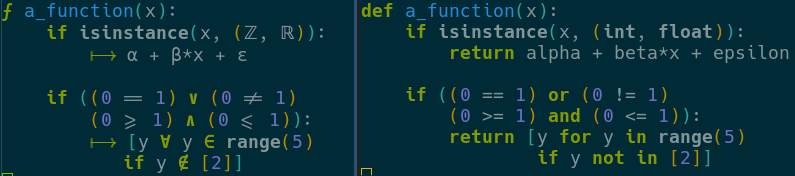
Emacs also has prettify-symbols-mode, which by default replaces lambda with λ, but can do a lot more - it can make Python look like this! http://www.modernemacs.com/img/spacemacs/python-code.png

Re: Italian Ruby

#75
post #48

Earlier quoted context omitted.

> We should fix our schools, A large part of the english language problem in the southern Europe (it's not just an italian problem) is cultural. The english language is considerably more embedded in the culture of the northern European countries; for example, there's considerably less dubbing. If Italy stopped dubbing (which will never happen, because it's a tradition), italians would speak a considerably better Engl…

The Germans are dubbing and they usually speak English quite well. My experience with Italian as well as French don’t like to learn or speak English.

German language is much more similar to English language than Italian language

Re: Italian Ruby

#76
post #23

Also, sometimes, translations have a different (perceived) meaning. A pet peeve of mine is "by default". In Italian it is translated (correctly) "per difetto", and it is "fine" when other people already know the term, but otherways "difetto" is also the translation of "defect", and you will have a tough time explaining to a layman that it is not a "defect" in that other sense. Another "queer" word (I found it in the…

I am appalled.

" "by default". In Italian it is translated (correctly) "per difetto" "

Correctly? Not at all!

Please don't take as given Google Translate's translations.

Re: Italian Ruby

#77
post #48

Earlier quoted context omitted.

> We should fix our schools, A large part of the english language problem in the southern Europe (it's not just an italian problem) is cultural. The english language is considerably more embedded in the culture of the northern European countries; for example, there's considerably less dubbing. If Italy stopped dubbing (which will never happen, because it's a tradition), italians would speak a considerably better Engl…

The Germans are dubbing and they usually speak English quite well. My experience with Italian as well as French don’t like to learn or speak English.

Germany is a bit more complex, because historically speaking, there has been cultural separation.

In my experience:

  - middle aged people speak an ok english
  - elderly speak a poor or no english
  - young people speak a very good one
Something also worth considering is, as I've previously mentioned, the exposure to international traffic. In big German cities, there are a lot of foreigners; much less in Italy.

Finally, it's correct, as mentioned in a sibling post, that German has (some) roots in the English language.

Regarding Italians I've hardly met people who actively refuse (in the sense of "dislike") the language per se, but I can't exclude the option you've mentioned of "cultural laziness".

There's a cliche of the French culture being proud of their language, so I can imagine a sort of active refusal in this case.

Re: Italian Ruby

#78

Earlier quoted context omitted.

Are there any attempts to have it both ways? Like, the source code stays in English but my IDE translates keywords to and from my language.

If you made all keywords fit one character or so and allow selective installation of dictionaries, that would probably also decrease source code form size significantly! That would be great even if you never were to use any language other than English. I’ve played with APL a bit and found out that one can configure Emacs to replace APL’s cryptic symbols with English words using this: https://www.emacswiki.org/emacs/P…

     that would probably also decrease source code form size significantly! 
I feel like, out of all the challenges facing software development today, "source code size" is probably not in the top 10,000 =)

Re: Italian Ruby

#79
post #23

Also, sometimes, translations have a different (perceived) meaning. A pet peeve of mine is "by default". In Italian it is translated (correctly) "per difetto", and it is "fine" when other people already know the term, but otherways "difetto" is also the translation of "defect", and you will have a tough time explaining to a layman that it is not a "defect" in that other sense. Another "queer" word (I found it in the…

> translations have a different (perceived) meaning I think the problem you're running into is that you just aren't used to these words. I imagine people having the exact same complaints about a computer "mouse" actually reminding them of the animal or "paste" reminding them of glue, but once you get used to them they just become the terms for things.

A very long time ago, I worked technical support for Bellsouth Internet, and occasionally we would get people from the bayou in Louisiana calling in, and the language difference was striking.

There was one memorable time when this happened, and as I was walking the user through their Dial-Up Network Settings configuration, I asked him to right-click on his dial up connection icon, and he had trouble understanding me. I said something to the effect of, "does your mouse have two buttons?", and he replied, "yes, and I'm mashing this critter right here".

So the parallels of the peripheral and the rodent are not lost on everyone.

Re: Italian Ruby

#80
post #45

Earlier quoted context omitted.

A fun one is: “throwing an error”, which can be translated in “lanciare (launch) un errore” or “tornare (return) un errore” or “causare (cause) un errore”.

tornare is probably more likely unless you caused the error on purpose.

I would not use that: a common programming idiom is that of "returning an error code", and "ritornare un errore" may be confused with this. As in "return error;" where "error" is some error code, against "throw error;" where "error" is whatever exception class.
Post reply on HN