Live data from Hacker News

After 48 years, Democrats endorse nuclear energy in platform

forbes.com

161–170 of 489 posts

Re: After 48 years, Democrats endorse nuclear energy in platform

#161
post #64

I’m continuously baffled by those that claim that nuclear power is safe. Look at Fukushima for example. It seems hard to imagine a nuclear power plant design, even Gen III or IV that would be immune to any possible natural disaster. Analysis of nuclear power should take into account Black Swan events: no matter how well designed, some fraction of plants will cause INES Level 7 disasters. If the resulting cost (ie $10…

Nuclear power isn't flawless, but the fossil alternatives can kill people every single day.

Fukushima killed somewhere on the order of 10 people? That's a level 7 event on an ancient plant, a wind turbine falling over could easily kill that many people if it landed on a bus. This time it can be different, but your black swan argument isn't much different from our fear of flying.

Re: After 48 years, Democrats endorse nuclear energy in platform

#162

Earlier quoted context omitted.

The magnitude and extent of the radioactive release was largely unknowable in the immediate aftermath of the disaster. The local authorities were put in an impossible position, either gamble with everyone's health or evacuate at great cost. The root cause of the dilemma is that the worst case scenario for traditional nuclear is so severe and nobody can tell decision-makers with high confidence whether or not you've j…

The fundamental, unsolvable difficulty of making decisions with imperfect information seems to be often under analyzed. Are there any related fields that study this decision making difficulty?

professional poker

Re: After 48 years, Democrats endorse nuclear energy in platform

#163

Earlier quoted context omitted.

Your assuming we can run on renewable, which we can't, and won't be able to in our life time. Germany is a good example.

How is Germany a good example? Renewables were less than 20% 10 years ago and are now more than 50%. Meanwhile it has one of the most stable electricity network. https://www.energy-charts.de/energy_pie_de.htm?year=2020

The 50% is for peak renewable usage. To keep grid stability, Germany depends a lot on French nuclear power plants, imports from elsewhere (usually not green), and ridiculously dirty lignite power plants with natural gas for load following.

And they are building more and more gas power plants and can't really decrease the amount of dirty coal (lignite fueled power plants make other coal-fired power plants look clean)

Re: After 48 years, Democrats endorse nuclear energy in platform

#164
post #104

Earlier quoted context omitted.

Yes, and even when you consider those costs, it pales in comparison to the lives lost and negative externalities of coal, oil, and gas usage. These include climate change, particulate pollution, environmental release of mercury, devastation of vast swaths of the environment worldwide, and other factors that may be hard to quantify but negatively impactful.

Agreed. The question I meant to raise was nuclear power versus other alternative energy sources, eg wind/solar/hydropower/geothermal. Comparisons of nuclear power to these other sources are typically dishonest in that they do not account for nuclear disasters. This may be an acceptable risk but it needs to at least be included in analysis, say one disaster per 100 operating years (my estimate of this value: 1 in 50-5…

> The question I meant to raise was nuclear power versus other [renewable sources]

(I'll assume this is still about safety, as the comment you're referring to with "meant to raise" started with "I’m continuously baffled by those that claim that nuclear power is safe".)

As far as I have read, nuclear is the safest option barring none. There are so few nuclear accidents that the casualties are a rounding error and the confidence is low.

But that is not the only thing we're optimizing for. What we need is to have a lower environmental impact so that later generations shall live long and prosper. Wind, solar, hydro, geothermal, and nuclear all fit that bill right now. Eventually we'll get rid of fission, perhaps in favor of fusion or perhaps of 100% renewables.

Given that we didn't do a large effort in the past few decades on shutting down carbon-based power generation and building 100% renewable green energy without nuclear, and we aren't managing to do it fast enough today, either, we need to make big steps to get there without fighting a billion small battles: one person doesn't like the sight of solar panels on the neighbours' roof (e.g. my dad), another doesn't like a wind turbine in their back yard, hydro power has environmental concerns and doesn't work everywhere... etc. We don't have time for this. Heck, we also don't have the time necessary to build nuclear power plants, but I just don't see any other option than to start now and finally cut down on carbon emissions.

If you're not convinced by nuclear, fine: by all means let us build renewable energy sources at the rate warranted to limit the impact of this climate disaster. I'm just not sure we'll be fast enough.
Re: After 48 years, Democrats endorse nuclear energy in platform

#165

How much of the resistance to nuclear power in the US was due to the very unfortunately combination of the Three Mile Island incident and the release of the movie The China Syndrome both happening within two weeks of each other? Add in the nuclear arms race of the time and the emotional aspect for anything nuclear becomes even greater.

As a Californian, it always seems to come in two flavors. There's the people who think it's risky because they read about something that's not terribly relevant to their region or they're part of the hippie cult that thinks anything sciencey is unnatural an therefore bad. I love the state because I like how accepting the people are at the social level, but when it comes to anything material like construction or energy suddenly the loudest voices are a bunch of good vibes idealists who'd prefer a bad bad but fashionable solution to something that actually solves the problem.

Re: After 48 years, Democrats endorse nuclear energy in platform

#166
post #38

That’s great, anti-nuclear energy was definitely one of the anti-science stances standing in the way of progress.

I think many oppose nuclear power because for the same cost, you can build a lot of wind, solar, and hydro instead. I don't know if efficiencies have caught up and all. There's less of a catastrophic risk with these compared to nuclear, at least in people's imaginations. (Hydro dams have been broken in the past though and lead to many deaths.)

Except that solar or wind power plant will require significant backing from other power sources (hydroelectric outside of microscale is dead due to environmental concerns and costs), usually gas and coal.

Energy storage is still very expensive in large scale except for pumped hydro storage, which again, is very problematic to arrange.

Re: After 48 years, Democrats endorse nuclear energy in platform

#167
post #71

But what's going to happen with the nuclear waste? I've heard too many times about water getting into permanent repositories and leaking containers contaminating the biosphere. Seems like a bad idea to me...

You can reprocess it.

France does so, Japan does so, even Poland sold off nuclear waste from research reactors for reprocessing - the parts of it that aren't critical medical radioisotopes, which we sold separately for use in hospitals etc.

All of French fuel waste fits in one hall. That's smaller than space taken by one fly ash repository at a coal plant.

Re: After 48 years, Democrats endorse nuclear energy in platform

#168
post #38

That’s great, anti-nuclear energy was definitely one of the anti-science stances standing in the way of progress.

I think many oppose nuclear power because for the same cost, you can build a lot of wind, solar, and hydro instead. I don't know if efficiencies have caught up and all. There's less of a catastrophic risk with these compared to nuclear, at least in people's imaginations. (Hydro dams have been broken in the past though and lead to many deaths.)

All of those things disrupt a much larger swathe of land than a nuclear plant though. Environmental impact is more than "does it explode?" it's also things like ecological impact. Hyrdoelectric dams are incredibly disruptive to their environment and wind/solar take up at least 300x the space of a nuclear plant depending on which of the two you're talking about.

Re: After 48 years, Democrats endorse nuclear energy in platform

#169
post #110

Earlier quoted context omitted.

> nuclear accidents can make a place uninhabitable for thousands of years Note that this is not special to nuclear materials; it's true for a good chunk of industrial chemistry in general as well. > peak uranium I'll need to look up some more up-to-date numbers, but going by https://www.withouthotair.com/c24/page_162.shtml , there's more than enough for couple centuries (and new reactor designs can make one-two order…

>Note that this is not special to nuclear materials; it's true for a good chunk of industrial chemistry in general as well. Hmm interesting. Where has this happened on the scale of Chernobyl or Fukushima? I can't thinking of any exclusion zones in once populated areas caused by industrial chemicals. Is the fact that plants are built near populated areas a factor?

Can't think of a well-known industrial exclusion zone, but the "Industrial" subsection here lists some pretty nasty incidents, involving contaminating entire surrounding communities, next to significant ecological damage:

https://en.wikipedia.org/wiki/List_of_environmental_disaster...

> Is the fact that plants are built near populated areas a factor?

The thing with big plants in general is that even if they're built in remote areas (like Chernobyl), you want the thousands of plant employees housed nearby, which also means housing their families, who now all need food and healthcare and education and other services, and suddenly you end up with a pretty large town right next to that plant (like Pripyat). And such towns will draw further investments, making once remote area quite populated.

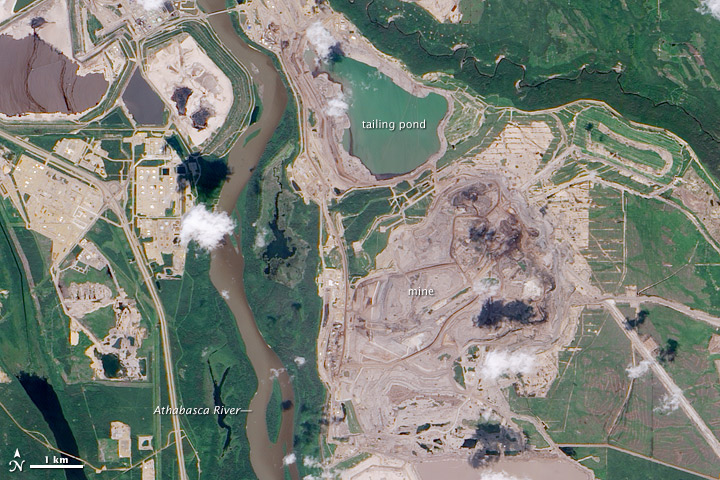
On top of that, power generation unfortunately is pretty special wrt. range of potential contamination because of energies involved - so when things go bad, they go with a bang. That's why I usually mention industrial chemistry when discussing nuclear waste, as this is more of an apples to apples comparison. But then, my mind is often drawn to the oil sands in Canada - particularly to the artificial lakes storing highly carcinogenic toxic waste.

https://upload.wikimedia.org/wikipedia/commons/6/60/Athabasc...

Now imagine what would happen if that kind of thing ever spilled for some reason.

Re: After 48 years, Democrats endorse nuclear energy in platform

#170
post #61

Earlier quoted context omitted.

The existing regulatory structure for nuclear power was designed for the previous generation of reactors. I don’t have deep knowledge in this area, but it’s clear to me that more modern designs have very different risk profiles, and the regulatory structure should change to reflect that. This should reduce the compliance cost, which is a very large portion of the initial and operational costs of nuclear power. In sho…

It's not just that "The existing regulatory structure for nuclear power was designed for the previous generation of reactors." It was designed specifically to bankrupt them. It was designed to make them unprofitable. Just changing an ordinary light bulb in a nuclear power plant is all sorts of certification and paperwork. There was a ratchet effect on regulations. You could always add more, but nobody would take resp…

The existing regulatory structure was designed specifically to stop nuclear power plants from doing things like running all the sets of redundant control and monitoring wiring through a single narrow space, filling that wiring space with flammable foam, and then testing the foam for air leaks with a candle when the plant was in operation. (This is not a hypothetical example - it actually happened in the US during the golden era of nuclear power, indeed I think it may have even been standard practice across multiple plants, and it very nearly caused a serious accident when the inevitable happened.)

I know the Trump administration has tinkered with adding more flexibility to the regulations covering fire protection and safety in nuclear plants in order to try and encourage more economical new nuclear power plants with modernized designs, but it hasn't really helped because the tradeoff for being able to deviate from the rigid rules is that the companies building them have to do a bunch of work to show that their new designs achieve the same safety goals.

Post reply on HN