I think connecting two separate pieces of knowledge is usually called intelligence.
Why Understanding Beats Knowledge
11–20 of 30 posts
Re: Why Understanding Beats Knowledge
#12>> Ask you that same question in a different way and you have no idea. Never heard of it. This is why whiteboard interviews are hard – questions that you know, but out of context
In my experience this is true. I "test" my friends on these and most of them always screw up an answer to the questions I asked them just a couple of days ago when the question is slightly different but the underlying principle is the same. This is also why I spend hours on a question I get an answer to easily. Because it's important to understand the principle rather than getting the right answer. You can also conduct this test. The simplest and the most basic test is to ask someone what "binary search" is. Obviously, every developer knows what it is but when you ask them to apply binary search in a slightly different context(pick up any medium binary search question on Leetcode, Hackerrank etc) they will fudge it up. I get the hate "trivia" algo interview questions get on HN. However, I just love them because I have always loved "puzzles"
Re: Why Understanding Beats Knowledge
#13I really like the graphics in this. I like how "information" and "knowledge" are contrasted in the six squares. This is really what it feels like. Knowledge is structured, tightly connected in predictable ways, whereas information is just a kind of soup, a mess of facts. What the other distinctions are supposed to mean is less clear, but at least they're entertaining. I also really hope that the "knowledge" vs "under…
Not a psychology researcher and this wasn’t a study so I can’t vouch for “accurate”. Think of that graph as a distillation off my observations and experiences into 4 lines. The idea I’m trying to share is that understanding compounds. The more you understand, the faster you can gain new understanding. And the more frameworks you have for the world, the faster you can gain knowledge because you need fewer examples to…
> And the more frameworks you have for the world, the faster you can gain knowledge because you need fewer examples to grok something.
Oh, of course! This is a really good argument and now that you say this, I realize I've also noticed this happening.
Re: Why Understanding Beats Knowledge
#14Does not apply to tech interviews.
Re: Why Understanding Beats Knowledge
#15But knowledge is understanding.
We often mislabel 'information' as 'knowledge'. But information is just information. A 'knowledge base' is no such thing; it's an information base. Knowledge is not 'memory of facts'.
Knowledge == information + understanding.
Wisdom == information + understanding + experience.
Example: Python syntax is information. Understanding and using Python syntax is knowledge. Knowing when Python isn't what you need is wisdom.
Re: Why Understanding Beats Knowledge
#16This is why it's important for STEM and tech people to have some understanding of liberal arts. "Understanding" means having perspective, it's easy to get caught up in our world, thought patterns, echo chambers, and biases. I think that's why curiosity is such an important trait, it promotes understanding, not the accumulation of facts. Next time you're at a book store, pick something up on a topic that sounds intere…
So I'm totally on board with everyone knowing something about the liberal arts and trying to expand your world outside your traditional scope.
But I think "understanding" can mean just making connections within a single tech field, even without involving liberal arts. For example, a grade school math problem: "Assume the earth is a perfect sphere with radius 6378 km, and you have a piece of string just long enough to reach all the way around the earth's equator at the earth's surface. How much longer would your string have to be to make a perfect circle exactly one meter above the earth's equator at every point?"
The answer is 2(pi) meters. That's true for any spherical planet of any size -- that's what it means for the derivative of 2(pi)(r) with respect to r to be 2(pi). That is sometimes not the first thing people think of though, because of the grade-school context they associate with this problem....
Re: Why Understanding Beats Knowledge
#17But knowledge is understanding. We often mislabel 'information' as 'knowledge'. But information is just information. A 'knowledge base' is no such thing; it's an information base. Knowledge is not 'memory of facts'. Knowledge == information + understanding. Wisdom == information + understanding + experience. Example: Python syntax is information. Understanding and using Python syntax is knowledge. Knowing when Python…
it seems like you're saying the same thing, but with different definitions.
The key to both you and the article is that the base memorization of discrete rules and facts is not sufficient -- the real value comes from being able to dynamically connect the rules yourself in new contexts (rather than having them simply handed to you, to be memorized)
Re: Why Understanding Beats Knowledge
#18But knowledge is understanding. We often mislabel 'information' as 'knowledge'. But information is just information. A 'knowledge base' is no such thing; it's an information base. Knowledge is not 'memory of facts'. Knowledge == information + understanding. Wisdom == information + understanding + experience. Example: Python syntax is information. Understanding and using Python syntax is knowledge. Knowing when Python…
Closish, but not quite how I see it.
Having information does not imply having knowledge of it. For example, an engineer may not know which material can withstand a given environment (temperature, corrosion, pressure, etc) but they may be able to look it up in a book and select the appropriate material.
Knowledge is similar, except it's within the mind. For example, an engineer may know that the thermal coefficients for steel and concrete are similar, so the expected deformation under temperature change should be similar. But this doesn't mean that they necessarily understand why these two materials have similar coefficients, only that they do.
Understanding is a matter of cognitive appreciation of the underlying situation and is built around the parameters of a situation. For example, someone drowning understands that they need to grab something buoyant in order to breath. It's built on a base of knowledge, but it doesn't necessarily imply that they have knowledge of the complete situation. Even in science or software, there are things that one can know without understanding. Personal example: There was once a bug in ruby when built from source. I was tracking down a bug in production and I was unable to replicate it locally. So I finally got someone to shell into prod and run three lines of code for me. That code crashed even though it worked fine on literally every other computer I tried it on, including staging. I knew that the issue was with the production server, but I didn't understand why. It took further work to go from knowledge to understanding.
Wisdom is squishy. It correlates with experience, yes, but there are other factors that play into it as well. A child can be wise and choose not to associate with, say, a gang not because they've experienced it before, but because of something else. An inner reflection of the dangerousness of the situation and the courage or inner resolve to avoid it.
Re: Why Understanding Beats Knowledge
#19But knowledge is understanding. We often mislabel 'information' as 'knowledge'. But information is just information. A 'knowledge base' is no such thing; it's an information base. Knowledge is not 'memory of facts'. Knowledge == information + understanding. Wisdom == information + understanding + experience. Example: Python syntax is information. Understanding and using Python syntax is knowledge. Knowing when Python…
Or we could take the piece charitably and assume the best instead of asserting incorrect definitions. Especially given that common terminology is loose.
Alternately, we need formal language to talk about these concepts or we risk another "evolution is just a theory."
Re: Why Understanding Beats Knowledge
#20> the derivative (tangent) of the minimum (lowest point) of any curve is zero (horizontal). > holding their pencil up to it at the lowest point and laying it along, and discovering that, sure enough, the tangent is horizontal. Any gifs showing that? just really curious and can't picture that in my head.
Here is a GIF demonstrating the tangent line as a point traverses a curve: https://s3-us-west-2.amazonaws.com/courses-images/wp-content...
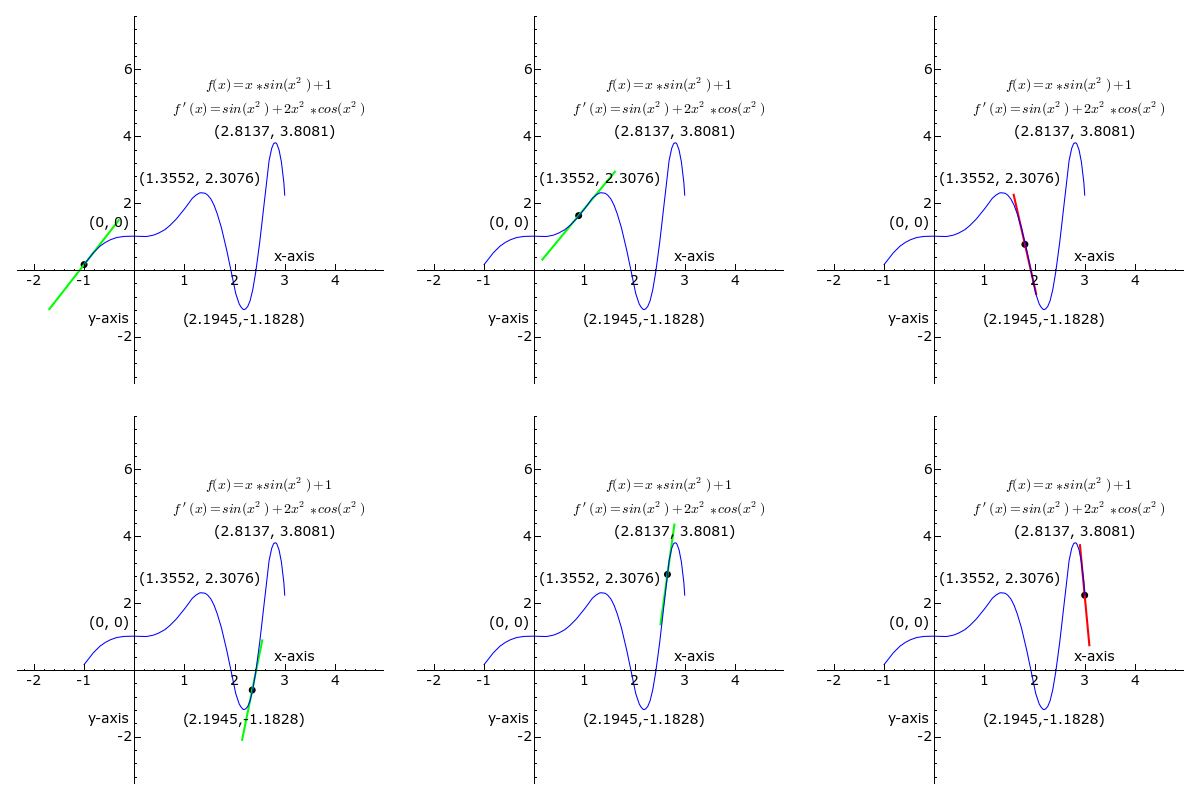
The "pencil" (the short line representing the tangent) is green when positive, black when zero, and red when negative. Note that when it is black/zero, the "pencil" line is flat. This occurs at both local maxima and minima.