Live data from Hacker News

Netflix is now doing per-shot encoding for UHD content

netflixtechblog.com

61–70 of 200 posts

Re: Netflix is now doing per-shot encoding for UHD content

#61
post #20

> Sometimes we ingest a title that would need more bits at the highest end of the quality spectrum — even higher than the 16 Mbps limit of the fixed-bitrate ladder. From just a cursory inspection using my Apple TV 4K, 12 Mbps is their target bitrate but their ceiling was ~16 Mbps. That's still only a third of what AppleTV+ offers (36/48) and only 2/3 of Disney+ (18/24). Netflix is still higher than Prime Video (10/14…

As far as I know, with netflix the quality depends on things like the platform you're watching. Even with the highest subscription plan, if you watch it in Firefox or Chrome you're limited to 720p and you now get about 500 kbit/s, which looks awful. The older content seems to be at 1 or 2 mbit/s, and the 2 mbit/s looks good. But as you can see in the figures, they no longer seem to offer good quality 720p.


Re: Netflix is now doing per-shot encoding for UHD content

#62
post #14

A lot of those graphs seem to show that video quality at 1920x1080 is going down significantly. Does that mean you now need to be on their most expensive plan and using one of their approved devices/platforms to continue receiving the same video quality, now only obtainable with 2560x1440 and higher resolutions?

How’d you get that out of the article? I read it as scores the board, you’re getting better quality at a lower bit-rate. They talked about being able to serve 1080p at the same bitrate they were serving 720p (where they talked about mobile devices).

All 4 of the Bitrate vs Video Quality graphs have two 1920x1080 data points on each line. All four graphs show the data points lower on the Video Quality axis under the optimized ladder.

Sure, the first graph shows 1080p at higher quality for lower bitrate to the 720p on the optimized ladder, but if I'm resolution-limited (on a phone) and Netflix isn't streaming higher quality and downsampling on the device, the changes here show that my perception of quality will suffer. (I feel for folks stuck with a 720p screen, if they're just streaming native resolution it looks like they'll be getting worse than previous 480p quality levels.)

Re: Netflix is now doing per-shot encoding for UHD content

#63
post #49

Earlier quoted context omitted.

I've noticed that ATV+ looks the best, which is much appreciated. However, what has been driving me insane with all these services is how the bitrate is completely inconsistent throughout, depending on network congestion. Every service I subscribe to will "automagically" lower the bitrate if the network can't handle it. Which is fine, I get it. The thing is, it's the only way to watch anything, and depending on the c…

And this is why I still get discs by mail. No dropouts, no unexplained drops in resolution, and it has a deeper catalog.

Scratched discs.

Re: Netflix is now doing per-shot encoding for UHD content

#64
post #61
post #20

> Sometimes we ingest a title that would need more bits at the highest end of the quality spectrum — even higher than the 16 Mbps limit of the fixed-bitrate ladder. From just a cursory inspection using my Apple TV 4K, 12 Mbps is their target bitrate but their ceiling was ~16 Mbps. That's still only a third of what AppleTV+ offers (36/48) and only 2/3 of Disney+ (18/24). Netflix is still higher than Prime Video (10/14…

As far as I know, with netflix the quality depends on things like the platform you're watching. Even with the highest subscription plan, if you watch it in Firefox or Chrome you're limited to 720p and you now get about 500 kbit/s, which looks awful. The older content seems to be at 1 or 2 mbit/s, and the 2 mbit/s looks good. But as you can see in the figures, they no longer seem to offer good quality 720p.
Seems to be the case on Linux for both Netflix and Amazon Prime video for me, I’d cancel both but my mum uses the hell out of them and I watch an iPad in bed occasionally.

It’s kinda annoying though I get the business reasons and all that.

It’s just that it did used to be better and it’s gotten worse over time that really annoys me.

Re: Netflix is now doing per-shot encoding for UHD content

#65
post #20

> Sometimes we ingest a title that would need more bits at the highest end of the quality spectrum — even higher than the 16 Mbps limit of the fixed-bitrate ladder. From just a cursory inspection using my Apple TV 4K, 12 Mbps is their target bitrate but their ceiling was ~16 Mbps. That's still only a third of what AppleTV+ offers (36/48) and only 2/3 of Disney+ (18/24). Netflix is still higher than Prime Video (10/14…

I've noticed that ATV+ looks the best, which is much appreciated. However, what has been driving me insane with all these services is how the bitrate is completely inconsistent throughout, depending on network congestion. Every service I subscribe to will "automagically" lower the bitrate if the network can't handle it. Which is fine, I get it. The thing is, it's the only way to watch anything, and depending on the c…

Try doing "offline" downloads (with "highest" quality of course) in the app then casting to your TV.

For true videophiles there's Kaleidescape but it's less valuable now that there are so many exclusive shows.

Re: Netflix is now doing per-shot encoding for UHD content

#66
post #34

Earlier quoted context omitted.

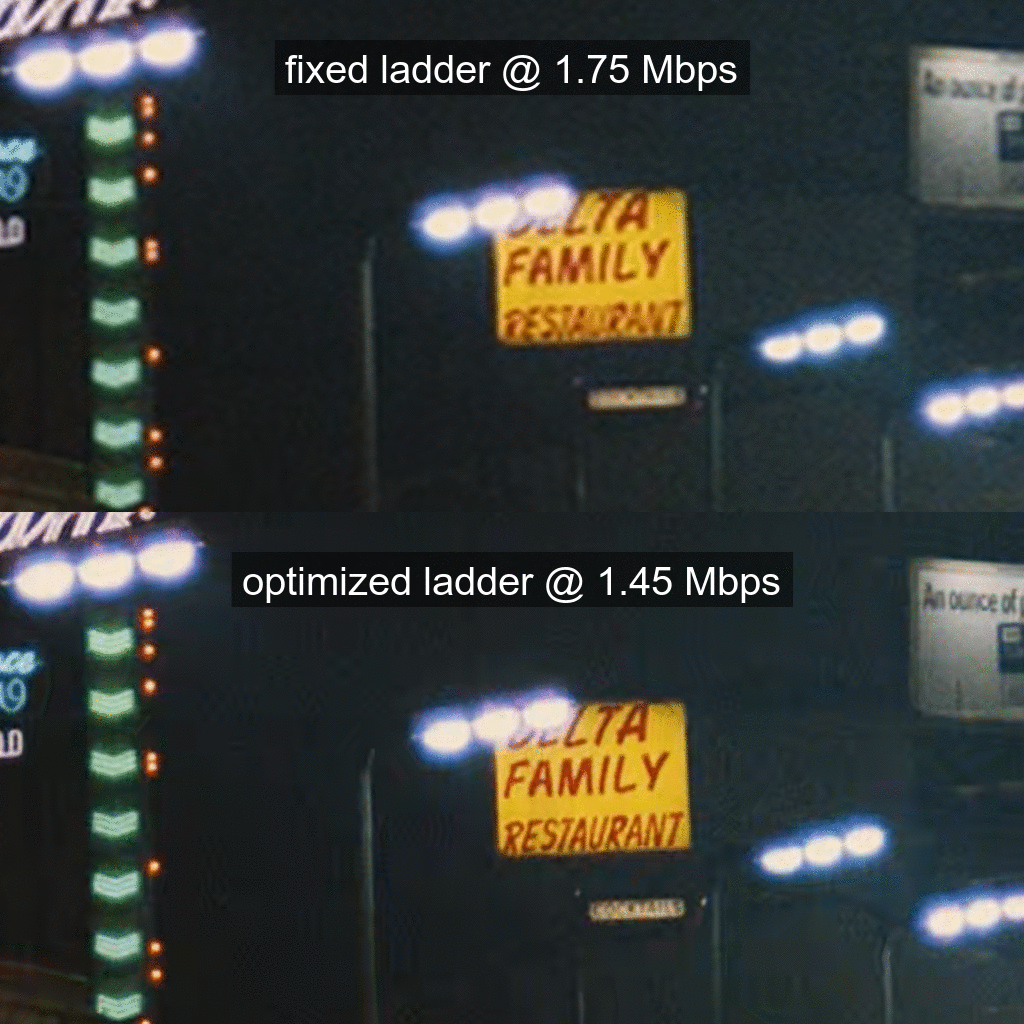
https://miro.medium.com/max/2000/1*c28F7YXjNo-GpmB9bBmbrA.pn... This chart clearly shows multiple data points per resolution under the old fixed-ladder scheme, and under the new scheme the new data point for 1080p is lower on the video quality scale than any of the old 720p encodes. That's a pretty significant difference, and my question about where these new encodes fit into their existing price structure remains va…

The article addresses this point: > As a side note, we do have some additional points, not shown in the plots, that are used in resolution limited scenarios — such as a streaming session limited to 720p or 1080p highest encoding resolution. Such points lie under (or to the right of) the convex hull main ladder curve but allow quality to ramp up in resolution limited scenarios.

Thanks for pointing that bit out. It would still be useful to see where those other points lie. It seems counter-intuitive that they would need a higher bitrate for 1080p than 1440p when both are encoded to the same quality. Maybe their quality metric is slightly biased in favor of having more pixels and is more concerned with accurate reproduction of high-frequency components of the image than having an artifact-free low noise reproduction at a lower resolution?

Edit: Looking at their animated GIF comparisons, the newer encodes definitely give a much sharper image, but also have a lot more in the way of ugly artifacts:

On the left, under the tree branch: https://miro.medium.com/max/2000/1*SQQkYltbVC-HT-l8GpN-7Q.gi...

The right side of the frame: https://miro.medium.com/max/2000/1*A37BBzK4Ap8JPhmiUiFKcw.gi...

Many of the areas that should be fairly flat looking: https://miro.medium.com/max/2000/1*qI3EY7HDp3p0gwK9YGqchQ.gi...

There's definitely a lot more ringing and similar artifacts in the newer, lower-bitrate samples despite their overall increase in effective resolution.

Re: Netflix is now doing per-shot encoding for UHD content

#67

Earlier quoted context omitted.

Do we still need an Intel Kaby Lake or later CPU for 4K DRM decoding? (And Windows... forgot about that.) If so, Netflix is on the wrong side of the CPU war with AMD ascending.

The arguments Netflix made for this highly model-specific DRM never made sense to me. There are 4K rips of pretty much every Netflix show available for download on various bays related to piracy. So why bother locking your paying customers out of 4K content? What's the upside? Also: I'm reasonably convinced that NetFlix is violating the law, at least in Australia, by advertising that their content is 4K and then arbi…

In a lot of cases the decode is happening on the GPU anyway, so requiring a specific CPU is doubly pointless.

I figured it was some backdoor Intel scheme where they paid Netflix to be exclusive.

Re: Netflix is now doing per-shot encoding for UHD content

#68
post #20

> Sometimes we ingest a title that would need more bits at the highest end of the quality spectrum — even higher than the 16 Mbps limit of the fixed-bitrate ladder. From just a cursory inspection using my Apple TV 4K, 12 Mbps is their target bitrate but their ceiling was ~16 Mbps. That's still only a third of what AppleTV+ offers (36/48) and only 2/3 of Disney+ (18/24). Netflix is still higher than Prime Video (10/14…

I'm assuming that when you're at as large of a scale as Netflix, if you were to provide bitrates like Apple does, it would probably collapse most of the internet backbone. I think Netflix and Youtube already use something like half of the internet's bandwidth. Now imagine if they just tripled that overnight.

Though I guess there's a difference between allowing the user to switch to it vs making it default. Youtube lowered the default to 480 to help with congestion during the pandemic, but you can still manually still. I assume 99% of users use the default which is why they can get away with it.

But it would be kinda silly for Netflix to provide 48mbps but only to those who know to enable it.

Re: Netflix is now doing per-shot encoding for UHD content

#69
post #15

That seems like a pretty impressive achievement! Question for anyone here: What do you use to play 4K/HDR? I have an Apple TV 4K, which can do 4K Dolby Vision playback and looks ok, but the Apple TV tends to have some jittering when streaming certain shows (very noticeable in panning shots of animation). The sound quality is also noticeably worse on my set with it (it doesn’t seem to be able to do direct pass through…

I use the native apps in my Samsung Q70 TV. They are really good, and I rarely find a need to use my 4K Apple TV anymore. Even the Samsung Apple TV apps, and the AirPlay 2 support is excellent. As it is, Apple has screwed up HDR on the 4K so badly that it's very difficult to make it work smoothly without also screwing up HDR on other devices.

Agreed, i have Sony Android TV and with Amazon Prime 4K HDR the content has really good quality the problem is that after some time it starts to buffer/jitter and i think its due to Android and bad processors Sony used in the TVs.

My Apple TV 4k obviously runs much snappier but i find the HDR quality really dark and lower than native Android TV.

Post reply on HN