Live data from Hacker News

Portland passes low-density zoning reform

sightline.org

231–240 of 438 posts

Re: Portland passes low-density zoning reform

#231

Earlier quoted context omitted.

I understand that most cities also have restrictions like minimum unit size and requirements for every unit to have it's own bathroom and kitchen. In the past people who just started out and poor people had the option to rent such rooms and that way afford to live in urban areas and avoid a crazy commute. To make that work now you have to find roommates and take over a unit that wasn't meant for this use case. It's n…

The silly thing in my opinion is that college dormitories are exactly that type of housing. No kitchens, shared bathrooms. Works perfectly fine for housing large numbers of young people. Somehow we've decided that we shouldn't give anyone other than college students access to that type of housing.

And we are seeing massive outbreaks of COVID-19 on college campuses now that some are reopening, these laws were first put in place for related reasons...
Re: Portland passes low-density zoning reform

#232
post #10

I like almost all of this. I have one minor concern, the maximum home size is dropping from 6750 to 2500 square feet. Which is probably fine for a nuclear family, but in my neighborhood, such homes are largely occupied by multigenerational families. In areas closer to colleges and universities, those homes end up being shared by large groups of students. Both of these populations will take a hit under this policy.

You can still have homes up to the full size you're talking about so long as they're multifamily, if anything that's better for multigenerational homes...

Re: Portland passes low-density zoning reform

#233
For anyone interested in reading on density, neighborhoods, and what sorts of things work well in cities, I can't recommend The Death and Life of Great American Cities by Jane Jacobs enough[0]. She wrote the book in the 60s and it has really stood the test of time.

Edit: I'd add that the book does a good job about explaining the sorts of motivations there were behind un-densifying cities (or keeping density from rising) in the first place.

[0]: https://en.wikipedia.org/wiki/The_Death_and_Life_of_Great_Am...

Re: Portland passes low-density zoning reform

#234

Earlier quoted context omitted.

Parking strikes me as something the market will fix without a need for subsidized public parking. Traffic needs system-wide reform. No argument there. Walkable neighborhoods, bike lanes, transit, etc. Views - you don't (normally) own the views from your property. I live on a golf course; if it gets redeveloped into condos, I'm SOL. Light - appropriate building setbacks mitigate this. I'm not disagreeing really, just…

In a city there shouldn't be set backs at all. If you want light buy a bigger lot and set yourself back. If you want a garden move out to farm country or put it on the roof (wasted space to most, as it happens I'm installing solar on my roof today, but even then most of my roof is wasted space)

Fair enough. I was thinking about the typical single-use zoning in the US, where single-family home zone is different from row-house zone. I agree that we'd be better off with urban zones not making a distinction. However, I'll gladly take small changes in that direction (allowing duplexes and ADUs) over no progress at all.

Re: Portland passes low-density zoning reform

#235
post #80

Earlier quoted context omitted.

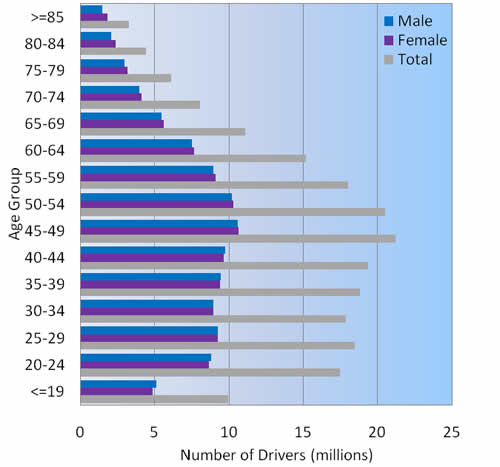
That's contrary to all available data. People over 70 are the least-likely group of adults to have drivers' licenses and have the highest public transport mode share or any group, take the fewest trips, and travel the smallest distance per day. The elderly are arguably the people who stand to gain the most from compact patterns of development.

> People over 70 are the least-likely group of adults to have drivers' licenses Not in the US! It's pretty common for them to continue driving until they have enough accidents that they're dropped by their insurance company. https://www.businessinsider.com/young-people-drivers-license...

I was going by this 2009 data which you have to mentally compute the rates from:

https://www.fhwa.dot.gov/policyinformation/pubs/hf/pl11028/i...

Re: Portland passes low-density zoning reform

#236
post #124

Earlier quoted context omitted.

Keep in mind that Americans on average have been raised in different environs, and likely different habits from the people you lived with. If you've always lived in close proximity, you've developed ways to cope, which people who've lived in copious space haven't. As an example, people who grew up in the country often find cities to be claustrophobic, impersonal, and uncomfortable. So you can't really say "it works f…

I don't understand the point you're trying to make. Culture is not a fixed thing. The majority of present day US citizens do not believe slavery is acceptable, but in the past a majority were prepared to tolerate slavery. Yes, changes to housing will bring about changes of attitudes to housing, but so what? That has already happened---US houses have grown by 40% since the 1980s per the BBC article. Why could this not…

My point is that it doesn't seem like you've bothered to put yourself in the shoes of the people that this will affect. You're effectively saying "it's what I do, so it'll be fine for them".

The change in housing size that you're talking about encompasses a 40 year period, your slavery example, much longer. Culture can change, but it doesn't happen suddenly, by fiat, it happens on generational timescales.

Re: Portland passes low-density zoning reform

#237
post #31
post #10

I like almost all of this. I have one minor concern, the maximum home size is dropping from 6750 to 2500 square feet. Which is probably fine for a nuclear family, but in my neighborhood, such homes are largely occupied by multigenerational families. In areas closer to colleges and universities, those homes end up being shared by large groups of students. Both of these populations will take a hit under this policy.

Would these groups still choose to share a kitchen, bathrooms, etc if they could find co-located, individual units at a similar, affordable price? I doubt it.

Some of us would, but even if not, why would it be the same price? More housing should lower the cost for both, and paying for 4 bedrooms + 1 kitchen should always cost less than 4 bedrooms + 4 kitchens.

Personally, I'd like a private bathroom, but prefer the shared kitchen, dining room, and living room.

Re: Portland passes low-density zoning reform

#238
post #10

I like almost all of this. I have one minor concern, the maximum home size is dropping from 6750 to 2500 square feet. Which is probably fine for a nuclear family, but in my neighborhood, such homes are largely occupied by multigenerational families. In areas closer to colleges and universities, those homes end up being shared by large groups of students. Both of these populations will take a hit under this policy.

> ...2500 square feet. Which is probably fine for a nuclear family... Post-War homes (e.g. after WWII) in America were intended for the nuclear family and were typically under 1000 sq/ft. Most 60s and 70s ranch homes were 1200-1700 sq/ft and considered spacious. A modern 2500 sq/ft house is at a minimum 3 bedroom, 3.5 bath, and a bonus room.

The houses at my local historical center were much bigger. Sears sold many different sizes of house in the early 1900s and some were pretty large even by today's standards.

I have noticed that as houses approach 2000 Sq feet that luxury goes up faster than space, almost as if there is an asomtomic limit in that area. That is people buying smaller than 2000 seem to be looking for more space for the money, while those looking bigger are willing to spend more for the space to make it nice.

Re: Portland passes low-density zoning reform

#239
post #213

Earlier quoted context omitted.

> Traffic, street parking, and public spaces all get more congested A proper transit network and walkable design ensures that this doesn't become a problem. > Plus a neighbor building a bigger building impacts my views and the light that falls on my property. People get so hung up on this, but that's just how it goes -- cities change. Just because you bought a place doesn't mean you're entitled to the exact same view…

> A proper transit network and walkable design ensures that this doesn't become a problem. While that's true, if you don't have a proper transit network, it's a real problem. And many cities aren't in a position to build a proper transit network at the drop of a hat. Don't get me wrong, I wish they did or could efficiently build one. But sometimes you have to deal with reality as it is, not as you'd like it to be, un…

Do you think they built the MTA before they built Manhattan?

Population growth creates the tax base, density, and demand required for a successful public transportation system. Demanding that the public transport comes first is simply backwards.

Re: Portland passes low-density zoning reform

#240
post #172

Earlier quoted context omitted.

Where are you from and which media outlets have you been consuming? From a local perspective, the national attempts to portray the protests are rather futile, since the area under contention is only about two blocks large [0] and it's not on most folks' daily walks. Even only a few blocks away, Portland continues life as normal [3], or as normal as COVID-19 will let us be [4]. To follow up on the grandparent's point,…

I am from Europe and one thing that I have heard is that your new DA is buddy with Antifa and announced that only major violations will get punished. This is basically a written invitation to rioters and looters to keep going. Oh, and of course I saw the Adam Haner scene that looked like a beheading from Irak until he was kicked in the head by BLM "Security", which then reminded me more of the curb stomping scene fro…

On one hand, yes, antifascists like myself intentionally voted for our new DA because we expected him to be not just tough on crime, but also tough on cops. On the other hand, though, the other candidate for DA was explicitly pro-policing and there's just not an appetite for more police in Portland right now.

The current mayor, Wheeler, is trying to walk a middle path. He might not survive re-election, as there are multiple candidates to his left who have indicated that they are more willing to tell the police to go home.

I find it telling that you cherry-pick which street fights reflect poorly on Portland. We have culturally been less and less accepting of street fascists over the past few years. And not all of us are violent, either; I've had heated but peaceful discussions with them up until last year, when the violence became an inevitable part of their platform.

Once the travel ban is lifted and the USA is safe to travel to, feel free to actually come and see for yourself what popular antifascism looks like.

Post reply on HN