Live data from Hacker News

U.S. FAA proposes requiring key Boeing 737 MAX design changes

reuters.com

161–170 of 260 posts

Re: U.S. FAA proposes requiring key Boeing 737 MAX design changes

#161
post #6

Given the option, would anyone choose to book a trip on one of these new Boeing aircraft rather than anything else? I know I wouldn't, my family wouldn't, and none of the friends or co-workers I've discussed this with would. Something tells me airlines are going to be making it even more difficult to determine which aircraft you'll be flying on when you book a ticket. As far as I know they're not required to tell you…

> would anyone choose to book a trip on one of these new Boeing aircraft rather than anything else? I would - and I'm a former Boeing flight controls engineer, so my opinion is not limited to whatever I read from journalists who get about 75% of things wrong whenever they write about aviation.

[deleted]

Re: U.S. FAA proposes requiring key Boeing 737 MAX design changes

#162

Earlier quoted context omitted.

> Even with the warning (which some US airlines paid for) Are you saying that a bad input warning was an optional(paid) extra?

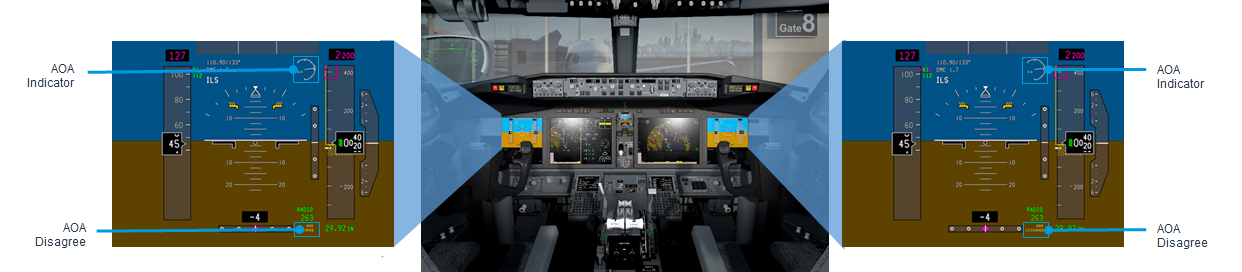
Yep. The "AOA sensor disagreement" light is built into every cockpit, but it won't turn on unless the airline purchased a specific premium add-on. Boeing claims they initially didn't realize the light was bundled as an add-on, and then once they did realize, they decided it wasn't critical to the airplane's safety and just kept selling it as an add-on, which is... kind of alarming, to put it mildly. https://www.nytim…

> The "AOA sensor disagreement" light is built into every cockpit,

While technically true, that sounds a bit misleading considering that the AOA DISAGREE warning "light" is just a text indicator on the primary flight display: https://www.boeing.com/resources/boeingdotcom/commercial/737...

Re: U.S. FAA proposes requiring key Boeing 737 MAX design changes

#163

Earlier quoted context omitted.

Yeah 2 out of 387 hull losses over 2 years is a pretty awful record. I will stick to not 737 MAX thanks.

My understanding is that the crashes were due to properly functioning (but awkward and confusing) MCAS systems. I have to imagine that any pilot flying a 737 MAX is going to have a very solid understanding of how that system works and how to tell if it's malfunctioning and avoid the same situation. Also, it was 2 crashes in 500,000 flights. It seems a little misleading to just compare it to hull losses.

If we are talking about flights and not hulls, then you should include every incident report by every pilot on any issues - it wasn't only times MCAS acted up .

Re: U.S. FAA proposes requiring key Boeing 737 MAX design changes

#164

Earlier quoted context omitted.

> properly functioning (but awkward and confusing) MCAS systems It had almost unlimited pitch authority, used only one (potentially faulty) AOA indicator to decide to activate, and could activate repeatedly unless purposefully deactivated. Even the way in which it was certified was extremely suspect. I'm curious as to how you think that is "properly functioning". Its initial implementation was straight up dangerous,…

The EA pilots were given an Emergency Airworthiness Directive which gave a two step process for recovering from MCAS malfunction: 1. use the electric trim switches to drive the trim to normal 2. cut off the trim system with the console cutoff switches. That's it. As simple as that. And it is NOT what the EA pilots did (they cut off the trim first). Here are the exact directions: "Initially, higher control forces may…

Thanks for giving the link to the document. Looking at the context, the sentence you quoted is more a built-in disclaimer than a procedure that the pilots were supposed to learn to apply in only a few seconds they would have before the airplane crashes to the ground for overriding pilot close to the ground.

After all the changes, it's at the end, and uses the weaseling "may be needed" and "can be used". We saw that not doing very specific sequence in a few seconds makes the plane non steerable.

Edit: Answering: "The LA pilots worked the problem for 5 minutes, the EA 2 minutes. Quite a bit more than seconds." They "worked the problem" during that time by actively attempting to prevent the plane to crash. It's surely not that they simply had that much time to think about what to do next. Also, during most of that time of "minutes", if I remember correctly, the plane was most of the time actively turning to the ground, overriding their attempts to force it flying in the safe direction and doing that repeatedly. I really don't see that for these two accidents it can be said that it was "a pilot error" and I don't see any institution claiming that publicly anymore, even if some would really, really like to be able to do that and would immediately do, if it were possible. "Two simple steps"? Well "may be needed" and "can be used" is surely not even "after X happens do P and then do Q, if not exactly done in that sequence and at that point, the plane will surely crash." Nobody had the training to fight against the program that every time they straightened the plane up turned it back to the ground, making the manual trim impossible to be applied.
Re: U.S. FAA proposes requiring key Boeing 737 MAX design changes

#165

Earlier quoted context omitted.

I think it makes a lot more sense to look at risk per time, because it's basically the same thing as risk per trip, and that's what I really care about. If you tell me I can fly to Mars in a few days on a brachistochrone torchship and it's safer per mile than any other mode of transport, you may be right, and a few days cooped up in a cramped cabin might be a small price to pay for such an exotic vacation destination…

This seems like a mode of comparison that's disconnected from actual utility. The distance comparison lets me consider a scenario like "I live in Washington, DC. I want to go to New York. I can choose to either get there by plane or car, and I want to know which is safer." This seems like a real, sensible thing to contemplate. The time comparison is "I live in Washington, DC and want to go... to wherever it is that h…

Most people do, in fact, have specific travel time expectations for specific kinds of trips. Going away for a long weekend? Probably you're thinking 1-5 hours, whether you're driving or flying. A week or two? Maybe 5-10 hours. Going to the store? 5-15 minutes. Physical distance doesn't matter at all, because it's abstracted away by the transportation technology. All we care about is cost (time and money), availability of destinations, and risk; and since distance doesn't matter, it really can't be risk per distance that we care about.

In practice, no mode of transportation anywhere near as risky per time or per trip as my Mars example is ever going to become mainstream. The point of it is to demonstrate how absurd risk per distance is as a way of getting at a practical and meaningful assessment of travel risk, and we have to go outside of existing mainstream transportation options to see that absurdity because all the existing options must be extremely low risk by any measure or they wouldn't exist. The majority of consumers won't tolerate 1 in 10, 1 in 100, or even 1 in 1000 odds of death per trip.

Re: U.S. FAA proposes requiring key Boeing 737 MAX design changes

#166
post #164

Earlier quoted context omitted.

The EA pilots were given an Emergency Airworthiness Directive which gave a two step process for recovering from MCAS malfunction: 1. use the electric trim switches to drive the trim to normal 2. cut off the trim system with the console cutoff switches. That's it. As simple as that. And it is NOT what the EA pilots did (they cut off the trim first). Here are the exact directions: "Initially, higher control forces may…

Thanks for giving the link to the document. Looking at the context, the sentence you quoted is more a built-in disclaimer than a procedure that the pilots were supposed to learn to apply in only a few seconds they would have before the airplane crashes to the ground for overriding pilot close to the ground. After all the changes, it's at the end, and uses the weaseling "may be needed" and "can be used". We saw that n…

The LA pilots worked the problem for 5 minutes, the EA 2 minutes. Quite a bit more than seconds.

Frankly, I'm baffled by the EA pilots. If I was a MAX pilot, and I received an EMERGENCY AIRWORTHINESS DIRECTIVE about how to not crash like LA pilots, it's my job to read, understand, and remember those instructions. And not just my job, it'd save my own life, too. It's not like it's complicated, either. Two simple steps.

After all, what would you do?

Re: U.S. FAA proposes requiring key Boeing 737 MAX design changes

#167

Earlier quoted context omitted.

My understanding is that the crashes were due to properly functioning (but awkward and confusing) MCAS systems. I have to imagine that any pilot flying a 737 MAX is going to have a very solid understanding of how that system works and how to tell if it's malfunctioning and avoid the same situation. Also, it was 2 crashes in 500,000 flights. It seems a little misleading to just compare it to hull losses.

> properly functioning (but awkward and confusing) MCAS systems It had almost unlimited pitch authority, used only one (potentially faulty) AOA indicator to decide to activate, and could activate repeatedly unless purposefully deactivated. Even the way in which it was certified was extremely suspect. I'm curious as to how you think that is "properly functioning". Its initial implementation was straight up dangerous,…

Nitpicking: the A320NEO first test fly was in September 2014, and the first commercial delivery was in 2016, so it has not been flying for 10 years.

About the 737 MAX: I calculated a while ago that it is, or rather was, about two orders of magnitude less safe than other airliners. Terrible indeed.

Re: U.S. FAA proposes requiring key Boeing 737 MAX design changes

#168
post #6

Given the option, would anyone choose to book a trip on one of these new Boeing aircraft rather than anything else? I know I wouldn't, my family wouldn't, and none of the friends or co-workers I've discussed this with would. Something tells me airlines are going to be making it even more difficult to determine which aircraft you'll be flying on when you book a ticket. As far as I know they're not required to tell you…

It depends on who’s flying it. No argument the aircraft design was faulty and Boeing is fully responsible for that, and even worse covering it up. However Lion Air pretty regularly crashes non-MAX 737s and the first officer on Ethiopian was extremely inexperienced and wouldn’t have been let anywhere near the front of a commercial airliner in the US. Your choice of airline will have a much bigger impact on risk than your choice of aircraft.

Re: U.S. FAA proposes requiring key Boeing 737 MAX design changes

#169
post #146

Earlier quoted context omitted.

Do we know or is a reason to believe that FAA checked anything else then the MCAS and the systems related in the crashes? The MAX has probably many differences because is larger so all the new stuff should be put under the microscope since you can't trust the previous tests, measurements or decisions, Boeing guys were proud on how they mind tricked the FAA guys so FAA should now re=review everything then you can be 1…

The European equivalent of the FAA, the EASA are double checking all of the FAAs working here. The FAA are highly motivated to get everything correct this time in order to repair their reputation (which was tarnished by their original MAX approval). It would be highly embarrassing for if the EASA find anything the FAA missed.

I think FAA's reputation was more tarnished during in the grounding than the original approval, and their failure to investigate thoroughly after the first crash, the delayed the grounding for two days and doing it only after many other regulators did and put pressure on them was really damaging.

Similarly Boeing actively blaming pilot error after the first crash and ignoring reports from the field is the real issue to me rather than poor design itself.

Every new version of any commercial aircraft is long line of decisions cutting corners, 737's airframe were designed in 1960's for smaller older engines requiring the newer larger engines to placed in the more complex higher position- maintaining the airframe was cheaper than building a brand new model. Keeping the same performance made training/ type certification cheaper etc for airlines. For the most part such decisions do work, developing brand new airplane models is extremely risky financially.

It is plausible that risks were not understood well during design and developement, but their failure to act after the first crash is criminal negligence to me and they deserve all they are getting .

Re: U.S. FAA proposes requiring key Boeing 737 MAX design changes

#170
post #121

Earlier quoted context omitted.

Measuring the risk of travel in terms of hours seems largely pointless, unless I'm missing something. It equates an hour bus ride with an hour plane ride, which are not interchangeable, so it makes sense that the associated risks are also not interchangeable. You could account for the additional time it takes to go on a bus to adjust for the longer duration of risk, but at that point it seems like you're just approxi…

> Measuring the risk of travel in terms of hours seems largely pointless, unless I'm missing something. Again, it depends on what you're trying to measure. If you're trying to quantify the risk of dying by accident at a certain hour, what activity you are doing in that hour is highly relevant. If you are trying to quantify the risk of dying by accident while going from A to B, then it's not (that) relevant.

> If you're trying to quantify the risk of dying by accident at a certain hour, what activity you are doing in that hour is highly relevant.

and this is an irrelevant measure, because by that logic, most people sleep for about 8hrs a day, so the chance they die in their sleep is high!?

You measure risk _only_ against what it rewards you. Otherwise, why take the risk at all? Therefore, measuring the risk of air-travel has to be accompanied by a comparison to bus-travel (or rail and/or boat), and measurement should be by distance travelled.

Post reply on HN