20% Stocks
20% Bonds
20% Real Estate
20% Cash
20% Bitcoin
391–400 of 509 posts
20% Bonds
20% Real Estate
20% Cash
20% Bitcoin
Earlier quoted context omitted.
Ok so say I have enough risk tolerance to put my money in something other than cash, but not more aggressive than a fund that tracks the S&P, what precise steps should I do to live off of my cash stack while doing absolutely 0 work other than sitting on my couch?
If it’s all in the market, most wisdom says you can take out 4% a year and never run dry. Is 4% of your stash enough to live on? Congratulations you are financially independent. You can read through mr money mustache if you want more depth..
Earlier quoted context omitted.
> And only 20 years even less. I'm guessing you're in the US. I'm sure you can find papers and articles doing back-testing to the 1920s, which would include the Great Depression. If you can wait long enough, things have always recovered and earned a return. > Did you adjust your calculations for inflation? For the S&P 500, the absolute worst-case is 58 years of not being up, I believe. 1929 - 1987. Not my calculation…
Both of you make excellent points. I guess I'm jaded by the fact that VT (or e.g. VFFVX) has been almost flat for 2.5 years now. A pure US investment would have fared better. I'm pessimistic about bonds because of the debt bubble (gov debt, MBSs, CLOs, corporate bonds) and low yields. Governments couldn't stomach higher rates, either. In the big sell-off we have seen in March everything went down together margin-call…
First: 2.5 years is a ridiculously short investment timeframe. I have sneakers older than that.
Second: perhaps it would have, but there was no way you could have known that ahead of time. Yes, from 2010-2019 the US markets (often measured by the S&P 500) has seen high returns. Now go back to 2000-2009 and see how things faired.
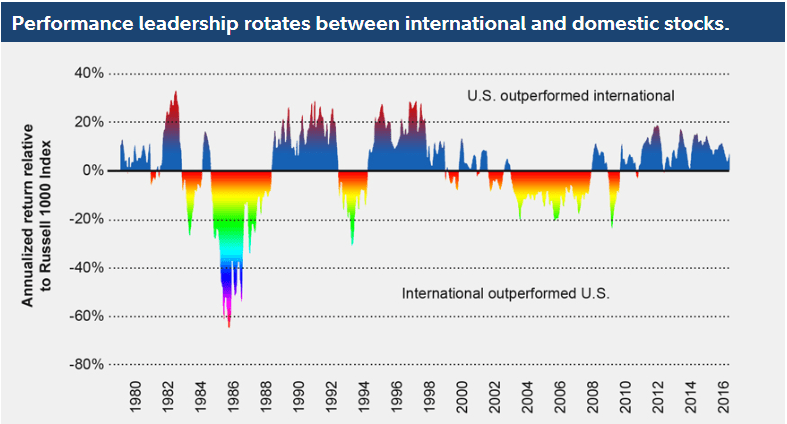
As a Canadian I often see often asking "why invest in Canada at all? why not go all-US?". This is often asked by people younger than 35 or so, who haven't looked up a bit of history, and only know about the last few years (look up the term "recency bias"). There have been times where Canadian equities outperformed the world, and also when international has outperformed the US:
* https://warrenstreetwealth.com/wp-content/uploads/2018/04/Pe...
You can make a good decision with the information you have available, but the result still be disappointing. See the video "How to Evaluate Your Investment Decisions":
Wait for the next crash and then buy up stocks and rental properties (apartment buildings) at a discount. See 2008 for reference. While you are waiting for the crash, you could put some of your cash into gold, which will do well when the US economy crashes.
I did that from 2008 to 2014 (but I didn’t buy gold). It worked out terribly. I should have parked it in a diversified portfolio. Instead, housing and equity prices inflated, and I lost a ton of potential gains. Buying gold during the crisis would have made it even worse: https://www.macrotrends.net/1333/historical-gold-prices-100-... If you must buy gold, it’s best to buy some when the stock market is booming. If yo…
> I'm not comfortable investing the entirety into an index fund, given the current socio-political climate. Over the the long term there is not really anything better to do with it than equities: the Great Depression, World War 2, gold standard retirement, 1980s inflation, etc. Even if you only invested in the peaks, you'd still do quite well over the decades: * https://awealthofcommonsense.com/2014/02/worlds-worst-m…
> Even if you only invested in the peaks, you'd still do quite well over the decades: This is not true for a 10 years period though https://www.vizlit.com/finance/2020/07/01/sp-performance.htm... You might to add that even though in the past economic growth has always been the case, it doesn't mean it will always be the case, especially now that the energy consumption more or less reached a peak
It was true in this ten-year period (2000-2009) if you rebalanced between VFINX (S&P) and VBMFX (bonds):
* https://www.forbes.com/sites/investor/2010/12/17/the-lost-de...
> ... I have $450K in cash burning a hole in my pocket. First, the urge to put money somewhere could be a problem. Examine why you feel this way - closely. It could be you're letting emotions take over and that's rarely a good thing. Second, you didn't mention debts. If you have any, you might look at the interest rate (including government freebies) and compare that to the most likely return you'll get. If your inte…
Much like having enough in savings that you don't have to fear a few months without a job drastically changes what you'll tolerate from an employer, not having the weight of debt, however advantageous leverage might be, does grant the ability to look at opportunities large and small without the "but ..."
Earlier quoted context omitted.
> A market with no active management would allocate capital arbitrarily, without an eye to returns. I recommend you read up on the following (from me elsewhere on this topic): > So what would happen if the majority of investors started to buy the market and stopped trying to beat the market? > Mispricings would start to develop regularly, and the people that had continued to try and pick stocks would be able to profi…
The GP isn't disagreeing with you. They just said in the limit that all investment couldn't be passive. There is probably some equilibrium value between active/passive investment.
The concern that passive/index investing will ruin The Market is just not something we need to worry about.
Jack Bogle made the claim that even if 90% of the market went passive, the remaining 10% would probably be enough to keep things going:
* https://www.forbes.com/sites/greatspeculations/2019/02/12/a-...
* https://www.ft.com/content/4594f554-ba1a-11e7-9bfb-4a9c83ffa...
I'm less worried about the issue of market and price efficiencies, and more about shareholder votes and company management decisions. How do passive, potentially 'non-opinionated' index funds vote on various measures?
A nearly even allocation between: SPY, GLD, TLT, HYG, VXX (or equivalent sector standins) Has a very good very stable yield for many, many decades. To have anything better, one must learn a lot about investing and keep after it.
Warning: VXX is virtually guaranteed to drop in price in the long run. It uses periodic reverse spits to maintain its price. Never buy and hold it, ever.
“Indeed, in the initial prospectus from 2009 stated, “due to the construction for this product one needs to be aware that its value will approach zero over time.” The prospectus also called to retire the fund after 10 years which will be at the end of this month on January 30.“
“All told since its inception 10 years ago, on a split-adjusted basis, the VXX has declined from $120,700 to the current $47 level.”