Live data from Hacker News

What vertical farming and ag startups don't understand about agriculture

thinkingagriculture.io

191–200 of 321 posts

Re: What vertical farming and ag startups don't understand about agriculture

#191
post #154

Earlier quoted context omitted.

You mean... Goats?

Lol, that’s great. Would love to have grazing animals in the future but we’re not quite ready to take care of them yet. Also involves decisions on fencing etc. I have been warned a LOT about goats and their ability to destroy everything, and evade even the tallest fences.

What about goats with earphones, trained to stimuli?

I'm not actually "rural", but I have chickens. (One of which is 10 years old!) There is such a thing as a "judas goat"; or "judas chicken". I've been through three generations of chickens now. The first generation ended up a quarter mile away on Pete's garden (he wasn't that upset). It doesn't happen any more.
Re: What vertical farming and ag startups don't understand about agriculture

#192
post #174

My father is an ag soil chemist of 50+ years. I'm an industrial systems eng. w/ a specialty in polymer-textile-fiber engineering. (Mostly useless skillsets in the US now) Gonna share a few lessons here about agriculture that I try to convey to EECS, econ, Neuroscience, and the web developer crowd. - You can only grow non-calorically dense foods in vertical farms - It takes 10-14 kwh/1000 gallons of water to desalinat…

> 1MWh/capita annum Oh this is fascinating! I never thought of this but of course energy consumption per capita is going to be an indicator of how industrialized a country is. I briefly checked the two countries I am a citizen of (Canada, Hungary) and counterchecked with one of the poorest countries I know of (Chad) and the numbers are as expected: 14.6, 4.1, 0.013 (oof).

Yes, and for this reason (IIRC) GDP/capita scales linearly with MWH/capita.

Re: What vertical farming and ag startups don't understand about agriculture

#193

My father is an ag soil chemist of 50+ years. I'm an industrial systems eng. w/ a specialty in polymer-textile-fiber engineering. (Mostly useless skillsets in the US now) Gonna share a few lessons here about agriculture that I try to convey to EECS, econ, Neuroscience, and the web developer crowd. - You can only grow non-calorically dense foods in vertical farms - It takes 10-14 kwh/1000 gallons of water to desalinat…

So you can't grow potatoes vertically? Can you elaborate? Is it a function of physiology, i.e. calorie dense vegetables need far more leaves and supporting stems than can be practically stacked vertically?

Re: What vertical farming and ag startups don't understand about agriculture

#194

My father is an ag soil chemist of 50+ years. I'm an industrial systems eng. w/ a specialty in polymer-textile-fiber engineering. (Mostly useless skillsets in the US now) Gonna share a few lessons here about agriculture that I try to convey to EECS, econ, Neuroscience, and the web developer crowd. - You can only grow non-calorically dense foods in vertical farms - It takes 10-14 kwh/1000 gallons of water to desalinat…

Re: Which brings up another issue, which is energy density/m2 of land. To support industrialization/high density urbanism the only fuel sources that do this are currently fossil fuels, or nuclear, but none of the renewable fuels have the energy density.

So if these countries want to increase the amount of MWh/capita, the most efficient (only?) pathway is through high-energy density fuel sources, which right now is being achieved through the use of fossil fuels. To me, this is (one of) the main reasons nuclear energy needs to be prioritized as a climate change solution.

ETA: And, now that I think about it, another way to squeeze more effectiveness from your grid is to build super energy-efficient buildings that reduces the overall and peak grid energy consumption.

Re: What vertical farming and ag startups don't understand about agriculture

#195

My father is an ag soil chemist of 50+ years. I'm an industrial systems eng. w/ a specialty in polymer-textile-fiber engineering. (Mostly useless skillsets in the US now) Gonna share a few lessons here about agriculture that I try to convey to EECS, econ, Neuroscience, and the web developer crowd. - You can only grow non-calorically dense foods in vertical farms - It takes 10-14 kwh/1000 gallons of water to desalinat…

> The end result is that the optimal decision is to have more children to harvest more calories per an acre.

For a photo-essay about this there's the New Humanitarian article here: https://www.thenewhumanitarian.org/report/94947/lesotho-weat...

It describes the interaction between climate change, HIV/AIDS, and poverty.

(It used to be called "Too poor to farm").

Re: What vertical farming and ag startups don't understand about agriculture

#196
post #37

Earlier quoted context omitted.

I would like to build on top of your point: - Indoor farming would not have to worry about things like drought. As a water feeding system can be led all the way to the ocean and the salt removed using pure sunlight as power. - Indoor farming has shown to yield crops with 96% less water in many cases, again solving the problem mentioned previously. - Many areas don't have ready access to tons of water so these water c…

>Indoor farming would not have to worry about things like drought. As a water feeding system can be led all the way to the ocean and the salt removed using pure sunlight as power. Are you aware of how much water it takes to produce the output of the Midwest or Central Valley? We'd be talking about the largest desalination project in human history by orders of magnitude. As of 2013, Israel had a desalination capacity…

So with indoor farming let's say you'd only need 5-10% of that, right? That suddenly makes it basically the same magnitude.

Re: What vertical farming and ag startups don't understand about agriculture

#197

My father is an ag soil chemist of 50+ years. I'm an industrial systems eng. w/ a specialty in polymer-textile-fiber engineering. (Mostly useless skillsets in the US now) Gonna share a few lessons here about agriculture that I try to convey to EECS, econ, Neuroscience, and the web developer crowd. - You can only grow non-calorically dense foods in vertical farms - It takes 10-14 kwh/1000 gallons of water to desalinat…

So you can't grow potatoes vertically? Can you elaborate? Is it a function of physiology, i.e. calorie dense vegetables need far more leaves and supporting stems than can be practically stacked vertically?

I imagine space is a factor, but energy will be a big one as well. Calorie dense foods will likely need more space and energy (light) inputs. Vertical farms are very water efficient, so I don't think that matters much.

Vertical farms make a lot more sense with fresh vegetables like leafy greens that grow quickly, command high prices if grown organically, and benefit from being closer to market.

Potatoes are the exact opposite. If it ever becomes more cost effective to grow corn, wheat, and potatoes in virtual farms then outdoor agriculture is dead. While I don't agree with the article that it will never happen, it might require energy advances like fusion power or drastically higher _rural_ land values and water prices.

Greenhouses make sense long before vertical farming, just look at agriculture in the Netherlands, it's mind boggling how much they produce for such a tiny country.

Re: What vertical farming and ag startups don't understand about agriculture

#198
post #7

The author here has a good premise, although glosses over many things. Yes, "vertical farming" is over-hyped. That said, the author didn't mention weather or pesticides/fertilizers at all. Statements such as "Current agriculture doesn’t need an artificial energy source" are plain wrong. Producing fertilizers takes quite a bit of artificial energy and the bulk of the corn and soybean farmers the author is pointing to…

Also, no mention of drought and other extreme weather events. Additionally, no talk about how the Ogallala Aquifer (and others) is being decimated and continued trajectories would be catastrophic in just a few decades. The higher yield and minimal water and and getting rid of pesticides/fertilizers and removing transportation pollution are interesting things to research and see if we can do better. It is already a hi…

I'm very familiar with the Ogallalla aquifer. When the drought of 2012 hit, people were very worried about it never recovering. After several 'wet' years it appears to be fine. Mother Nature is stronger than we give her credit for

Re: What vertical farming and ag startups don't understand about agriculture

#199
post #174

My father is an ag soil chemist of 50+ years. I'm an industrial systems eng. w/ a specialty in polymer-textile-fiber engineering. (Mostly useless skillsets in the US now) Gonna share a few lessons here about agriculture that I try to convey to EECS, econ, Neuroscience, and the web developer crowd. - You can only grow non-calorically dense foods in vertical farms - It takes 10-14 kwh/1000 gallons of water to desalinat…

> 1MWh/capita annum Oh this is fascinating! I never thought of this but of course energy consumption per capita is going to be an indicator of how industrialized a country is. I briefly checked the two countries I am a citizen of (Canada, Hungary) and counterchecked with one of the poorest countries I know of (Chad) and the numbers are as expected: 14.6, 4.1, 0.013 (oof).

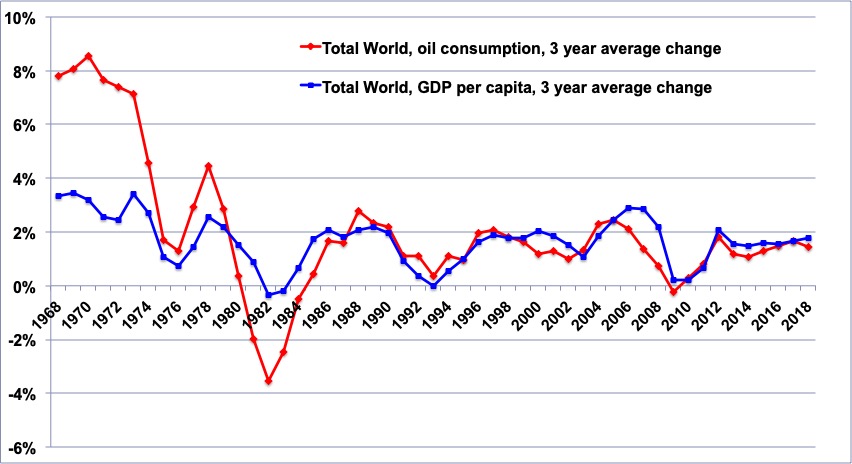
On the topic of energy, I find this correlation fascinating as well: https://jancovici.com/wp-content/uploads/2016/04/petrole_gra.... Oil consumption predicts GDP. Complete article: https://jancovici.com/en/energy-transition/oil/is-the-price-...
Post reply on HN