Live data from Hacker News

Why are there so few black people in STEM?

labroots.com

161–170 of 212 posts

Re: Why are there so few black people in STEM?

#161
post #153

Earlier quoted context omitted.

> There is a gene for basketball--it's called being tall and fairly muscular so then by that logic, you can argue why there are so few whites in basketball must be that they aren't as tall and muscular.

I think most basketball fans would agree with that argument.

And yet when there's little or no representation of one race in one area of human endeavour, it's OK and accepted. But in another endeavour, it's frowned upon and spell racism.

Re: Why are there so few black people in STEM?

#162
post #118

They sure love that 13% figure. Why are so many nigerians in america so well educated [1] ? Not doubting any other assertions but my theory is that historically, STEM has not been a well reputed path to success,recognition and respect for black americans both in their communities and nationally. Segregation is only half a century ago,but even these days being STEM educated and black is associated with negative stereo…

Are these ideal Nigerians you're referring to from poor families? Or are their parents upper-middle class?

Generally their parents are generals or kings, according to my mailbox.

Re: Why are there so few black people in STEM?

#163
post #159

Earlier quoted context omitted.

1. Poverty, especially generational poverty, is extremely difficult to get out of. Studying in a university means you won't be able to help your family financially for 5-8 years. Which can be really difficult for many. 2. No role model. Let's say you can somehow manage those hardships. But how do you know all this effort and education loans will be worth it? There are not many role models for African Americans in STE…

So these are true for the current generation of immigrants. What about the generation of asians [0] that were from the beginning of the 19th century? They broke out of poverty, despite all the same disadvantages. [0] https://en.wikipedia.org/wiki/History_of_Chinese_Americans#:... .

I don't believe the Indians and Chinese who immigrated back in 1900s ever got rid of poverty. It's only the last few decades of educated immigrants that changed the narrative that Asians are the model minority, it's been a part of US propaganda for decades now - https://www.washingtonpost.com/news/wonk/wp/2016/11/29/the-r...

I can see the same happen in my ancestry too. The ones who migrated back in 1900s or during the wars never made it big while the educated ones who went there after 50s are doing well.

Re: Why are there so few black people in STEM?

#164
I’ve been in the industry since the late 90’s, right before the H1B volumes really spiked. I worked with a number of black people, and my hiring class consisted of a number of black engineers from historically black colleges. Fast forward 10 years, and cost savings forced a deep round of layoffs and offshoring. The black engineers were hit disproportionately. The current team’s makeup consists heavily of H1Bs. Those black engineers haven’t all returned to STEM.

I’ve transitioned through many roles in my careers, and remained very interested in this topic, so I notice the black makeup of each company. In St Louis, a city with about 50% black population, I consulted on a few projects. These companies employed a few African Americans, as security guards, but the engineers were about 50% white and 50% Indian.

In Florida, I consulted on another project. Every black engineer had the accent of a Caribbean native or African native. Judging by the accents, there were no American born black engineers.

I keep wondering if the H1Bs have out competed the black new college graduates, or if they’re simply not being given a chance at the jobs being filled by H1Bs.

Other companies have huge Infosys, TCS consulting presence, and those new engineering roles are filled without true competition from American workers, but doled out to new H1Bs.

I continue to think that an additional yearly salary tax should be levied on any H1B. This forces the employers to be financially aligned with employing US citizens. Ideally those taxes should for for STEM scholarships for the poor, increasing the US pool of these supposedly in demand engineers.
Re: Why are there so few black people in STEM?

#165

I'd like to see how many poorer men in general. I'm a black engineer and I couldn't count how many of my classmates would have graduated if they were in my shoes. There were 4-5 weeks at different where I just ran out money and sat on bed instead of eating thinking I couldn't be hungry is I was sleep. I usually found enough money to collect to buy a bag of rice for the month. But regardless of race this is hard. Give…

I've never gotten to that point but definitely had a great moments when it wasn't entirely clear how I'd find the finances to continue without the support of family financially and otherwise and much else in terms of a social safety net. The absolute lowest point was after a particularly bad first semester in second year that required much higher average in the second to retain good standing I received a letter in informing me not only that no longer qualified for the loans for academic performance but also that repayments wer soon to start. I think it eventually turned out to be a clerical error but I definitely had a few episodes wandering aimlessly from twilight to dawn questioning my ability to complete the degree, who I'd be able go to for support, how I'd live with myself if I took support and still failed, how I'd afford to pay it off or support myself if I dropped out right now, the embarrassment of doing so, rationality of choosing to double down on sunk costs vs potentially losing a once in a lifetime opportunity I'd already sunk so much into, and if I had really made the right decision in choosing to attend in the first place.

Looking back though, the experiences and situations were so formative I sometimes wonder if to change them would be to dilute and erase oneself.

Re: Why are there so few black people in STEM?

#166

I'd like to see how many poorer men in general. I'm a black engineer and I couldn't count how many of my classmates would have graduated if they were in my shoes. There were 4-5 weeks at different where I just ran out money and sat on bed instead of eating thinking I couldn't be hungry is I was sleep. I usually found enough money to collect to buy a bag of rice for the month. But regardless of race this is hard. Give…

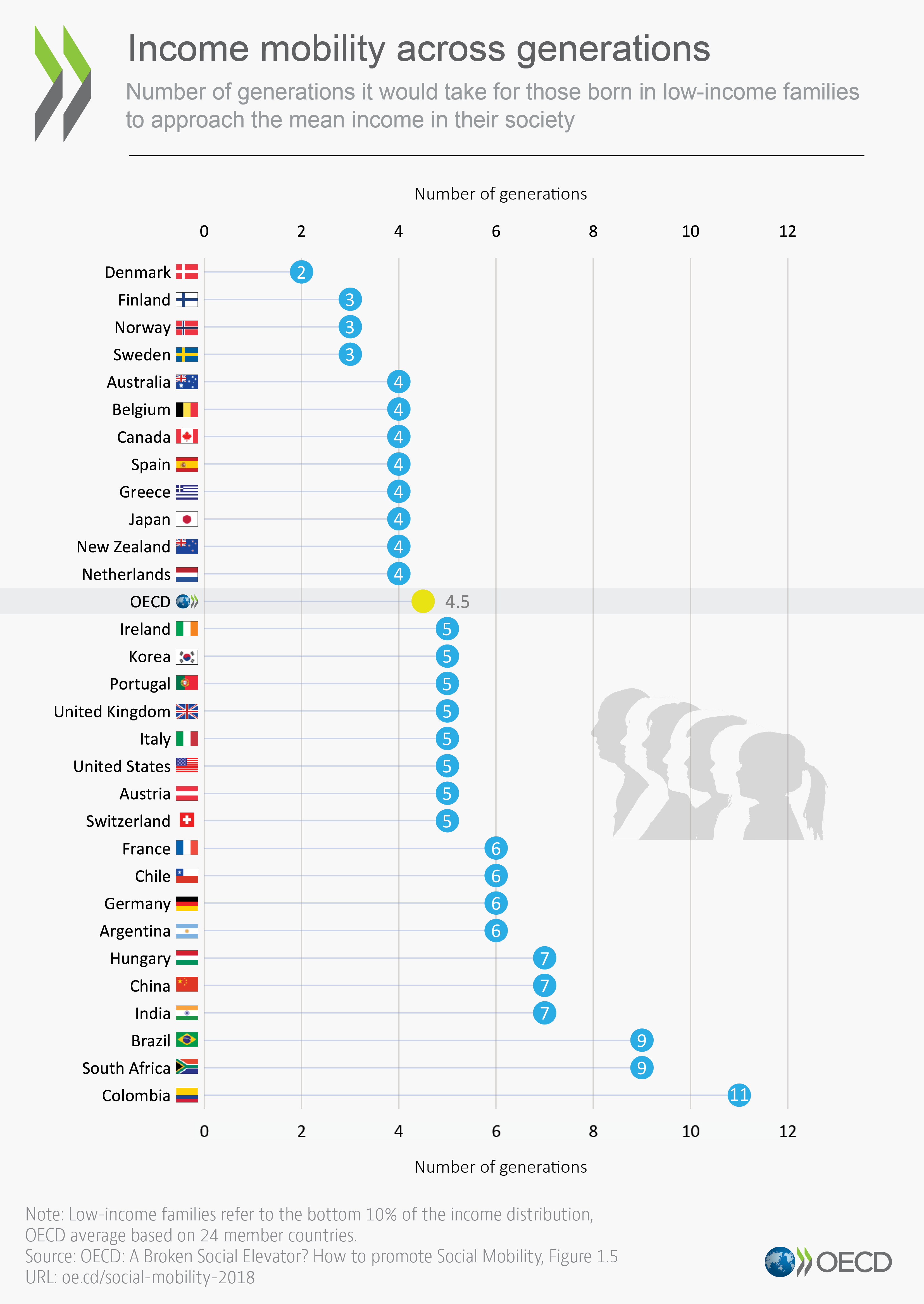
The US definitely has a lot of untapped potential. And they're not even worst in class. According to the OECD, other countries (e.g. Germany, France) are much worse when it comes to social mobility [1].

[1] http://www.oecd.org/els/soc/1-5%20generations.png

Re: Why are there so few black people in STEM?

#167

Earlier quoted context omitted.

No amount of funding towards schools can make up for a home life or general environment that's not conducive towards education. I wish we in the US looked at solutions beyond throwing money at it (or at least, in a different way) because it obviously doesn't work.

Yeah, it depends where the money is thrown. Experiments in Brazil and India suggest that the really simple, dumb solution works best: give poor people money, no strings attached. Sure, they'll waste some of it. But not all that much, maybe a third. To economists, that's very effective targeting. (If you demand perfect targeting and use of funds here, why not with private-sector investments (67%-90% loss rate) or 'nor…

But India and Brazil still don't have great social mobility. Most studies in that area are still pretty young and it's too early to say if that can increase social mobility in the long term.

Re: Why are there so few black people in STEM?

#168
post #71

Earlier quoted context omitted.

There's not really a lot of debate about what makes for good schools. Small class sizes, and well qualified(paid) teachers. It is that simple. You can try whatever alternative educational styles you want, and it will not work in a class size of 50. Nor does the federal government have to take over the education system to achieve this, it just has to guarantee equal funding for all students. Or the US can continue to…

You need teachers who are passionate and regard it as a vocation rather than just another job. Pay and qualifications don't necessarily imply this. Poor discipline in a school can demoralise a teacher. You also need to get rid of teachers who are badly underperforming. This can be very difficult, which is also demoralising. I've gleaned the above from having many family and extended family members in teaching.

Pay and qualification go a long way to achieve quality in teaching. To get excellent people to become teachers, you need to pay them at least similar amounts as they could get elsewhere and give them some guarantees that their job is safe. Changing back from being a teacher to the industry can be hard so the easiest way to get bright people to become excellent teachers is by educating them as teachers and promising them a secure job with good pay. That makes getting rid of bad teachers harder but that's subjective anyway. Sure, some teachers might be awful but most way to test this focus purely on academic outcomes which don't incentivize teachers to help poor students with little prospects.

Re: Why are there so few black people in STEM?

#169

Earlier quoted context omitted.

> rich districts pay more taxes and get better schools I struggle to see how this is wrong. It's not any different than rich people buying private education, though it makes it easier for non-rich folks to try and find the cheapest place in that district so they can benefit from the well-funded schools. It seems popular to think that people should have equal opportunity, independent of any other factors. But from the…

> But from the perspective of a parent, why should I be disallowed from providing my own kids every possible advantage I can afford? Because it's bad for society, and because there's a long since established moral precedent in favor of things that may make life slightly worse for any given individual but better for a large majority of everyone. It's also worth keeping in mind that there's a massive difference between…

Disallowing discretionary funding and efforts for education would be what could charitably be called deeply misguided approach to try to make it fair for everyone. (Allowing every possible advantage taken literally would get into no shit answers like cheating or bribery not being okay.)

I recall hearing from New Jersey and judges taking strict stances of equal outcome in education that found locality funding discriminatory, was that the poorer districts needed to be funded more per student to start to reach parity. Which makes some sense on some levels given knowledge and habits from parents transferring and would need more effort and funding to catch up because they are already providing more teaching just in a remotely middle-class concept.

That sort of equality is clear folly, like trying to force every kid into creches and separate them from parents. It might work with some hypothetical aliens but in practice for humans prepare for massive psychic trauma, inevitable abuse from caretakers, and frankly a well deserved outright insurrection and rebellion.

Don't get me wrong, working to raise the floor is a noble goal and makes sense just from rational selfishness alone. Throwing more money at the high end is 'dimminshed returns' but the money has already been allocated for better or worse. And well the obvious caveats of how the money is spent matters, there is no fixed true universal value per of any unit or commodity.

Re: Why are there so few black people in STEM?

#170
post #152

Earlier quoted context omitted.

Not sure about other Asians, but most South Asians that immigrated to US already had degrees and were upper-middle class (having the money to buy international plane tickets automatically qualifies you to be upper-middle class). Sure they had to live poor initially but their mentality was "this is temporary and we will improve our situation soon enough".

> Sure they had to live poor initially but their mentality was "this is temporary and we will improve our situation soon enough". so to get back to the grandparent post's question - why don't black people have this same mentality? What is it that's specific that's causing the disparity between asians and blacks?

One obvious result is generational poverty and what hints at 'learned helplessness' of sorts and loss of hope. It isn't limited to just the racial context. London schools found that their low end of the bell curve were native working class children. Worse than even refugees from a non-privileged background in even the 'relative to origin' sense.

The phenomenon is larger than race, although it may be involved in any given instance or manifestation. It is a shared cliche for successful professionals hailing from both inner city to suburbs and dying small town Midwest that they never want to return to. That 'they're ones of the ones who made it out of that (shit/hell)hole', along with a disgust at its inhabitants or melancholy resignation that they are stuck in dysfunction, along with optional lingering resentment over mistreatment by the local crab-bucket.

I'm not sure anyone has an answer for how to solve those issues. A hypothetical solution probably wouldn't be very popular even if it isn't anything morally or ethically uncomfortable just from how 'counter-intutive' it would have to be.

Post reply on HN