Live data from Hacker News

No Recent Automation Revolution

overcomingbias.com

171–180 of 368 posts

Re: No Recent Automation Revolution

#171
post #124

I have very interesting process when taking vacation. Automation does not mean robots from movie “I Robot”, some software can do the job too. To take time off I must open shitty software, enter my vacation days, then print the sheet and sign it. My manager signs it too. Then I bring it to secretary, she signs too, confirms the date in shitty software. Secretary sends paper form to the HR lady, she checks, if it’s ok…

All of that is automated at my company using SAP. Could be a nicer interface, but at least everything is online in the portal.

That's also why it's usually a multi-year project to introduce SAP systems at an existing company. The hard part is not installing the software (though I'm not saying it's always easy either). The hard part is getting all layers of the company to change away from their pre-existing, sometimes nonsensical processes.

(Disclosure: I work at SAP, though not on customer-facing software.)
Re: No Recent Automation Revolution

#172

Living in a country where people are expensive and machines are cheap, I can attest the automation level is higher here. For instance, I often see cows at farms here enjoying automated brushing systems. There are youtube videos in english, but I don't recall ever having seen something like that in the US, even at Harris Ranch. (I have yet to witness a farmer using fully-autonomous hay feeding robots, but the ag magaz…

The rules (in Germany, but also other places) say you either have to offer the cows these brushes or brush them manually. It's not really a choice.

Re: No Recent Automation Revolution

#173

Economics noob here: the paper concludes that past automation is predicted by 2 key factors: pay and employment. What does that mean exactly? Are they saying that higher a job pays, the more likely it is to get automated? Or the other way around? Also what does 'employment' refer to exactly? Is measuring how well the demand for labour is being met in a certain job?

"Are they saying that higher a job pays, the more likely it is to get automated?"

Yes. One aspect that I've seen in e.g. computer vision and robotics for industrial automation is that there are a lot of processes for which we have the technology to automate production, but it's not worth because it's currently cheaper to get the job done manually by someone in a poor country getting paid very, very little.

However, the obvious implication is that if/when the worker conditions in the world improve and these workers start requiring reasonable wages then these jobs will be automated pretty much immediately. If the shop owner has to choose between buying a robot or providing a handful of rice to a team of near-slaves, the people are cheaper; If the shop owner has to pay something comparable to the minimum wages in the first world, then the best worker gets to supervise and clean the imported robots and all the others are out on the street.

If the first world would stop offshoring these jobs to poor countries, then that would not mean large numbers of blue collar jobs coming back, that would mean shifting to automation.

Re: No Recent Automation Revolution

#174
post #10

Due to the Covid-19 lock down, my company was forced to accelerate our automation program. We did in months what we had originally planned to do in years. As we are able to open our operations center further, it's clear that we'll be providing fewer jobs than we did before. At least some part of that is the result of automation. I can't help but think this same pattern is playing out at other companies right now.

A similar thing happened post 2001-bubble-pop and post 2008.

Post 2001, there was a huge shift to offshore models, ticketing-workflow models, and a shift to a blossoming open source environment.

Post 2008, there was another huge shift to more flexible infrastructure models, and to automation.

Companies are often reluctant to restructure workforces, even when there are potential efficiencies available. Economic crises provide an "opportunity" for them to right-size.

Re: No Recent Automation Revolution

#175
post #169
post #10

Due to the Covid-19 lock down, my company was forced to accelerate our automation program. We did in months what we had originally planned to do in years. As we are able to open our operations center further, it's clear that we'll be providing fewer jobs than we did before. At least some part of that is the result of automation. I can't help but think this same pattern is playing out at other companies right now.

It really makes me sad that jobs are seen as inherently valuable. The way you phrase it, 'provide jobs', feels like jobs are something needed. Of course, in the current setup, this is true, but there are so many boring and hard jobs (worked by people who are yet poor) that we shouldn't mourn once we manage to get rid of them. I want an economy where we can celebrate automation and distribute the profits evenly.

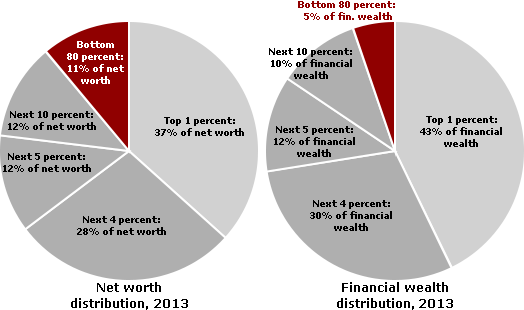
>I want an economy where we can celebrate automation and distribute the profits evenly.

Not going to happen under capitalism.

Look at the numbers, they are pretty horrifying.

https://whorulesamerica.ucsc.edu/power/images/wealth/Net_wor...

https://sociology.ucsc.edu/whorulesamerica/power/wealth.html

Re: No Recent Automation Revolution

#176
post #155

Earlier quoted context omitted.

This is true, but better tooled, equipped humans do more work and so you need fewer of them. When your landscaping company buys an excavator, one person can now move as much earth as 15 people used to. You don't keep the other 14 on the payroll.

A larger amount of people can now afford landscaping services because earth moving cost have now gone down. Poor people used to go barefoot before industrialization. Producing more with less human input is how we raise the living standards of everyone in the long term.

The Jevons paradox absolutely does play a part, especially at first, but I don't believe it's enough for higher efficiency to result in an overall win (edit: for the employees). Most markets saturate surprisingly quickly when you apply 10x - 100x efficiency increases.

Re: No Recent Automation Revolution

#177
post #169
post #10

Due to the Covid-19 lock down, my company was forced to accelerate our automation program. We did in months what we had originally planned to do in years. As we are able to open our operations center further, it's clear that we'll be providing fewer jobs than we did before. At least some part of that is the result of automation. I can't help but think this same pattern is playing out at other companies right now.

It really makes me sad that jobs are seen as inherently valuable. The way you phrase it, 'provide jobs', feels like jobs are something needed. Of course, in the current setup, this is true, but there are so many boring and hard jobs (worked by people who are yet poor) that we shouldn't mourn once we manage to get rid of them. I want an economy where we can celebrate automation and distribute the profits evenly.

Unearned income is unfulfilling and the people who think they earned it resent it being taken from them, even if it's only particularly large because there's a big market to sell into and a big winner effect in the market structure.

I don't know the answers here but they don't look like free market capitalism or redistributive socialist utopia, and actually I think this axis or spectrum is an actively harmful frame for constructing a society with fulfilling lives and less inequality. Neither more government nor more free enterprise is quite right.

People want to live productive lives where they are valued and make a difference. How do you do that in a society which has such enormous returns on capital which alienates people from their work product?

Re: No Recent Automation Revolution

#178
post #175
post #169

Earlier quoted context omitted.

It really makes me sad that jobs are seen as inherently valuable. The way you phrase it, 'provide jobs', feels like jobs are something needed. Of course, in the current setup, this is true, but there are so many boring and hard jobs (worked by people who are yet poor) that we shouldn't mourn once we manage to get rid of them. I want an economy where we can celebrate automation and distribute the profits evenly.

>I want an economy where we can celebrate automation and distribute the profits evenly. Not going to happen under capitalism. Look at the numbers, they are pretty horrifying. https://whorulesamerica.ucsc.edu/power/images/wealth/Net_wor... https://sociology.ucsc.edu/whorulesamerica/power/wealth.html

Do you think it has a chance of happening in Vietnam or North Korea under communism?

Re: No Recent Automation Revolution

#179
Tasks makes up Jobs.

Certain tasks that form a particular job are being automated more now than ever before.

This is more true of knowledge workers where they are operating and working in a digital environment already (e.g. traders, accountants, lawyers, marketing, admin...)

This is less true of manual labour - like cleaners and gardeners - why? Well look at robotics, its good but nowhere good enough to replace these dexterity required which a human can provide.

For knowledge workers it is very hard to automate all the tasks that make up a job. Hence why automation has not resulted in mass unemployment (excluding all other factors).

Re: No Recent Automation Revolution

#180
post #169

Earlier quoted context omitted.

It really makes me sad that jobs are seen as inherently valuable. The way you phrase it, 'provide jobs', feels like jobs are something needed. Of course, in the current setup, this is true, but there are so many boring and hard jobs (worked by people who are yet poor) that we shouldn't mourn once we manage to get rid of them. I want an economy where we can celebrate automation and distribute the profits evenly.

Unearned income is unfulfilling and the people who think they earned it resent it being taken from them, even if it's only particularly large because there's a big market to sell into and a big winner effect in the market structure. I don't know the answers here but they don't look like free market capitalism or redistributive socialist utopia, and actually I think this axis or spectrum is an actively harmful frame f…

Unearned income is unfulfilling in the context of a default assumption that the ability to earn an income is a valid measure of worth. There are other, better, measures.
Post reply on HN