Earlier quoted context omitted.
Increasingly they don't even buy small companies. They just copy. Look at half of Microsoft recent activity.
recent? They have been copying since the 1980s...
True. There was a phase of acquisitions in the interim.
101–110 of 256 posts
I am curious what the author thinks about the same problem in pharma/biotech. On the one hand, they are kind of _forced_ to do research in one form or another to power the pipelines, so clearly corporate research is still alive there. However, given the pathetic track record the industry seems to hace, and arguably complete lack of any real innovation (almost all of the drugs in most pipelines are just antibodies or…
> ... firms in the life sciences such as Pharmacia, Lilly, Bristol Myers Squibb, Pfizer, and Amgen significantly increased publications. In the case of Pfizer and Amgen in the 2000s, this increase in publishing kept up with changes in R&D expenditures. One key feature of the pharmaceutical industry during this time period was the strong merger activity. However, comparisons with other sectors that also experienced strong merger activity suggests that the publishing behavior of firms in the life sciences was not simply an artifact of merger activity.[1]
[1] https://static1.squarespace.com/static/593d9b08be65945a2e878... Page 29
Bell Labs and Xerox PARC are the poster children for successful corporate R&D labs, but I wonder if, to some extent, they were in the right place at the right time? The advent of modern computing and digital telephony provided rich soil for impactful research. I worked for a large R&D lab a while back after completing my PhD, but the organization turned out to be completely directionless. Funding went to snake-oil sa…
It's certainly true for PARC, which owes its success in large part to the ARPA research community that preceded it. Many of the same people from that community came to PARC when in the beginning, as government funding was drying up elsewhere
I am curious what the author thinks about the same problem in pharma/biotech. On the one hand, they are kind of _forced_ to do research in one form or another to power the pipelines, so clearly corporate research is still alive there. However, given the pathetic track record the industry seems to hace, and arguably complete lack of any real innovation (almost all of the drugs in most pipelines are just antibodies or…
> it's revealing when the CEO of the org is not a technical person Merck's CEO is a lawyer. > they are kind of _forced_ to do research in one form or another Modern pharma companies spend more on legal and marketing than they do on R&D [1]. Valeant and Michael Pearson are emblematic of that horrifying trend. MBA types and McKinsey alums have very different priorities than most hackers/researchers/builders, and it is…
Holdup. Lack of anti-trust enforcement is blamed (among other things) for the end of corporate R&D, but Monopoly breakup is exactly what killed Bell labs! 9 smaller companies weren't going to fund their own lab, and the only reason the lab existed was to find new markets to explore. In fact, nearly all of the examples of successful R&D labs came from corporations that so dominated their industry they put money into f…
In the monopoly position they are no longer concerned about competition so don't need to worry about their position ever more. Unlike startups which are constantly in survival mode so basic research with long term benefits is like the last thing they would spend money on.
Long term basic research in academic settings is also not very viable. It seems to favor vocal people with grant hunting skills instead of true researchers. Also academic environment seems to diverge away from practicing of science to more like practicing of religion by studying and promoting either topics completely ungrounded to reality or promoting outright politicized topics.
Monopoly companies on the other hand have a good track record of amazing research which is still practical but with long term vision which can have great benefits to the entire society.
So monopoly companies should not be broken up but forced to allocate percentage of revenue to this research like the examples of Xerox PARC and AT&T Bell Labs. If the companies have the privilege of no competition they should pay heavily for it.
Also since monopolies often fall into caregory of too-big-to-fail companies necessary for economy they should be paying a bailout tax - because you know they will need bailout money in crises, so better to fund it upfront instead of being so surprised that we need bailouts every time the market wobbles.
Monopolies are not very well studied by political and economics circles - everybody fears them and think of them as bad. They are inevitable anyway - infrastructure networks can't be form a competition unless a new technology appears. Maybe monopolies have a natural role in society.
Embrace, not fear, the monopoly. But understand it is a monopoly and you grant it expensive privileges that they would otherwise use to extract rents from the society. Let them pay for the privileges appropriately and you can form a nice symbiotic relationship with monopolies.
I've worked in a couple of corporate research labs. Yes, you'll be expected to do more convincing about the value of your research for the company. That raises two problems: - Some great researchers are not very good at convincing. - From a purely financial standpoint some research does not make sense considering the risk (more ground breaking and longer usually means more risk). I'm not sure that the alternative is…
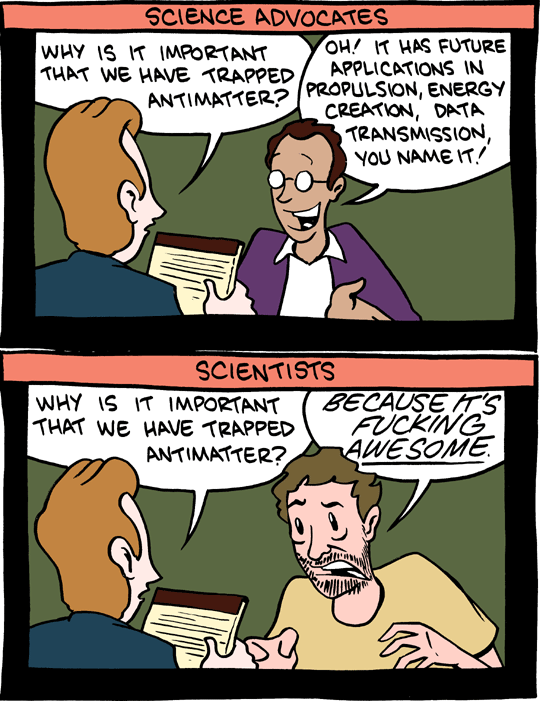
Reminds me of this. https://www.smbc-comics.com/comics/20101209.gif
I am curious what the author thinks about the same problem in pharma/biotech. On the one hand, they are kind of _forced_ to do research in one form or another to power the pipelines, so clearly corporate research is still alive there. However, given the pathetic track record the industry seems to hace, and arguably complete lack of any real innovation (almost all of the drugs in most pipelines are just antibodies or…
Holdup. Lack of anti-trust enforcement is blamed (among other things) for the end of corporate R&D, but Monopoly breakup is exactly what killed Bell labs! 9 smaller companies weren't going to fund their own lab, and the only reason the lab existed was to find new markets to explore. In fact, nearly all of the examples of successful R&D labs came from corporations that so dominated their industry they put money into f…
Maybe we should not hold on to the bureaucracy patents bring. Especially considering in some countries international patent are used as recipe to copy innovations.
Tesla has moved their patents into open source because they are under the opinion that competition is won by attracting the best engineers.
> Elon Musk: "After Zip2, when I realized that receiving a patent really just meant that you bought a lottery ticket to a lawsuit, I avoided them whenever possible."
https://www.tesla.com/en_GB/blog/all-our-patent-are-belong-y...
Holdup. Lack of anti-trust enforcement is blamed (among other things) for the end of corporate R&D, but Monopoly breakup is exactly what killed Bell labs! 9 smaller companies weren't going to fund their own lab, and the only reason the lab existed was to find new markets to explore. In fact, nearly all of the examples of successful R&D labs came from corporations that so dominated their industry they put money into f…
Very good points. I think we (I, maybe) default to the mistake of thinking in terms of "one big systemic explanation." Ultimately, something like investment in or success at innovation doesn't follow strict rules. The factors that go into it tend to be local. Any practicable "Theory of Innovation" is likely to be true locally, at best. A few years back Neil Degrasse Tyson, advocating for a re-funding of the NASA spac…
R&D has been rising globally for over 70 years with no major declines. Globally, $1.7 trillion USD a year is currently spent on RD; roughly 2% of the global GDP. There is more research going on right now than at any point in history at any scale.
R&D, similar to startups, is full of broken dreams, surviver bias, etc. — those complaining their source of funding dried up, they never got lucky, etc.
There is no magic recipe for success in R&D — and anyone that tells you they are able to outperform the market at scale as it relates to R&D outcomes is lying.