My main concern with this would be the security and W3 standard support. Browser engines and whatnot do make your life easy, but they add a lot of attack vectors. Also the support for W3 standard is usually limited and incomplete. Also it seems that the engine itself is distributed as binary only? I can't find source anywhere. That's a -1 for security.
Sciter – Multiplatform HTML/CSS UI Engine for Desktop and Mobile Applications
21–30 of 77 posts
Re: Sciter – Multiplatform HTML/CSS UI Engine for Desktop and Mobile Applications
#22HTML/CSS based native interfaces are some of the hardest to use, least reliable, least accessible, least robust interfaces I encounter; The demo interfaces on their website all fit into the unusable pot. I admit most/all of the interfaces I've personal used are using electron/webkit/ie to render which are all quite bloated. Is this different? It's not entirely clear and would be an important differentiator. I still d…
I had a similar discussion on reddit a long time ago, and posted this screenshot of various Linux music players compared to Spotify. https://i.imgur.com/K44tJ2Y.png Lots of native UIs (especially from the past) tend to all have the same "grey boxes" look. I don't see how that's universally better. Another example was this part of Slack UI https://i.imgur.com/O71fdP5.png - how would you even do something like that wit…
As a backend dev, I find that the most annoying part. I don't want free-form; I want something I can put together in a few minutes without having to think about design and it still having it look acceptable on the platform I deploy it on. On the web I can do that with bootstrap (and it's 100.000s of themes), native I can do this with the native libraries but in the html5-for-desktop-apps space it seems I have to spend time on doing stuff I don't want to do or even care about to make it look anything different than vomit; that is simply not worth the time. I know that is very different from your use-case, so not saying you are wrong or anything, just that this is what annoys me about html/css. I think there would be a market for 'electron desktop themes' like (1) (basically unsupported now) but seems there is not (or no-one finds it necessary anyway; maybe i'm the only one with this 'issue', well, me and all my colleagues that is).
Re: Sciter – Multiplatform HTML/CSS UI Engine for Desktop and Mobile Applications
#23I have never used this but something better for GUI would be great even if commercial; what I miss (as a native GUI dev) with all(? if you know any besides framework7 which is basically only mobile) of these html/css frameworks is that there is no equivalent of a control library that can be rapidly used without using (bucketloads) of css. When you browse the examples you see that most have some desktop controls like…
Another discussion from today (React Native Windows / Mac) https://news.ycombinator.com/item?id=23160075 Not web/HTML though, uses native widgets directly (mostly).
Re: Sciter – Multiplatform HTML/CSS UI Engine for Desktop and Mobile Applications
#24HTML/CSS based native interfaces are some of the hardest to use, least reliable, least accessible, least robust interfaces I encounter; The demo interfaces on their website all fit into the unusable pot. I admit most/all of the interfaces I've personal used are using electron/webkit/ie to render which are all quite bloated. Is this different? It's not entirely clear and would be an important differentiator. I still d…
I had a similar discussion on reddit a long time ago, and posted this screenshot of various Linux music players compared to Spotify. https://i.imgur.com/K44tJ2Y.png Lots of native UIs (especially from the past) tend to all have the same "grey boxes" look. I don't see how that's universally better. Another example was this part of Slack UI https://i.imgur.com/O71fdP5.png - how would you even do something like that wit…
One can preach about "brand identity" the whole day, but as a user, I couldn't care less about your brand. Integrate or die!
Re: Sciter – Multiplatform HTML/CSS UI Engine for Desktop and Mobile Applications
#25Earlier quoted context omitted.
I had a similar discussion on reddit a long time ago, and posted this screenshot of various Linux music players compared to Spotify. https://i.imgur.com/K44tJ2Y.png Lots of native UIs (especially from the past) tend to all have the same "grey boxes" look. I don't see how that's universally better. Another example was this part of Slack UI https://i.imgur.com/O71fdP5.png - how would you even do something like that wit…
I'm not 100% sure but I think the slack design can be achieved in wxWidgets. Yes the native apps look bland but why would I use an app that requires 500M to play music?
Also, it's more like 200 MB on my computer, most of which is predictably CEF. In comparison bundling Qt dlls would also add like 50MB if I remember correctly.
Re: Sciter – Multiplatform HTML/CSS UI Engine for Desktop and Mobile Applications
#26HTML/CSS based native interfaces are some of the hardest to use, least reliable, least accessible, least robust interfaces I encounter; The demo interfaces on their website all fit into the unusable pot. I admit most/all of the interfaces I've personal used are using electron/webkit/ie to render which are all quite bloated. Is this different? It's not entirely clear and would be an important differentiator. I still d…
I had a similar discussion on reddit a long time ago, and posted this screenshot of various Linux music players compared to Spotify. https://i.imgur.com/K44tJ2Y.png Lots of native UIs (especially from the past) tend to all have the same "grey boxes" look. I don't see how that's universally better. Another example was this part of Slack UI https://i.imgur.com/O71fdP5.png - how would you even do something like that wit…
In 90s this was solved by using "skins" which were actually drawn in graphics programs and then spliced and edited in some proprietary editor and/or positioned by hand crafted config file.
See https://winampheritage.com/skin for example. You can't go more original than these. :-D
I don't see a point why you would need web library for this.
Re: Sciter – Multiplatform HTML/CSS UI Engine for Desktop and Mobile Applications
#27Earlier quoted context omitted.
I had a similar discussion on reddit a long time ago, and posted this screenshot of various Linux music players compared to Spotify. https://i.imgur.com/K44tJ2Y.png Lots of native UIs (especially from the past) tend to all have the same "grey boxes" look. I don't see how that's universally better. Another example was this part of Slack UI https://i.imgur.com/O71fdP5.png - how would you even do something like that wit…
Nearly every native UI framework I’ve touched allows for a rich customized look of UI components. Often this means subclassing an abstract view thing that opens a toolbox of fine grained drawing commands. Your examples of boring native UI is the result of developers that don’t bother to exploit these features for whatever reasons- probably because it can be extremely time consuming to build native custom UI and adds…
Take for example that "Jump to" text box - if your native UI toolkit doesn't let you add icons into the placeholder text like that (does it even have placeholder text natively?), you'll have to deal with drawing offsets, caret position, or possibly nested components, overriding focus outline, in the worst case resizing the stuff when focused, and other stuff that makes the whole endeavor not worth it due to the added complexity (assuming that text box works how I think it works, I haven't used Slack in a while).
Re: Sciter – Multiplatform HTML/CSS UI Engine for Desktop and Mobile Applications
#28I have never used this but something better for GUI would be great even if commercial; what I miss (as a native GUI dev) with all(? if you know any besides framework7 which is basically only mobile) of these html/css frameworks is that there is no equivalent of a control library that can be rapidly used without using (bucketloads) of css. When you browse the examples you see that most have some desktop controls like…
Another discussion from today (React Native Windows / Mac) https://news.ycombinator.com/item?id=23160075 Not web/HTML though, uses native widgets directly (mostly).
In this regard even Visual Basic was far ahead of most of today's client tech. HTML/CSS/JS are not even close to be called a serious GUI stack for applications despite they are used for that as the Web ate the world.
Re: Sciter – Multiplatform HTML/CSS UI Engine for Desktop and Mobile Applications
#29HTML/CSS based native interfaces are some of the hardest to use, least reliable, least accessible, least robust interfaces I encounter; The demo interfaces on their website all fit into the unusable pot. I admit most/all of the interfaces I've personal used are using electron/webkit/ie to render which are all quite bloated. Is this different? It's not entirely clear and would be an important differentiator. I still d…
I had a similar discussion on reddit a long time ago, and posted this screenshot of various Linux music players compared to Spotify. https://i.imgur.com/K44tJ2Y.png Lots of native UIs (especially from the past) tend to all have the same "grey boxes" look. I don't see how that's universally better. Another example was this part of Slack UI https://i.imgur.com/O71fdP5.png - how would you even do something like that wit…
it's not "grey box", it's "uses the native theme of the user's desktop". e.g. I use strawberry music player, if I am on a computer with a dark theme it's dark.
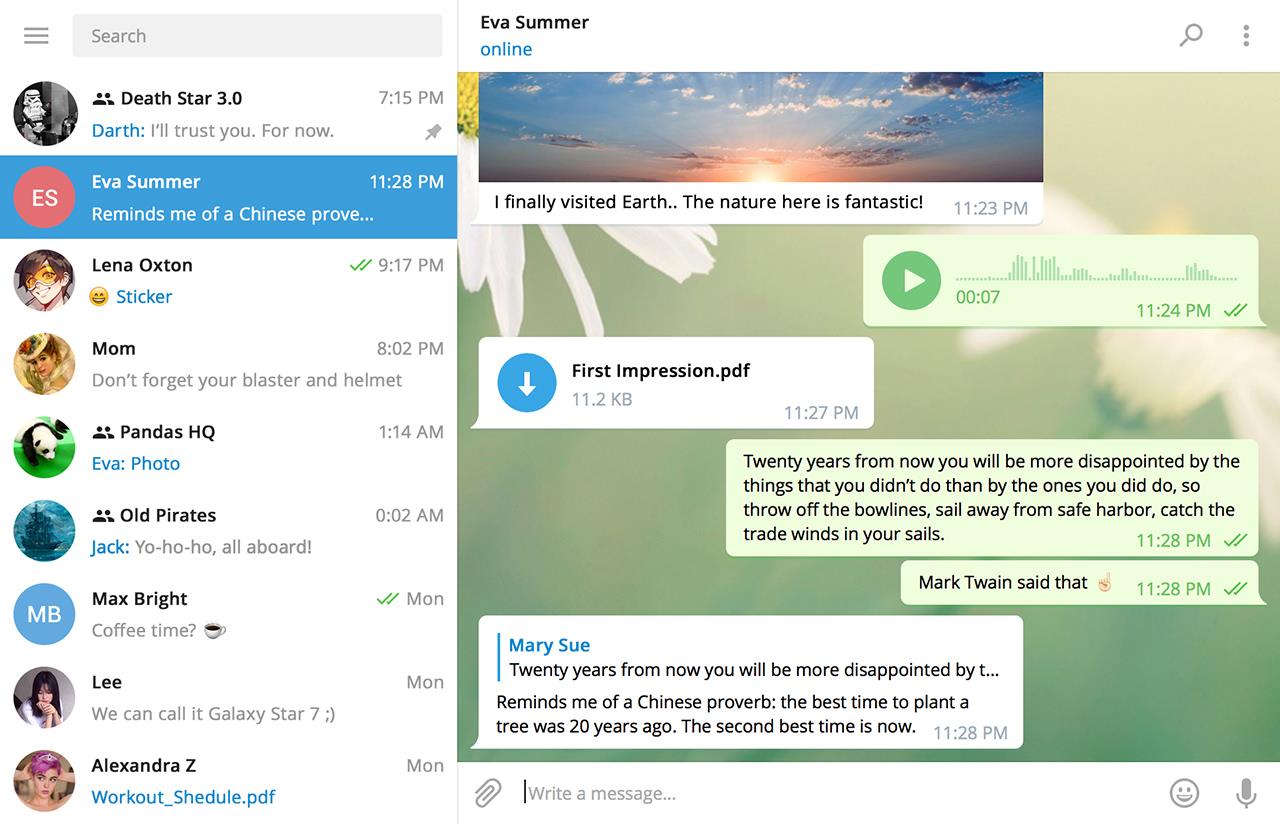
Qt definitely allows slack-like look though if the developer opts-in to it - e.g. Telegram Desktop (https://cdn2.nextinpact.com/images/bd/news/163843.jpeg) is made with Qt Widgets.
Ripcord is another Qt app which is a discord / slack client made by a single guy, which goes more for the native look'n'feel : https://cancel.fm/ripcord/
(contrast this with slack needing dozens of developers and being at their third rewrite of the app because of performance issue :-))
Re: Sciter – Multiplatform HTML/CSS UI Engine for Desktop and Mobile Applications
#30Earlier quoted context omitted.
Nearly every native UI framework I’ve touched allows for a rich customized look of UI components. Often this means subclassing an abstract view thing that opens a toolbox of fine grained drawing commands. Your examples of boring native UI is the result of developers that don’t bother to exploit these features for whatever reasons- probably because it can be extremely time consuming to build native custom UI and adds…
I'm not saying it can't be done, I'm saying it would take a lot more effort (by a huge amount, plus more in prototyping phase of development when you're trying stuff out), and in the process you will likely lose many of the advantages of native UI that were mentioned (consistent behavior etc.). Take for example that "Jump to" text box - if your native UI toolkit doesn't let you add icons into the placeholder text lik…
It would still look mostly native (even though it's clearly not a native control), be very performant and use a tiny amount of memory.