Live data from Hacker News

Holocene Extinction

en.wikipedia.org

71–80 of 136 posts

Re: Holocene Extinction

#71
post #48

Earlier quoted context omitted.

May I kindly ask, why do you feel the need to jump out and defend the human species as also being good in the face of what is described in the article? I am genuinely interested in understanding what motivates this reaction.

You are here, so obviously you feel "good" enough and worthy to exist. With population control its always the "others" need to be eliminated. No one wants to start with themselves. Its an extremely selfish position really. Its also not very logically viable, since those that feel the world is over populated and kill themselves, will just be selected out of the gene pool. Leaving only those that want to live, procreat…

there is no need to kill oneself. but making a start by not choosing the ego-project of procreation would already make a huge difference. if people really want to have children there are enough orphans out there and which would make the world better by raising them instead.
Re: Holocene Extinction

#72

A huge chunk of our net impact on global warming and deforestation is a direct result of our food system, namely animal agriculture. There is disagreement about just how inefficient turning an acre of corn into slabs of cow, but it should be clear that it is some fraction of the efficiency of just eating that corn as food itself.

I'm always amazed how good the fruit and vegetables look, but how little flavour they have when bought from super market here, compared to Europe, or actually most parts of the world where vegetables are grown locally and organically.

Very sour unripe oranges, bananas, grapes, flavourless green peppers, tasteless tomatoes. Pretty much the norm in Supermarkets.

Re: Holocene Extinction

#73
I'm optimistic that a few things will help save us from ourselves: lab grown meat, electric cars, and solar power.

My undergrad degree is in biology and it was depressing to learn how humans have eviscerated nature. I remember joking with a classmate during my evolution class saying "what way are we going to learn about how humans destroyed nature today?"

Re: Holocene Extinction

#74

Struggling to find a word for it, but it’s obvious that humans lack the will collectively to avoid certain types of systemic multigenerational issues. Climate change is the most obvious, but there’s long list of issues like this that if suddenly every human on Earth magically expected to live 1000 to 10,000 years would become more pressing issues. As a semi-futurist, this is the core issue, it’s not that humans don’t…

> the issue is that humans simply do not care about the future.

I think that's overstated. Many only look to their /own/ future, not the species/collective. Maybe the family unit, so humans with children may have a longer term outlook. Also, many people's economic situation makes immediate or short term needs (food, shelter etc.) more pressing. I agree that current trends are disheartening.

Re: Holocene Extinction

#75

Struggling to find a word for it, but it’s obvious that humans lack the will collectively to avoid certain types of systemic multigenerational issues. Climate change is the most obvious, but there’s long list of issues like this that if suddenly every human on Earth magically expected to live 1000 to 10,000 years would become more pressing issues. As a semi-futurist, this is the core issue, it’s not that humans don’t…

Even if humans did care, that doesn't mean they could organize a meaningful response.

COVID-19 is affecting people right now. It, and other viruses like the flu, are just a giant rhythm game: if everyone could be isolated for 2 weeks, it would be over in 2 weeks, and we'd never have to deal with it ever again.

We just have a fundamental coordination problem. A lot of foresight and resources are required, and only a Central Overmind that mind-controls everyone would be a practical way to implement that kind of coordination. When the price of non-coordination is extremely jacked up, like in a crazy future where anyone can cook up an antimatter bomb or an extinction-tier supervirus (or super AI?) at home, it's obvious that the only tenable mode of operation is massive surveillance + censorship (and perhaps hivemind motor control) by a Central Overmind. :D

Re: Holocene Extinction

#76

Many times there is a heavy dose of misanthropy in these environmental discussions. Phrases like "humanity is a virus", etc. I would like to share a different perspective.There is a saying, "It is better to have loved and lost, than never to have loved at all." Even if humanity overburdens the planet and goes extinct in the next 100 years, I prefer what we have now, than if we had remained hunter-gatherers or pre-ind…

I have noticed that this claim (that our current system is a net positive) is not frequently uttered by indigenous Americans, or for that matter indigenous people anywhere.

Re: Holocene Extinction

#77
post #42

Earlier quoted context omitted.

When people talk about climate, resources, ecology etc. people are typically quite optimistic until you bring up the idea of "sustainability". The typical reply is something like "oh, we'll get there one day, it's certainly possible in the future.." but the idea of that sustainability is something we can put off is rather absurd, in the most technical sense. Sustainability is the border between two ways of life. The…

I agree. And the other thing too is nobody wants to hear about the prospect of overpopulation. In fact, I think most of our problems stem from this. Bill Gates, for example, says we can "feed 12 billion people". Ok sure, but at what cost to the planet and our quality of life? Others say "the whole population could fit in an area the size of Texas". Or they look at Hong Kong density and say "it's possible". But I don'…

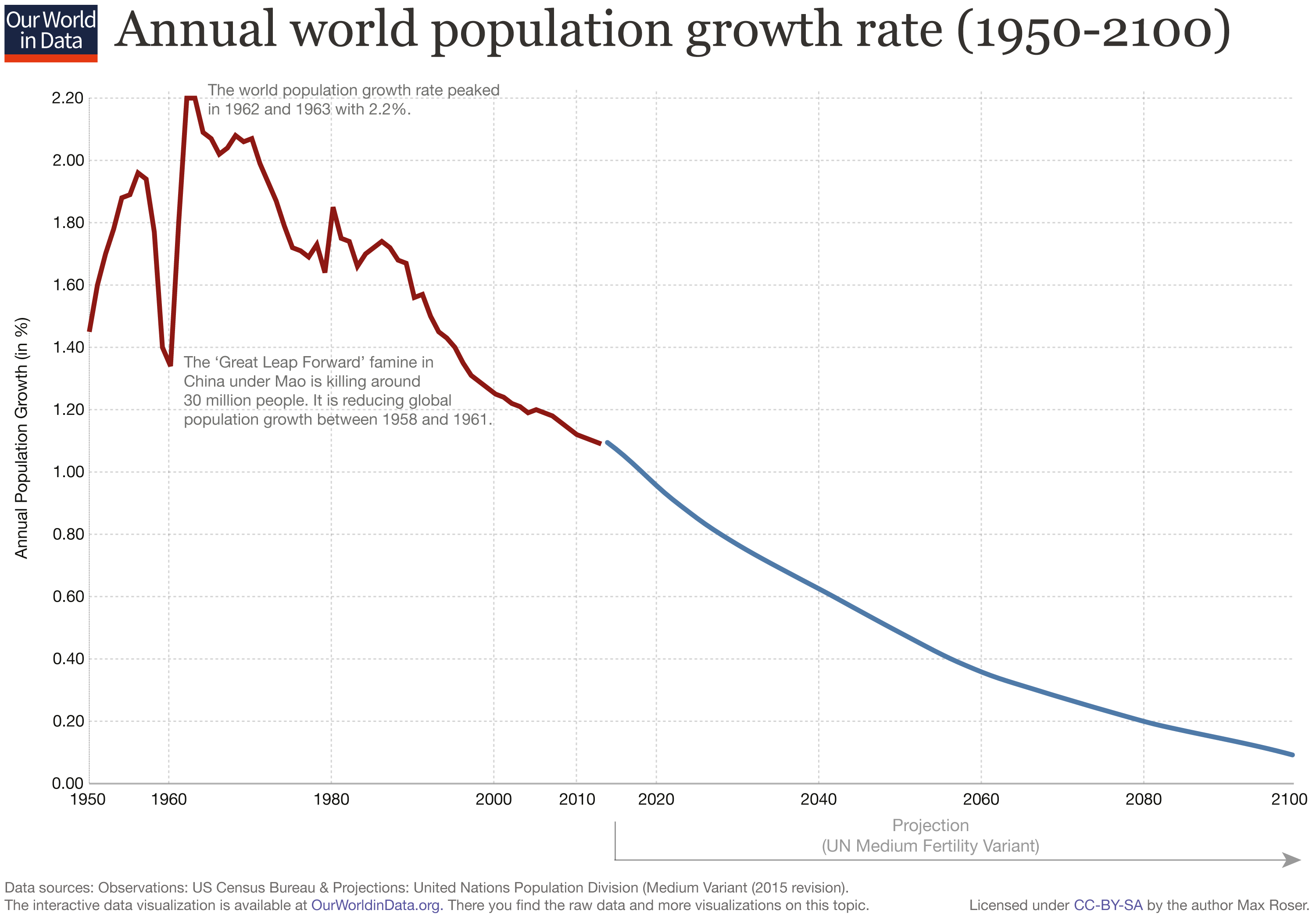
World population growth has plummeted. You should be pleased. https://ourworldindata.org/uploads/2013/05/Updated-World-Pop.... That drop in growth was not achieved by impact of war, disease or starvation but by economic activity of the kind you think is an 'issue'. People want to trade and better themselves. When they do this, dramatic improvements can result at all levels. You're hardly able to take an interest in protecting and nurturing your environment when you're poor. Note how it's the middle and upper classes in the West who largely comprise the environmental action groups across the world. The poor are too busy just surviving. 19th century families in the UK (one of the richest countries in the world at the time) were large because 15% of babies under 1 year, died.

Hans Rosling: bedrooms drive economies.

Re: Holocene Extinction

#78

A huge chunk of our net impact on global warming and deforestation is a direct result of our food system, namely animal agriculture. There is disagreement about just how inefficient turning an acre of corn into slabs of cow, but it should be clear that it is some fraction of the efficiency of just eating that corn as food itself.

What about in the case where animals can extract more nutrients from plant food than we can? Cows in particular have specially built stomachs that can extract nutrients from plants than we can. I don't think this would be enough to make eating meat more efficient, but it may be necessary to eat some meat to get nutrients you wouldn't otherwise get from plants.

Re: Holocene Extinction

#79
post #3

This makes me wonder if perhaps sentient life/civilisation is simply incompatible with nature by default. That doesn't make the former bad or mean that we shouldn't try and preserve the nature world, just that I suspect any species that evolves to be like humanity is probably going to have a similar effect on its ecosystem. Any alien world with a sentient species might also be in a similar situation for many of the s…

We _are_ nature and have no more control over our destiny than ants do.

The word "nature" is meant to specifically exclude humans so the argument "we are nature" is self-defeating

Re: Holocene Extinction

#80

Struggling to find a word for it, but it’s obvious that humans lack the will collectively to avoid certain types of systemic multigenerational issues. Climate change is the most obvious, but there’s long list of issues like this that if suddenly every human on Earth magically expected to live 1000 to 10,000 years would become more pressing issues. As a semi-futurist, this is the core issue, it’s not that humans don’t…

Even if humans did care, that doesn't mean they could organize a meaningful response. COVID-19 is affecting people right now. It, and other viruses like the flu, are just a giant rhythm game: if everyone could be isolated for 2 weeks, it would be over in 2 weeks, and we'd never have to deal with it ever again. We just have a fundamental coordination problem. A lot of foresight and resources are required, and only a C…

> and perhaps hivemind motor control) by a Central Overmind.

I volunteer to be the Lead DevOps engineer who looks after the Central Overmind.

Post reply on HN