Live data from Hacker News

History of Logo

escholarship.org

21–30 of 89 posts

Re: History of Logo

#21

Here is the source code to LLogo in MACLISP, which I stashed from the MIT-AI ITS system. It's a fascinating historical document, 12,480 lines of beautiful practical lisp code, defining where the rubber meets the road, with drivers for hardware like pots, plotters, robotic turtles, TV turtles, graphical displays, XGP laser printers, music devices, and lots of other interesting code and comments. https://donhopkins.com…

Also running on the emulator: PDP-10 Logo, PDP-11 Logo, Applle II Logo.

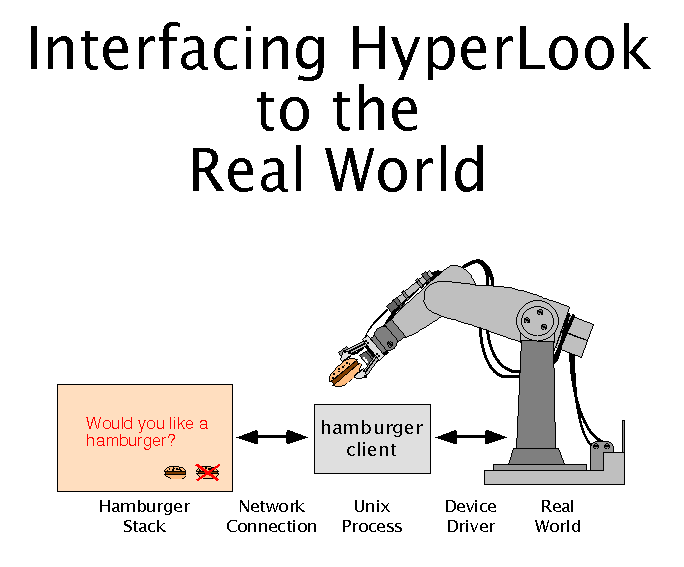
The emulator doesn't support the robot arm yet.
Re: History of Logo

#22

Here is the source code to LLogo in MACLISP, which I stashed from the MIT-AI ITS system. It's a fascinating historical document, 12,480 lines of beautiful practical lisp code, defining where the rubber meets the road, with drivers for hardware like pots, plotters, robotic turtles, TV turtles, graphical displays, XGP laser printers, music devices, and lots of other interesting code and comments. https://donhopkins.com…

Also running on the emulator: PDP-10 Logo, PDP-11 Logo, Applle II Logo. The emulator doesn't support the robot arm yet.

I have nightmares about that! ;)

https://donhopkins.com/home/catalog/hyperlook/TalkInterfacin...

Re: History of Logo

#23

There's a StrangeLoop talk about teaching programming by Felienne Hermans ( https://www.youtube.com/watch?v=g1ib43q3uXQ ) that claims that all fields have an "exploration vs instruction" debate on how to teach their field, but this debate is apparently absent from the field of programming for the most part, wherein the "mess around and figure it out" exploration style of LOGO and Papert ("every time you teach somethi…

OT, but Felienne has a great talk on functional programming in Excel (thanks for reminding me of her name): https://www.youtube.com/watch?v=0yKf8TrLUOw

Re: History of Logo

#24
My first exposure to computers was through Logo in 1992!

Thinking back, it was really effective in grabbing your attention and making you want to experiment with different commands!

This is a good reminder that Logo is still a great teaching tool, especially for kids.

I suppose python + turtle can replicate the effect to some degree as well.

https://docs.python.org/3/library/turtle.html

Re: History of Logo

#25
post #6

Logo was a hard pill to swallow in the 1980's. It had some neat features 'on paper' but it was hard to appreciate them because it was agonizingly slow on the computers of the day. It was the first programming experience I ever had where I'd type in my function, and then had to wait a while for the computer to do something to it (it never used the word "compiler"), and then it could run. I remember thinking: this make…

I never really thought of LOGO as a programming language as a kid. It just seemed like a game to me. I also had no concept of anything with a computer being fast or slow so its speed seemed normal.

That's an interesting connection. Logo claimed to be "interactive" but staring at a compilation log go by for 30 or 60 (or more) seconds really pushed the limits of what one might consider "interactive".

Whereas, "Robot Odyssey" was an actual game, and it was a terrific way to get me even more interested in programming. You never had to just sit and wait on it -- or maybe you did but they disguised it so well with animation or loading screens or whatever that I never noticed.

Re: History of Logo

#26
post #25

Earlier quoted context omitted.

I never really thought of LOGO as a programming language as a kid. It just seemed like a game to me. I also had no concept of anything with a computer being fast or slow so its speed seemed normal.

That's an interesting connection. Logo claimed to be "interactive" but staring at a compilation log go by for 30 or 60 (or more) seconds really pushed the limits of what one might consider "interactive". Whereas, "Robot Odyssey" was an actual game, and it was a terrific way to get me even more interested in programming. You never had to just sit and wait on it -- or maybe you did but they disguised it so well with an…

I don't remember the details but I remember some of the kids who were good at math would get to go to the computer room sometimes and instead of math class and we'd make LOGO programs or do other stuff on Commodore PETs. Just seemed like fun. We each had to bring our own disk with our name on it. This was like 2nd and 3rd grade.

Re: History of Logo

#27
post #12

Earlier quoted context omitted.

Even in 2020, I was pleasantly surprised that my kids school teaches Logo at the elementary school level! However, I had a hard time convincing parents who were suggesting it to be replaced with Python or a more modern programming language :(

You lucky! My kid's school teaches Delphi/TurboPascal (8. grade, first programming language course), which they replaced with Lazarus unable to install Delphi on modern PCs.

On one hand, Lazarus and Free Pascal are great so it is nice to see it being used as an introduction to programming.

On the other hand... Lazarus is way too complicated for someone's first foray into programming, IMO. The IDE throws at you a barrage of windows, buttons, lists, etc that can be almost as overwhelming as an airplane's cockpit :-P.

I always maintained that Free Pascal should either ditch the text mode IDE (outside of looking weird to anyone who didn't grew up with Turbo Pascal, almost no terminal/console works reliably enough for it and even in cases where it works, the IDE itself is very buggy - especially in the recent versions) and develop a simple GUI-based one akin to Turbo Pascal for Windows (ie. something that focuses only on small-sized programs) and have Lazarus as the "next step". Hell, it could even be based on Lazarus since most of its functionality is in the form of reusable components.

Re: History of Logo

#28
post #12

Earlier quoted context omitted.

You lucky! My kid's school teaches Delphi/TurboPascal (8. grade, first programming language course), which they replaced with Lazarus unable to install Delphi on modern PCs.

On one hand, Lazarus and Free Pascal are great so it is nice to see it being used as an introduction to programming. On the other hand... Lazarus is way too complicated for someone's first foray into programming, IMO. The IDE throws at you a barrage of windows, buttons, lists, etc that can be almost as overwhelming as an airplane's cockpit :-P. I always maintained that Free Pascal should either ditch the text mode ID…

> I always maintained that Free Pascal should either ditch the text mode IDE

Why not fix the bugs instead? And it shouldn't look weird to anyone who has used TUI programs. In fact, we really should have support for these TUI features (stackable text windows, mouse-controlled menubar and widgets, context-sensitive status-bar) right inside emacs, or some other generic editor. They have stood the test of time wrt. intuitiveness and ergonomics, and it's weird that we still lack them in terminal-like environments.

Re: History of Logo

#29
Logo was definitely my introduction to programming. Never thought of it as programming. Lots of fun. We tried to make an animation with it as a kid.
Post reply on HN