Live data from Hacker News

10-core i9-10900F desktop CPU lags behind 8-core Ryzen 9 4900HS mobile APU

notebookcheck.net

91–100 of 148 posts

Re: 10-core i9-10900F desktop CPU lags behind 8-core Ryzen 9 4900HS mobile APU

#91
post #85
post #73

Earlier quoted context omitted.

Yeah TDP is calculated differently for Intel and AMD, usually to make Intel look better. It makes it harder to compare because hardware components are going to be different (e.g. different mobo, different memory, etc) but they should measure wattage out the wall.

Intel's is roughly "the thermal dissipation required to maintain base clock speeds indefinitely without thermal throttling". AMD's is roughly "the thermal dissipation required for all-core turbo indefinitely". In recent generations (since AMD's Zen architecture), AMD is much closer in testing to their published numbers than Intel is. It is important to note that this is a thermal specification, rather than a power co…

Gamers Nexus has a video & article explaining how TDP is primarily a marketing term.

https://www.gamersnexus.net/guides/3525-amd-ryzen-tdp-explai...
Re: 10-core i9-10900F desktop CPU lags behind 8-core Ryzen 9 4900HS mobile APU

#92
post #87

Earlier quoted context omitted.

> There are Thunderbolt 3 AMD motherboards currently even, just only on desktop where it's borderline pointless. Here's a setup which takes advantage of TB3 on the desktop. I think this is a compelling setup, though not something I aspire to. https://www.youtube.com/watch?v=wQMCvQ01e80

I do like that setup but it doesn't actually need TB3, as a follow-up video from LTT showed: https://www.youtube.com/watch?v=jvzeZCZluJ0

Certainly not necessary. TB looks to be a bit more economical. The fiber setup is pricey in the second video.

I do love the idea of being distant from primary compute. I run a Threadripper desktop and my mobile option is an old, low-powered laptop from which I can remote into one of several environments hosted at home.

Re: 10-core i9-10900F desktop CPU lags behind 8-core Ryzen 9 4900HS mobile APU

#93

I'm really hoping apple puts these AMD mobile chips in their next MacBook Pro. At the moment I'm not seeing much reason to upgrade from my 2015 model, but if I could have 8 cores, that would a different matter...

I think Apple is already in the process of making their own chips. I'm thinking that they'll release an ARM chip for laptops. They are already blazing out on the mobile side.

Yeah and we already know, it won't be in any way better but it will cost you a 5digit number but it will look sooo nice.

Re: 10-core i9-10900F desktop CPU lags behind 8-core Ryzen 9 4900HS mobile APU

#94

Earlier quoted context omitted.

What would you use the GPU for in a home server?

Hardware accelerated h265/h264 decoding/encoding for media streaming and CCTV cameras.

An APU is fine for those things, you don't need a dedicated GPU.

Re: 10-core i9-10900F desktop CPU lags behind 8-core Ryzen 9 4900HS mobile APU

#95
post #38

The 65W is a bit misleading, according to https://www.techpowerup.com/265695/intel-core-i9-10900f-can-... and https://wccftech.com/intel-core-i9-10900f-10-core-desktop-cp... it is allowed to draw 170W in PL1 mode and up to 224W(!) in PL2 mode. Those numbers should feature prominently alongside the 65W figure. It does not look good for Intel at the moment.

Yes, Intel's "marketing TDP" is a complete sham.

You get completely different digits once you get full engineering datasheets under NDAs.

Intel's 5W "ultraportable" CPUs for examples go to 17W.

15W ones can boost well above 40W.

Re: 10-core i9-10900F desktop CPU lags behind 8-core Ryzen 9 4900HS mobile APU

#96
post #34
post #28

Earlier quoted context omitted.

> So where do I find the actual maximum power consumption on recent desktop CPUs then? Unfortunately you do this by putting it on a motherboard and and generally putting an amp meter on the 12v EPS rail. Either that or just power from wall. The CPU vendors have worked really hard to hide this. Mostly because for most people it's largely irrelevant these days as the CPU will scale to cooling and power delivery. There…

You'd think "power consumption for prolonged 100% all-cores workload" would be the most relevant thing when selling server chips specifically, though, since it translates directly into OpEx. And yet even on those data sheets it's nowhere to be found.

But what 100% workload? Is it 100% integer throughput? In which case it'll use a small fraction of the power of a blended integer & float workload. What about AVX-512? Is that considered 100% or beyond 100%? How much RAM is in play? Is it entirely an L1/L2 workload such that memory is never a bottleneck? Or is RAM used and then the CPU isn't really hitting maximum compute throughput? Or is it RAM reads & writes perfectly intermixed with integer & float computations that will always be L1/L2 cache hits, even though literally nothing will ever have that flawless of an execution in terms of power consumption?

With how much of a CPU is dynamically gated & power controlled there is a difference between "maximum theoretical draw" and "maximum a 'real world' 100% load" will hit.

Re: 10-core i9-10900F desktop CPU lags behind 8-core Ryzen 9 4900HS mobile APU

#97
post #24

Hmm I need some schooling please: "The TDP for the latter part is 35 W while the i9-10900F is listed at 65 W, but being an Intel desktop processor that just reflects the TDP for the base clock, with much higher energy demands required for higher clocks (e.g. maximum PL1 has been recorded at 170 W)." So where do I find the actual maximum power consumption on recent desktop CPUs then? Do I set a limit in the BIOS? Do I…

You look at measured draws for the relevant workloads. Anandtech has a good intro to the various states that an Intel CPU can be in here: https://www.anandtech.com/show/13544/why-intel-processors-dr...

For Intel specifically the TDP is what you need to dissipate to sustain the base frequency. If you want to run beyond base frequency (the "all core turbo"), then you need to handle more. How much more isn't officially documented, nor are the turbo charts either annoyingly (aka, this: https://en.wikichip.org/wiki/intel/core_i9/i9-9900k#Frequenc... )

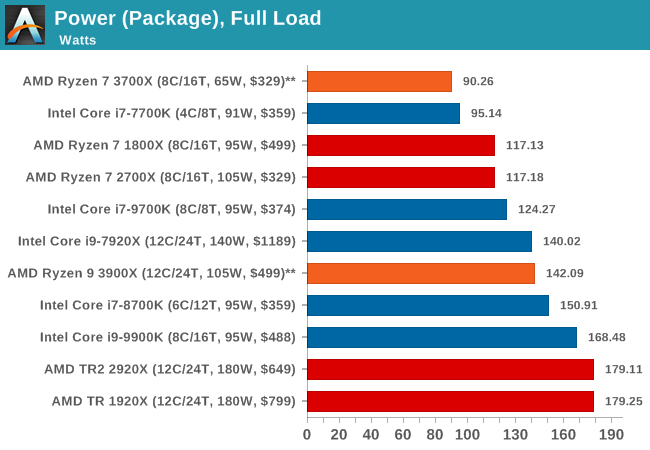
So for a 9900K looking the official numbers are 95W for 3.6GHz of all core load. But it'll turbo with all cores loaded up to 4.7GHz, for which you'll need some amount of cooling. How much? Well more than 95W that's for sure, but that's all you really officially know. So then you look at reviews and you find that under full load the 9900K pulls down ~170W if it's not hitting thermal limits: https://images.anandtech.com/graphs/graph14605/111362.png

Re: 10-core i9-10900F desktop CPU lags behind 8-core Ryzen 9 4900HS mobile APU

#99

Earlier quoted context omitted.

It is worth noting that this is the i9-10900F, not the i9-10900k (thank you, Intel, for the lovely naming scheme). I'd expect the -k variant to be at least as fast as the i9-9900k.

Also, 9900 was much easier to say... how do you pronounce 10900? "Ten-thousand-nine-hundred"? Feels tortured. "Ten-nine-hundred"? Yeesh.

On a related note, how do people pronounce the Intel 8088?

Eight oh eight eight? Eighty eighty eight?

Re: 10-core i9-10900F desktop CPU lags behind 8-core Ryzen 9 4900HS mobile APU

#100

I'm really hoping apple puts these AMD mobile chips in their next MacBook Pro. At the moment I'm not seeing much reason to upgrade from my 2015 model, but if I could have 8 cores, that would a different matter...

I think Apple is already in the process of making their own chips. I'm thinking that they'll release an ARM chip for laptops. They are already blazing out on the mobile side.

I'm actually rooting/hoping for AMD. They seem to be top of the line atm. I haven't seen much of ARM
Post reply on HN