Live data from Hacker News

IBM will offer free COBOL training

inputmag.com

151–160 of 235 posts

Re: IBM will offer free COBOL training

#151

Earlier quoted context omitted.

Not to mention GOTO. If your one of the people who hyperventilates when you see a goto because you learned that it was considered harmful in programmer school then Cobol might not be for you. ;) You might be surprised about the comments though - depending on the age of the codebase. Mainframes were rented back in the day, you paid by resources consumed, terminal time was precious, and mainframes were often turned off…

The terminals were turned off. The mainframe kept running. In the computer room, the second shift operators ran batch jobs, printed reports, and did backups. Didn't matter if the terminal was turned off or not either. The UI was burned into the phosphors.

>The UI was burned into the phosphors

Oh wow, so true, brought back many memories and also one of those overlooked aspects when you change a system as the previous burned in fields would with the right lighting create a whole avenue of data input errors that truly was a case of given the user a new monitor, which can be fun if your looking at it as a software issue in some new rollout. Yeah that can be a fun one and sometimes can't beat site visits as the local environment will never be replicated in any user transition training setup, however well it is done.
Re: IBM will offer free COBOL training

#152
post #21

It's a trap. The problem with those old codebases that governments, hospitals, big businesses are struggling with is not really the language, it's the engineering practices of that time with regards to constraints of old technology. The language is not the problem - lack of comments, bad variable naming, bad structure (little or no procedures or readability), and just sheer volume of it, is. It would be very interest…

Now imagine 30 years from now when you are going to have to track down the documentation for version X of the web framework for version Y of some language and version Z of frontend framework.

> Now imagine 30 years from

For the javascript ecosystem this is already true for projects that are > 2 year old.

Not kidding, try to build a 2 year old React web application, you'll see what I mean.

Re: IBM will offer free COBOL training

#153
post #21

It's a trap. The problem with those old codebases that governments, hospitals, big businesses are struggling with is not really the language, it's the engineering practices of that time with regards to constraints of old technology. The language is not the problem - lack of comments, bad variable naming, bad structure (little or no procedures or readability), and just sheer volume of it, is. It would be very interest…

Now imagine 30 years from now when you are going to have to track down the documentation for version X of the web framework for version Y of some language and version Z of frontend framework.

best documentation is getting the business logic mapped out and the code itself, along with data mapped-out with what does what to it when and how. As any code documentation will be out of date in way way or another, even best sites it will be case of getting that documentation and then mapping a few decades worth of change management, bug tracking and other avenues that modified that code.

I will say though, every migration project I worked up, the documentation was carefully worded in the contract as being the customers liability and with that, code gets migrated logic for logic, bug for bug and testing so anal that it will show that what goes in is the same that comes out in the migrated code. That and the business documentation will still be good, even much of the code documentation if high enough level, but the code itself will be the best documentation.

Until we get a standard in which the documentation produces the code and all changes done to the documentation over quickly hacking the code, the disparity between any documentation and the code will always be adrift.

So you see many bespoke solutions to go thru the code and produce documentation from that to varying levels of success, however that success for one sites quirks in code may not work as well with others.

Hence even the best documentation will wisely get treated with a pinch of salt and in many instances, be like comparing a book to the movie it spawned in many ways, some close to the original, many not even close. That is documentation and code in a nutshell.

Always best to map the data first and that can be done easier and more automated, more so databases and generating a schema and then map what code talks with what and gradual get to see what is happening.

Re: IBM will offer free COBOL training

#154
All this, Cobol programmers are in short supply and now let's train new ones, sounds like a sort of technical debt bailout.

As some have noted management has failed to look to the future and now their business has a major problem they are struggling to deal with. Same as we debate not bailing out, financially, companies that failed to plan for future disaster or catastrophies I would argue we don't bail out these companies that failed to maintain their own internal technical architectures by planning for upgrades and future maintenance.

It's akin to the BS ISPs argue about not being able to afford to maintain it upkeep their infrastructure. It's largely BS. Put less in the upper managements pocket and more in the business and all of a sudden the business works and has resiliency against unexpected events. If you don't think these "vital" banks and hospitals can't afford it then you haven't been paying attention.

Re: IBM will offer free COBOL training

#155
post #31
post #21

It's a trap. The problem with those old codebases that governments, hospitals, big businesses are struggling with is not really the language, it's the engineering practices of that time with regards to constraints of old technology. The language is not the problem - lack of comments, bad variable naming, bad structure (little or no procedures or readability), and just sheer volume of it, is. It would be very interest…

> keeping the old UI and UX (which often is incredibly ergonomic) I have the feeling that with the success of the iPhone many people forgot that a thing like a UI can have a target audience as well. If you make a tool that is beeing used twice a week for a minute at a time it has to look fundamentally different from a tool that is used 50 times every day. With the former beeing intuitive is more valuable, while with…

>People just make a UI that is akin to the ones Google or Apple make and call it a day.

It's worse than that. Lots of people involved in the creation of software don't just follow the trends, they have internalized the idea a UI exposing any complexity is inherently bad. That if something can't be easily expressed in the interaction language currently fashionable in mobile, then it must be a misfeature.

A distant but perhaps illustratively analogous example can be seen in non-nerdy teens and young adults. Take one that does class writing assignments in a google doc on their phone (they're not hard to find, you can even find some that try to do CAD on mobile devices). Try suggesting that if they learned to properly touch type on a real keyboard they'd find the whole process easier and faster. Then tell them apple's bluetooth keyboard can pair to iPhones. Compare the reactions.

tl;dr: In the TV show Metalocalypse the characters derisively called acoustic guitars "grandpa's guitars." That's the UX world in a nutshell.

Re: IBM will offer free COBOL training

#156
post #21

It's a trap. The problem with those old codebases that governments, hospitals, big businesses are struggling with is not really the language, it's the engineering practices of that time with regards to constraints of old technology. The language is not the problem - lack of comments, bad variable naming, bad structure (little or no procedures or readability), and just sheer volume of it, is. It would be very interest…

> It would be very interesting to see the old systems rewritten in a modern language, with modern engineering practices, but keeping the old UI and UX (which often is incredibly ergonomic) - so as to limit scope and not mess it all up by trying to introduce mouse navigation and windowing mess.

I was the tech lead on one of these projects. Personally I was sad and frustrated we had to keep the old UX/UI. I would have much rather have made something more ergonomic for our users. Alas retraining would have been too expensive to do that even though it would have been probably more intuitive.

I do agree with you that there is some benefit to being able to do everything on a keyboard without having to deal with the baggage of what we consider modern.

Re: IBM will offer free COBOL training

#157
post #21

It's a trap. The problem with those old codebases that governments, hospitals, big businesses are struggling with is not really the language, it's the engineering practices of that time with regards to constraints of old technology. The language is not the problem - lack of comments, bad variable naming, bad structure (little or no procedures or readability), and just sheer volume of it, is. It would be very interest…

Not to mention GOTO. If your one of the people who hyperventilates when you see a goto because you learned that it was considered harmful in programmer school then Cobol might not be for you. ;) You might be surprised about the comments though - depending on the age of the codebase. Mainframes were rented back in the day, you paid by resources consumed, terminal time was precious, and mainframes were often turned off…

> Mainframes were rented back in the day, you paid by resources consumed

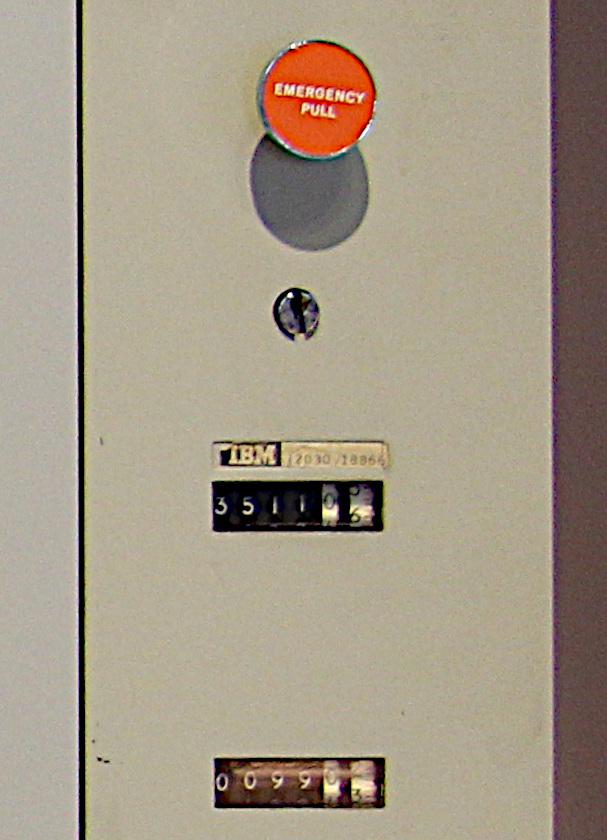
To expand on that, IBM used to rent mainframes based on a 40-hour week. The computer had a usage meter (like a car odometer) that would keep track of how much time the computer was running. If the meter ran over, you would be billed for the excess charge.

The computer actually had two usage meters, with a key to select between them. When an IBM service engineer maintained the system, they used their key to switch from the customer meter to the maintenance meter. Thus, customers weren't charged for the computer time during maintenance.

One interesting thing I noticed about the IBM 1401 is that it's built from small circuit boards (SMS cards) that are easily pulled out of the backplane for replacement. Except the cards driving the usage meter. Those cards are riveted into place so they can't be removed. Apparently some customers discovered that they could save money by pulling out the right cards and disabling the meter.

Re: IBM will offer free COBOL training

#158
post #157

Earlier quoted context omitted.

Not to mention GOTO. If your one of the people who hyperventilates when you see a goto because you learned that it was considered harmful in programmer school then Cobol might not be for you. ;) You might be surprised about the comments though - depending on the age of the codebase. Mainframes were rented back in the day, you paid by resources consumed, terminal time was precious, and mainframes were often turned off…

> Mainframes were rented back in the day, you paid by resources consumed To expand on that, IBM used to rent mainframes based on a 40-hour week. The computer had a usage meter (like a car odometer) that would keep track of how much time the computer was running. If the meter ran over, you would be billed for the excess charge. The computer actually had two usage meters, with a key to select between them. When an IBM…

I found a picture of the meters for those that are curious - http://static.righto.com/images/ibm-360/epo-30.jpg

Re: IBM will offer free COBOL training

#159
post #28

Do you really want to end up in a situation where you're in a position of maintaining someone else's ancient codebase? I guarantee you this is not a path to anywhere but misery.

As a freelancer who does this 2 out of 3 jobs, I can tell you is definitely fun if you like challenge as in debug for 3 hours to only realize the old coder in 80's never initialized a structure and a newer tool was used to create the modern platform. And when you come on-board for maintenance/upgrade you are not told this from nobody. So misery or challenge, depends on your point of view, but the other side of the co…

Reportedly, there are definitely more interesting challenges. We are seeing this in academia quite frequently where the older professors have some hard worked program in BASIC from whenever and they try really hard to get someone to maintain it's existence since otherwise their efforts really do disappear. For the person taking this on it's tedious, thankless and of dubious tangible merit to the participant who should be focused on their own contemporary work.

Have the reports of high pay been confirmed, AFAIK the push now is for volunteers.

Re: IBM will offer free COBOL training

#160
post #38

Earlier quoted context omitted.

I guess the thing about Fortran, to circle back to your question, is that it isn't common in critical infrastructure.

I work at a place that writes new Fortran code today. Also c++, Python, Julia. Scientists will choose the least impedance mismatch to a library, some needed data set, or their brain.

To be sure. And I don't think that modern Fortran is overly obscure that you couldn't basically pick it up over a weekend from the language specification.

Every modern Linux distribution has a current gfortran bundled.

Post reply on HN