Live data from Hacker News

Intel is changing the future of power supplies with its ATX12VO spec

pcworld.com

151–160 of 188 posts

Re: Intel is changing the future of power supplies with its ATX12VO spec

#151
post #131

Only as anecdata, in my practical experience over the years, I needed to change many power supplies[1], and very few motherboards. (excluding replacements due to upgrades) I would go a little bit further and say that the PSU is probably the most replaced "standard" part of a PC, followed by hard disks. I also a couple times repaired a PSU replacing this or that failed component, but it is simply not worth the time an…

Are you buying bottom of the barrel PSUs? I've had the same Corsair unit in three machines over the last decade. Works perfectly fine.

>Are you buying bottom of the barrel PSUs?

If you mean that "standard" OEM PSU's (think Asus, Fujitsu, IBM/Lenovo and a few - mini-ITX Shuttle cases) are "bottom of the barrel", yes.

Then, since often an used, original, non-standard (say) IBM/Lenovo PSU can be found for a mere 100-150 € on e-bay, I started getting el-cheapo (though not el-cheapest) ones with no appreciable decrease (or increase) in durability, putting them externally and re-mapping the cables.

For the mini-ITX cases (that use a not-very-common form factor) I gutted new 1U server PSU's and managed to fit them in.

The PC I am writing this with (ASUS) is 2008 and I replaced a PSU in 2012 and one in 2016 or 2017, cannot remember.

Out of the four IBM/Lenovo's I have at another office, dated 2010 or 2011, two have still their original PSU, two have the external adapted ATX, no other parts replaced.

All in all (and for whatever reasons) I would estimate that over a 5-10 years lifetime of a system[1] there are:

1-2 replacement of PSU's

1 replacement of hard disk(s)

No replacement of other parts, let alone the motherboard.

Sice 2012 I am at the third Fujitsu ThinClient (used as router) with PSU failing (in this case they are so cheap second hand that I change the whole little machine).

[1] the mini-ITX's (there were three of them) before being decommissioned) lasted 2003-2018, i.e. 15 years, running NT 4.0 or 2K 24/7 each with 2 PSU replacements, the last one, being a server grade PSU most probably would be just fine for another five or more years.
Re: Intel is changing the future of power supplies with its ATX12VO spec

#152

Earlier quoted context omitted.

I disagree. Intel’s capacity needs are huge, to the point where the benefits of outsourcing just can’t happen. Also, it’s not a good idea to rely on others, because they can screw up. Remember 28nm and the graphics fiasco? Sure, the costs will be high and there will be some risks of an in-house fabs but it’s Intel. They’re better off with it.

> Also, it’s not a good idea to rely on others, because they can screw up. Remember 28nm and the graphics fiasco? How long has Intel had 10nm on it's roadmap? I think their earliest roadmaps said it should have happened 5 years ago.

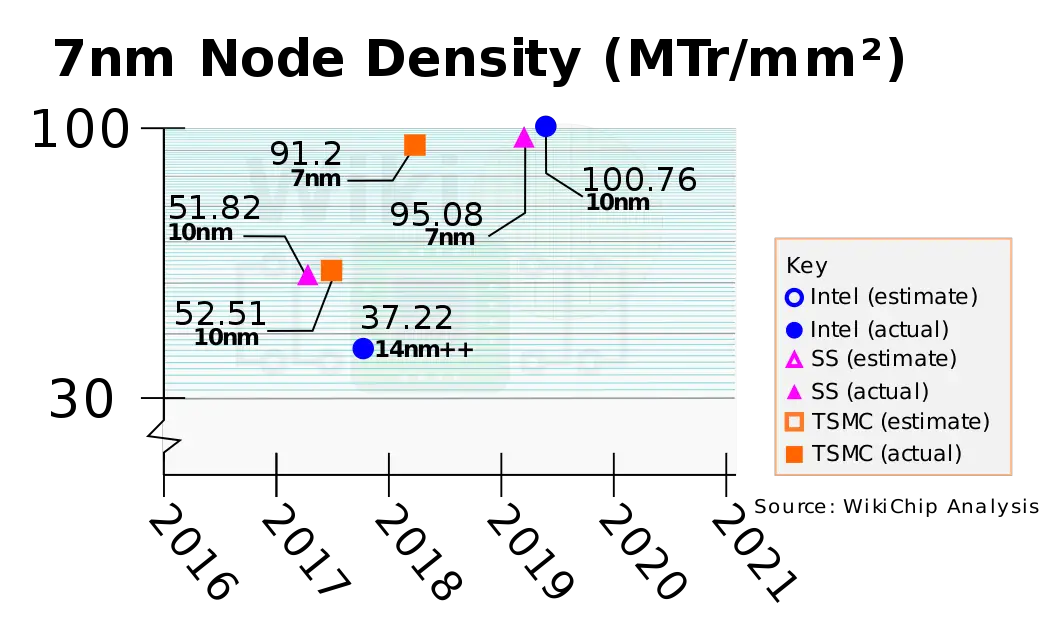
https://en.wikichip.org/w/images/thumb/5/5c/7nm_densities.sv...

Because their 10nm is denser than tsmc's so called 7nm?

Re: Intel is changing the future of power supplies with its ATX12VO spec

#153
Not the first time Intel is pushing for tighter VRM integration.

Haswell had FIVR, which I think was pretty revolutionary, the die itself contained VRMs for the CPU, IGP, memory and more.

Sadly, they gave up on it, probably because it made the processors run hot as hell.

There's not enough die area to cool all of that plus the processing cores and multiple controllers themselves

Re: Intel is changing the future of power supplies with its ATX12VO spec

#154
post #148

Why 12v though? What requires that much voltage? The chips are running at a few volts. Spinning drives are gone, is it just for fans? Seems silly to provide 12v then shift it down again.

While I don't know the exact component that needs 12V, you have to keep in mind that your typical computer draws about 300W under a small load. 300W/12V means 25 amps. Reduce the voltage without lowering the power consumption and you need bigger wires to handle the increase in amps.

Re: Intel is changing the future of power supplies with its ATX12VO spec

#155

In one sense this feels like pushing the efficiency problem under the rug. There's a requirement for power supplies to meet a certain efficiency standard, and generating 3.3v and 5v rails are pushing that number down. Solution? Move that task to the motherboard where they won't count against the power supply efficiency requirement. Of course, from a purely engineering perspective, it really does make sense and it's o…

This is an interesting thought and a different perspective on the situation. I was thinking something of that kind, that, instead of being able to rely on very high quality components and very high expertise for power supply design being centralized in the PSU, everyone else (motherboard / graphics card / harddrive ) manufactures must now become able to design, and willing to implement, high-efficiency, high-quality power-regulation circuitry in their own products.

This also affects the price of those components, while it probably does not make the PSU i get to buy in a webshop any cheaper.

From an engineering viewpoint, it probably does make sense, especially for the lower voltages, as less copper may be required.

Re: Intel is changing the future of power supplies with its ATX12VO spec

#156
post #23

Earlier quoted context omitted.

1 pin is called PS_ON, this shorting to ground turns it on. 1 called PWR_OK which says everything is working in some way I don't want to research. 1 +12V for stand by. 1 +12V sense for detecting voltage drop or something. And then 2 normal +12V and 3 ground. There is 1 reserved pin as well (rectangle connector so needs even pin count)

FWIW, the sense line is for 3.3V, not 12V. The 12V bus will see less drop to begin with, and nobody really cares too much about the voltage tolerance on that one. 3.3V is much more important.

The parent comment is talking about the new specification, which doesn't have 3.3V on the connector.

Re: Intel is changing the future of power supplies with its ATX12VO spec

#157

I love computers with 12VDC native power jacks. Why? My solar-powered van (interior only, the engine is still diesel) is 12VDC everywhere, and that's good clean battery DC, not some noisy-ass AC/DC conversion. I love it so much that 2 of the last 3 computers I built (on an ATX form factor) were 12VDC native. I have external AC/DC power supplies for them, but when travelling/living in a solar-powered environment, I ge…

>not some noisy-ass AC/DC conversion https://www.jonnyguru.com/blog/2018/07/03/seasonic-prime-ult... Is 30 dB SNR insufficient for a digital system? > My guess is that someone figured out how to shrink the necessary converters to a size that made it more "sensible" to put them inside the monitor I’m under the impression that this was demand/market forces. It used to be much cheaper to have an external brick rather th…

"noisy" in this context referred to the output signal, not the acoustic levels.

Also, the 12VDC native monitor that I did buy didn't have a unique plug. It used the fairly standard ring/core 12VDC jack and plug found in many different contexts, though not a lot of digital ones.

Re: Intel is changing the future of power supplies with its ATX12VO spec

#158
post #116

Earlier quoted context omitted.

Electric vehicles are a long way from the sort of mileage that would allow them to effectively replace vans and RVs. We routinely drive 5-800 miles in a day in our van. This isn't going to be possible until battery replacement takes over from battery charging. And yes, our van has 120VAC (1kW) available, but I prefer to use it only for things where's there no alternative (e.g. our toaster, or recharging laptops, sigh…

I bought a tesla 700 miles away and drove it home the same day. As to RVs and vans: - the cybertruck ships in the next year with 500 miles range, and will charge at 250kw/1000 miles per hour - the tesla semi is coming soon - other companies are entering the game - people have been putting lithium ion batteries in their RVs. - EVs have electric air conditioners now. Separately I will say if you're driving an RV 5-800…

I wouldn't want to drive 5-800 miles a day every day, and I don't. But when we do (e.g. just trying to get somewhere before staying there for a while), I don't want to be cramped in that way.

The cybertruck charging rate sounds great, but where are the charging stations? You know, the ones in southeastern Oregon or southwestern New Mexico?

I'm not trying to be a debbie-downer about this. I absolutely believe in an electrical vehicle future. But I don't believe it will happen via charging - it will happen via battery swapping, probably using a standard mandated by national (or international) level bodies.

Re: Intel is changing the future of power supplies with its ATX12VO spec

#159
post #136

I love computers with 12VDC native power jacks. Why? My solar-powered van (interior only, the engine is still diesel) is 12VDC everywhere, and that's good clean battery DC, not some noisy-ass AC/DC conversion. I love it so much that 2 of the last 3 computers I built (on an ATX form factor) were 12VDC native. I have external AC/DC power supplies for them, but when travelling/living in a solar-powered environment, I ge…

> I built (on an ATX form factor) were 12VDC native I want this! Mainly to run from batteries efficiently, transforming from DC to AC and then back to DC is so absurd. Can you give any photos/links/recommendations on how to start?

Sadly, I mistyped the above. I used ITX mobos, not ATX. However, you can get started by taking a look here: http://mini-box.com/ and in particular the "picoPSU" section.

A few images and details of one of the systems I built here: https://sprinter-source.com/forum/showpost.php?p=289185&post...

Re: Intel is changing the future of power supplies with its ATX12VO spec

#160

Earlier quoted context omitted.

I'm excited for the upcoming all electric Ford Transit! That's got E-RV conversion written all over it!

No it's got local delivery and workman written all over it. Unless you're going to go rv at the local supercenter. Rv parks and campgrounds will limit your pull from the mains and when someone starts pulling serious juice from their campsites they'll start auditing.

I really don't think people take exactly that into account.

Right now, and even for the past few decades, electrical use tended to be offered as either a freebie with just being somewhere as a guest or renter, or was generally priced in with discount for conglomerate use. As more and more power intensive appliances become more common (I.e, shift to E.V.) the pricing model is likely to have to change.

Right now you can host 100's of people at a campground, even with an AC on say every third, or every other camper. Throw 100 electric vehicles having to charge at the same time, and you may find the bill has to pass on to users just to be viable.

Post reply on HN