https://eoimages.gsfc.nasa.gov/images/imagerecords/80000/800...
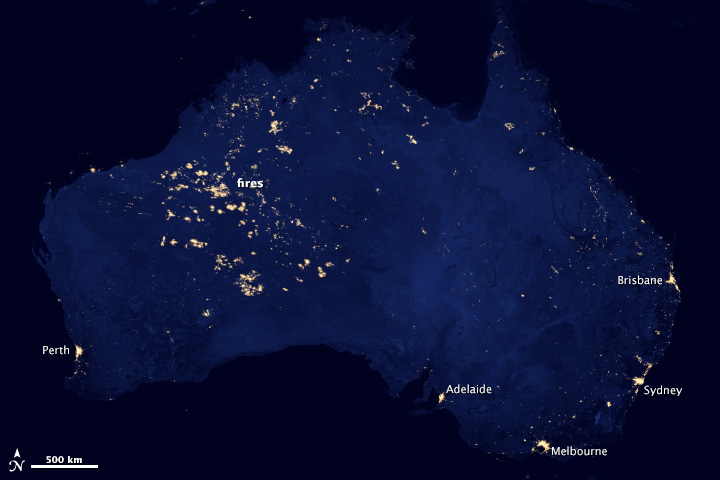
Some of what they have labelled as fires could be from mining but there is literally nothing out there as far as human population.
121–130 of 146 posts
https://eoimages.gsfc.nasa.gov/images/imagerecords/80000/800...
Some of what they have labelled as fires could be from mining but there is literally nothing out there as far as human population.
Earlier quoted context omitted.
Chicago has been slowly replacing its yellow sodium streetlamps with efficient LEDs that project down instead of up. They've been working block-by-block in a systematic way that you can see when you fly into the city at night. It's quite dramatic.
My town replaced the sodium light across the street with a LED. A lot more light comes in the windows now. It sucks.
The first observation was the it was like living with nearly a full moon out all the time; this increased after all lights were replaced. They produce very clean light which appears to reflect more than the old orange light color. the second was that birds in my front holly bushes and thuja trees took some time adapting to the newly lit world; at first they sang/chirped at night hours.
LED lights are amazing for efficiency to the point light pollution will increase simply because it cost so little to keep the lights on; I know I am guilt of that around Christmas as I run nearly five hundred feet of LED lighting then and don't even see the effect on my bill
I flew through the night to Singapore once. I remember two very striking light sources. Firstly, oil well flares in the Middle East. The oil fields are in the middle of nowhere, so they're these huge orange-red blooms set in utter darkness. Secondly, Delhi. The city is brightly lit with streetlights. But there's a suburb (?) to the south, Faridabad, that's as brightly lit, but with a different, whiter, kind of lights…
Chicago has been slowly replacing its yellow sodium streetlamps with efficient LEDs that project down instead of up. They've been working block-by-block in a systematic way that you can see when you fly into the city at night. It's quite dramatic.
[0] https://www.citymetric.com/horizons/you-can-see-berlin-s-eas...
Edit: As I continued farther downthread, I saw that this had already been mentioned; my apologies.
Ah yeah, in the post's first "unknown light pollution" example, I figured it must be a greenhouse. I was driving through a relatively small town one time and was a bit freaked out by this ominous yellow glow off in the distance. Like, the whole sky was glowing [0]. I ended up driving out to try to find the source, and discovered it was a huge greenhouse/farm. Luckily not an extraterrestrial landing zone or so on ;) […
I was struck by the phenomenal degree of light pollution the dragonfruit plantations made - huge arrays of incredibly bright lights, illuminating the sky and area for miles around them in a brighter than moonlight glow.
Similarly, while at sea in the Andaman and gulf of Thailand, the entire horizon is dotted with the bright sparks of squid boats, which use huge lighting arrays as artificial moons to attract squid.
Between the smog and light pollution, it’s a wonder there’s any night sky at all in SE Asia.
Earlier quoted context omitted.
Only 90 minutes? For me it's at least 3 hours to get to Class 4 on the Bortle scale. Class 2 is probably more than 5 hours. Only alternative is the sea. I'm planning to take a trip to a Class 1 this summer, it'll be hard to find a place that dark that is reasonably reachable though.
Exactly, this almost sounds like humblebragging (I know it's not, but still...) I mean, in the whole EU you literally couldn't find a place with Class 1 at all , unless going far-far North into Finland national parks or Norwegian mountains. Makes you hate civilization.
Earlier quoted context omitted.
There is research on whether solar arrays would be a net benefit. Those cells would catch most of the sun’s light, turn it into electricity to power the LEDs that have wave lengths that are better matched to what the plants need. A variation of that only catches the sun’s green light and uses it to power pink/red LEDs ( https://www.treehugger.com/solar-technology/solar-smart-gree... )
Mass produced photovoltaic is 22% efficient. LEDs tuned to the plant are 50% efficient. Net efficiency 11%. Now you need 9 times as much land to grow the same number of plants.
Earlier quoted context omitted.
Since these are greenhouses they have to be clear to let the light in during the day, I assume. Anything that's going to reflect light to prevent it from leaving at night will also block the sun from hitting the leaves during the day, unless it's a complicated mechanical system that can be folded up during the daytime. I'm guessing such a reliable mechnical system together with maintenance is much more expensive than…
What about that electrically controlled darkening glass like they use for windows on some of the newer planes?
I imagine some cheap opaque sheet metal, solar panels and 24/7 artificial lighting would be cheaper than mega-greenhouse amounts of specialty glass.
Earlier quoted context omitted.
Since these are greenhouses they have to be clear to let the light in during the day, I assume. Anything that's going to reflect light to prevent it from leaving at night will also block the sun from hitting the leaves during the day, unless it's a complicated mechanical system that can be folded up during the daytime. I'm guessing such a reliable mechnical system together with maintenance is much more expensive than…
There are systems on the market that are not too complicated. We have an iGrow system for instance for our greenhouse. But yes, the covers do tend to snag and such when rolling up and that can be problematic and require maintenance. Definitely though the industry does not seem to have yet embraced automation much.
I live close to one of the bigger ones in north Sweden. They run some accelerated daytime schedule in the darkess of the polar winter so at least part of the nights has a yellow sky in the whole area. You see it for 10 km on the way to the village nighttime. Could almost believe it's a 100 k town but no :-)
Earlier quoted context omitted.
Exactly, this almost sounds like humblebragging (I know it's not, but still...) I mean, in the whole EU you literally couldn't find a place with Class 1 at all , unless going far-far North into Finland national parks or Norwegian mountains. Makes you hate civilization.
According to Darksitefinder northern Sweden seems better. There are som great places to go up there in the winter that is well worth trying.
Earlier quoted context omitted.
Car parks are notorious light polluters as well. These are large parking lots where car manufacturers off load cars by rail for their "last mile" delivery to the area dealerships. The lights are meant to keep the thief away. On top of the horrendous light pollution, they also cause massive* traffic headaches where the trains can come to a complete park for 20-30 minutes while the train cars with autos are connected/d…
You mean loading cars on to trains? Surely they have sidings?