Earlier quoted context omitted.
That seems a lot less elegant a phrase...
I'm guessing it sounds a lot more elegant in Dutch...
Not really. It's a literal translation, and it's just as bad.
271–279 of 279 posts
Earlier quoted context omitted.
That's totally different from America, where police will get pissed and yell at you to get lost if you ask them for directions. (Speaking from personal experience)
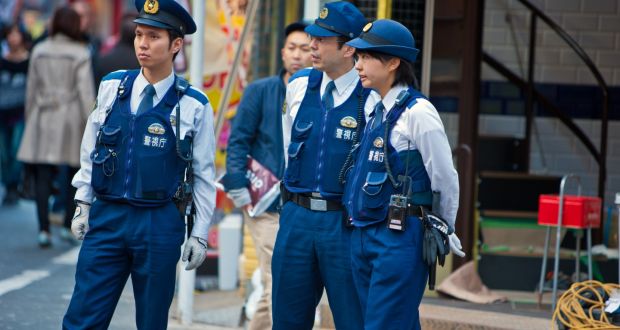
I know! I didn’t even have to ask for help in Japan. I think seeing a tourist holding a map is all they need to spring into action. Gotta keep those tourists out of trouble. I like how police officers in other countries look like normal humans and not stormtroopers. Makes me feel safe.
Yep, I feel exactly the same. The police in Japan look very professional, and not at all like stormtroopers; the shirt and tie they wear just isn't something you'd wear into combat.
See: https://www.irishtimes.com/polopoly_fs/1.3451993.1523010914!...
Versus: https://www.wsj.com/articles/americans-respect-for-police-re...
It also helps that police in other countries don't just shoot first and ask questions later, like American police: https://www.bbc.com/news/av/world-asia-pacific-38534288/wrap...
Earlier quoted context omitted.
Likely a few dollars means nothing to you so the act of pointing the nearly lost dollars is a similar small task (not withstanding the possibility the act could have a profound effect on the recipient depending on their situation). When I was younger and we were struggling hard, we found a wallet in a store loaded with green bills. That money would have had immediate, real, positive impact for us, like gas money and…
Why did you give the wallet to a random person you had no reason to trust when you could have looked at the address on the ID in the wallet and taken it there yourself?
Earlier quoted context omitted.
Ah, but I suppose there are areas with bigger fears of rain. I was hitchhiking through spain and someone who picked me up was a wine farmer, who told stories of people not coming to work, because that day it was raining - in a different village.
I've had people cancel meetings with me in San Francisco 'because it was raining'. To be fair the roads here do become significantly more stressful then, but whenever it happens it feels ridiculous. My theory is that whatever the worst 1-2% of weather days per year becomes a weather excuse anywhere in the world. In the Phillipines it had to be bad typhoon, not just a normal one. In London it was moderate snowfall (th…
Earlier quoted context omitted.
It depends on the situation with traffic and enforcement. At my college town the police were obsessive with writing jay walking tickets. Even if no one is around at all. They really took pride in fining broke college kids $300 for crossing the road. In LA, there is no jaywalking enforcement, or any petty crime enforcement for that matter. The LAPD is a disproportionately tiny police force that has far bigger fish to…
>At my college town the police were obsessive with writing jay walking tickets. Even if no one is around at all. They really took pride in fining broke college kids $300 for crossing the road. And police in America wonder why people hate them so much.
So you end up with broke college kids using their student loan money to ultimately pay for trash pickup or other critical city services that were previously paid for by taxation and higher levels of government.
I think part of this is that a far greater proportion of "lost" valuables in Japan are _really_ lost than in other countries, street crime being pretty rare. But still, that 6% figure for New York! Can it be true? Is it really normal to steal other people's shit if they leave it behind?
But still, that 6% figure for New York! Can it be true? Is it really normal to steal other people's shit if they leave it behind? Who said anything about shit getting stolen? The article claims: 88% of phones “lost” by the researchers were handed into the police by Tokyo residents, compared to 6% of the ones “lost” in New York. (emphasis mine) I found a wallet in NY once. The ID had the owner's address around the cor…
I found someone's house key in the road, likely of a nearby resident.
A safety issue as far as I was concerned - not a particularly rough neighbourhood but not a great one either. Some smackheads would absolutely have tried it in the closeby doors.
Police couldn't help. I ended up putting it in an envelope with a note, posting it through the letterbox of the nearest church. I put up a note on the closest lamppost, posted a redacted photo on Facebook, but never heard anything further.
Earlier quoted context omitted.
Since they sent me a Xmas card, I reciprocated in kind, also enclosing the gift card with a note apologizing but asking that they give it to a needy person at their church during the holiday season. (They had also sent me an invitation to attend services.) So no additional postage needed.
If they attend a church, they are really odd for Japanese, since almost no Japanese are Christian (at least in Japan).
Earlier quoted context omitted.
"purity" is an odd word choice there when "homogeneity" or perhaps more neutrally "uniformity" are equally accurate. more broadly, when i see/hear this line deployed by westerners in regard to certain east asian countries, I always wonder if such westerners think such statements are generalisable to other nations, or if they have considered whether other specific cultural factors than uniformity are in play and causi…
> It's my view that, other factors disregarded, having fewer cultural/ethnic outgroups does not magically result in higher levels of mutual trust in a society. This is a classic scissor statement to use SlateStarCodex lingo.