Live data from Hacker News

Maine's giant spinning ice disc looks like it's reforming

theguardian.com

61–70 of 76 posts

Re: Maine's giant spinning ice disc looks like it's reforming

#61
post #11

Earlier quoted context omitted.

Not really. Nature is full of beautiful symmetry

Not that large

I think what you mean is "not that medium". You can find this sort of shape at the astronomic and the microscopic scales, just not usually at human scale.

Re: Maine's giant spinning ice disc looks like it's reforming

#62
post #7

Earlier quoted context omitted.

The near-perfection of the circular shape is what really makes it stand out. It's strange to see such regularity in natural phenomenons.

Agreed (though circle is pretty common, but,) has anyone ever seen any trace of a mandelbrot-shaped feature anywhere in nature? (I mean the whole set, not just seahorses/etc) I'm on the hunt!

The actual Mandelbrot is a very specific and complex mathematical pattern; I'd be very surprised to see it. But fractals in general are everywhere.

Re: Maine's giant spinning ice disc looks like it's reforming

#63
post #59

Earlier quoted context omitted.

You could imagine a glass donut filled with water, as well as a small rotor to move the water in a circle. You obviously have to balance the water pressure and temperature to reach slow ice formation, and maybe you need a more interesting container shape than a donut to get interesting results.

Well, in space water starts to boil away immediately so you would need a gas tight container which don't typically happen in nature in sizes that would allow internal currents to develop.

Earth is a (reasonably) gas tight container filled with flowing liquid (lava propelled by convection currents). Europa (the moon) is a reasonably gas-tight container filled with water under an ice sheet.

Of course Earth also has appreciable gravity. The real problem isn't that nature produces no gas tight liquid-filled containers, it's that gravity is the primary mechanism by which things are naturally created in space. Asking for a situation without gravity virtually requires artificial construction.

Re: Maine's giant spinning ice disc looks like it's reforming

#64
post #54

Earlier quoted context omitted.

(Of course, pressure and temperature that sustains liquid water is rarely found in zero gravity, outside of human space stations).

Human space stations aren’t zero gravity (it’s actually 0.89g). The apparent weightlessness is due to continually falling and never hitting the ground. You don’t need to be in zero gravity to see the water form a sphere shape either, use an eye dropper and a high speed camera and you’d see similar results.

Getting a little off topic here, but general relativity is based on there being no observable difference between inertial motion and free-fall within a gravitational field. The weightlessness from free-fall isn’t just apparent. It’s identical in every way to the weightlessness experienced if you were sitting in one of the universe’s vast voids.

It is of limited meaning to say the gravity in LEO is 0.89G. That’s an Earth-centric statement, and ignores the gravitational contribution of the sun, the galaxy, the local group, and so on.... At best, you can say “a body initially at rest relative to the Earth at altitude 300km experiences an acceleration of 0.89g towards Earth”. Earth itself is in free fall around the Solar System’s barycenter, which in turn is in free-fall around the galaxy’s center of mass, which in turn is in free-fall around etc... etc...

The only gravitational experiment that could be done on the ISS to determine they were orbiting Earth (vs sitting in empty space far from any other bodies) would be to measure gravitational tidal forces.

When you create a drop of water and let it free-fall, it forms a sphere precisely because, from its frame of reference, there is zero gravity.

Re: Maine's giant spinning ice disc looks like it's reforming

#65
post #7

Earlier quoted context omitted.

The near-perfection of the circular shape is what really makes it stand out. It's strange to see such regularity in natural phenomenons.

Agreed (though circle is pretty common, but,) has anyone ever seen any trace of a mandelbrot-shaped feature anywhere in nature? (I mean the whole set, not just seahorses/etc) I'm on the hunt!

ferns, palms, and sunflowers are good places to start

Re: Maine's giant spinning ice disc looks like it's reforming

#66
post #36

Earlier quoted context omitted.

Why do the two photos at the top of that article look so weird? They look like 3D renders almost. Is that what it actually looks like to the eye too, if one looked at Saturn from a spacecraft orbiting around it?

They look like bad 3D renders because there are no walls and no sky in space, so all the light comes directly from the sun and shadows are absolutely black. The image looks different than with the naked eye though, because they filtered certain wavelengths. https://www.nasa.gov/jpl/cassini/pia18274

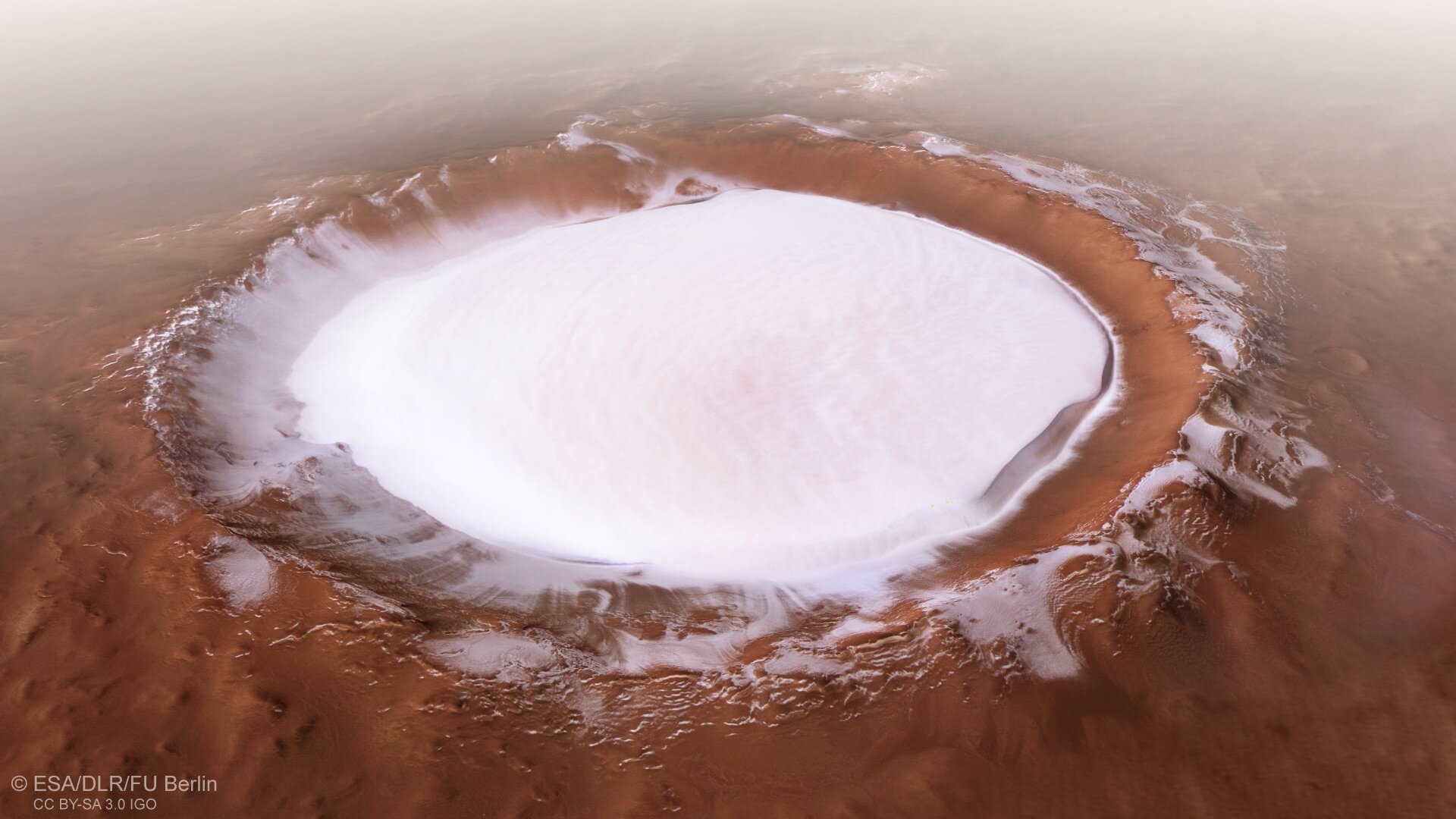
The question is legitimate though as sometimes we do get 3D renders, e.g. when it comes to this image of the Korolev crater on Mars: https://www.esa.int/var/esa/storage/images/esa_multimedia/im...

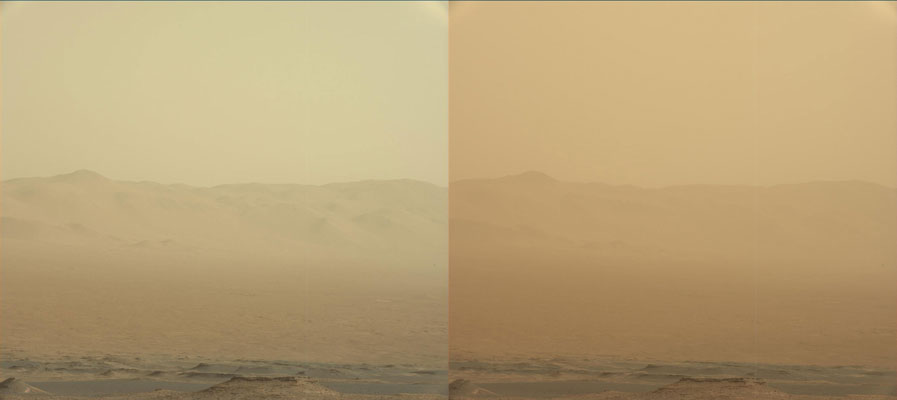
They even added the fog (the fog in the picture is white and while there is dust on mars it's rather brown as the planet's surface https://mars.nasa.gov/imgs/mep/weather/PIA22520-600.jpg ).

Re: Maine's giant spinning ice disc looks like it's reforming

#67

Earlier quoted context omitted.

Human space stations aren’t zero gravity (it’s actually 0.89g). The apparent weightlessness is due to continually falling and never hitting the ground. You don’t need to be in zero gravity to see the water form a sphere shape either, use an eye dropper and a high speed camera and you’d see similar results.

Getting a little off topic here, but general relativity is based on there being no observable difference between inertial motion and free-fall within a gravitational field. The weightlessness from free-fall isn’t just apparent. It’s identical in every way to the weightlessness experienced if you were sitting in one of the universe’s vast voids. It is of limited meaning to say the gravity in LEO is 0.89G. That’s an Ea…

Getting even more off topic, your comment is completely right except for this:

“a body initially at rest relative to the Earth at altitude 300km experiences an acceleration of 0.89g towards Earth”

which is false in the general-relativistic way of looking at things. An accelerometer initially at rest at 300km would show no acceleration as it starts to fall towards earth. If the atmosphere and the earth could be removed without affecting the shape of spacetime the accelerometer would continue speeding up till it reached where the center of the earth was, then slow down, reaching a speed of zero at a point opposite from where it started, at which point it would repeat the motion in reverse. At no point would it register an acceleration. Nor would an accelerometer in orbit register an acceleration. In the general-relativistic framework, free fall means no acceleration, and the motion of a body in free fall is determined solely by the shape of spacetime. So, at best you can say,

“The shape of spacetime at 300km affects a body's motion the same way an acceleration of 0.89g towards Earth would if spacetime were flat.”

By the way, an accelerometer on the surface of the earth, e.g., the one in your smartphone, registers a constant acceleration of 1.0g in the up direction caused by the normal force of whatever the smartphone is resting on. If someone knocks the phone off a table, the acceleration becomes zero till it hits the floor. (Air resistance can also apply an (upward) acceleration to the smartphone, but is negligible at the speeds reached during a fall of only a few feet by an object as heavy and dense as a smart phone.)
Re: Maine's giant spinning ice disc looks like it's reforming

#68

Earlier quoted context omitted.

Human space stations aren’t zero gravity (it’s actually 0.89g). The apparent weightlessness is due to continually falling and never hitting the ground. You don’t need to be in zero gravity to see the water form a sphere shape either, use an eye dropper and a high speed camera and you’d see similar results.

Getting a little off topic here, but general relativity is based on there being no observable difference between inertial motion and free-fall within a gravitational field. The weightlessness from free-fall isn’t just apparent. It’s identical in every way to the weightlessness experienced if you were sitting in one of the universe’s vast voids. It is of limited meaning to say the gravity in LEO is 0.89G. That’s an Ea…

> When you create a drop of water and let it free-fall, it forms a sphere precisely because, from its frame of reference, there is zero gravity.

Correct, which is what I said (just not as explicit). I now realize that the “you” could be ambiguous though, the intended “you” is the person performing the experiment doesn’t need to be themselves in zero gravity.

Re: Maine's giant spinning ice disc looks like it's reforming

#69

Earlier quoted context omitted.

Human space stations aren’t zero gravity (it’s actually 0.89g). The apparent weightlessness is due to continually falling and never hitting the ground. You don’t need to be in zero gravity to see the water form a sphere shape either, use an eye dropper and a high speed camera and you’d see similar results.

Getting a little off topic here, but general relativity is based on there being no observable difference between inertial motion and free-fall within a gravitational field. The weightlessness from free-fall isn’t just apparent. It’s identical in every way to the weightlessness experienced if you were sitting in one of the universe’s vast voids. It is of limited meaning to say the gravity in LEO is 0.89G. That’s an Ea…

> The weightlessness from free-fall isn’t just apparent. It’s identical in every way to the weightlessness experienced if you were sitting in one of the universe’s vast voids.

Also agree with this as well (I again just wasn’t as detailed in my response). I used the word apparent because that’s the established convention from all scientific papers on the topic, but you are 100% correct that it’s identical. The VomitComet flights are a great example, but a lesser known example is going downhill on a roller coaster.

Re: Maine's giant spinning ice disc looks like it's reforming

#70

I walk home most work nights and cross the Presumpscot River on my way. It adds about 20 minutes to go up to that end of town and see it. I did that a couple times last year, and will be doing so this coming Tuesday (since Monday is MLK day). Thankfully the weather will be mostly below freezing until then, although it will go up to 37 today. I think its the combination of the single digit nights which allow ice to fo…

Off topic, but I like to hear about the experiences of tech people living in Maine. If you’d like to chat, send a message to my username at gmail.
Post reply on HN