Earlier quoted context omitted.
This looks amazing, thank you! A few posts up, melvinroest suggested starting a study group for the (Windows-based) course in the original post -- would anyone be interested in doing the same for this Linux-based course?
I am all in to form a peer group to study RE (Windows or Linux) I am more interested in memory patching and binary modification of software (including games) than malware analysis
Reverse engineering course
41–50 of 57 posts
Re: Reverse engineering course
#42Earlier quoted context omitted.
I am all in to form a peer group to study RE (Windows or Linux) I am more interested in memory patching and binary modification of software (including games) than malware analysis
Yes I'm interested into Linux systems too, I work for embedded sw dev and sometimes I struggle with core dumps in gdb, this would help me :)
Re: Reverse engineering course
#43Re: Reverse engineering course
#44Re: Reverse engineering course
#45Always thought reversing is fun. Back in high school and college I would spend days or weeks trying to reverse random software packages I had installed on my system. It was pretty surprising how, with a few tools like OllyDBG, 90% of the software I attempted to crack was actually crackable. Most of Autodesk's software was ridiculously easy to crack. (Don't worry, I owned all that software already! I was studying anim…
Someone correct me if I’m wrong but it sounds like you just described “fault injection” or “mutation analysis.”
Re: Reverse engineering course
#46Re: Reverse engineering course
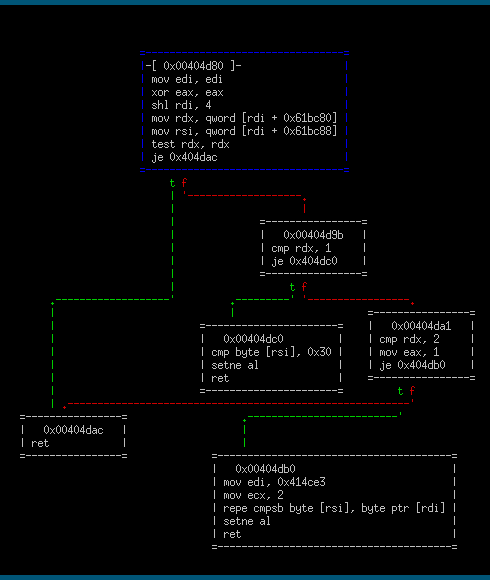
#47I used to dabble in Cheat Engine, Tsearch, and IDA Pro, for reversing games. Recently, a nice guy randomly showed me a demo of a modern tool called radare[1]. I was floored by the IDA-like flow-diagrams that it spit out in the terminal[2], and the short commands for navigating/bookmarking/documenting. Nice to see hobbyists don't need to buy IDA anymore! [1]: https://www.radare.org/r/ [2]: https://www.radare.org/r/img…
Re: Reverse engineering course
#48Re: Reverse engineering course
#49RPISEC RE/VR courses (a little scattered due to the passage of time): Secure Software Principles - CSCI 4971, Spring 2010: http://www.cs.rpi.edu/academics/courses/spring10/csci4971/ Malware Analysis - CSCI 4972/6963, Spring 2013: http://security.cs.rpi.edu/courses/malware-spring2013/ Advanced Exploitation and Rootkit Development, Spring 2013: http://security.cs.rpi.edu/~candej2/ Program Obfuscation, Fall 2013: http:/…
Re: Reverse engineering course
#50>Learning your first calling convention is like learning your first programming language. It seems complex and daunting at first, but it's really quite simple.
I will definitely read this as I'm also doing the Reverse Engineering for beginners, as well as getting sidetracked to learn Assembly with Programming From the Ground Up first.