Live data from Hacker News

A Sick Giant

waitbutwhy.com

101–110 of 138 posts

Re: A Sick Giant

#101

I've been reading Tim Urban's writing for a while. One of the most valuable things in his writing isn't originality, but delivery. He might not be coming up with original ideas (he regularly references the research he consulted to form his writing) but he _does_ do a great job of breaking down complex ideas into a form that's easily digestible. The first several chapters of this series (worth a read, even if it's the…

I think that breaking down the concepts is also helpful for Tim, as well as anyone who's trying to wrestle with complex ideas, in addition to the audience. Making sure your concepts are well-defined and clear is key to building them into something greater. So many flawed ideas are flawed because they're built off of a shaky foundation. Unfortunately analyzing those foundational ideas critically is difficult. I've fou…

I agree completely! Does wonders for your own understanding, but, like you said, takes a lot of time!

Re: A Sick Giant

#102
post #23

Earlier quoted context omitted.

Especially since we live in an oligarchy but everyone still thinks in terms of red vs blue or us vs them. It is quite the trick to misdirect blame to people who are just like you.

I find it ironic that you respond to a comment about political polarization increasing with a polarizing extreme of a comment...

There's nothing polarizing or extreme about noticing oligarchy. It is a prominent feature of contemporary life.

[I was tempted to respond with something actually "polarizing extreme" and thus actually "ironic", but I've been warned...]

Re: A Sick Giant

#103
There's a branch of analyzing US politics through the lens of "primitive" and "civilized" brains that stems from Haidt's old ideas ("elephant and the rider"), which I still to this day do not find compelling.

If part of my culture's routine every day is kicking a kitten and my society near-violently disagrees whether it should be 2 kittens per day or just 1, and instead of comparing cultural notes with the 10k+ other cultures of the world (to realize this isn't normal) I spend time talking about human brain hacks which preserves the hideous self-righteousness of my ego and my culture of kicking kittens, then I've effectively absolved myself from personal responsibility like a good Kantian ethicist and can keep kicking kittens without remorse (and, not hold anyone else accountable for kicking kittens) because "My selfish lack of critical thought is forgiven because my brain is just wired to be hacked that way, same for my peers and their brains".

Take responsibility for how you use your brain and what you expose it to, and do the same to your peers. You are so much more than just a brain being hacked upon.

Re: A Sick Giant

#104
post #85

Earlier quoted context omitted.

I'm a fan of single transferable voting, but the claim that FPTP is responsible for America's politics does not seem well borne out by the evidence. As the Wikipedia article on Duverger's Law notes: "In practice, most countries with plurality voting have more than two parties." The USA is very much an outlier here. Even if there remained only two _dominant_ parties, a significant third party like the NDP in Canada, o…

I think the reason why US has two parties is that most States apply FPTP at a district level, but then also have a winner-takes-all at State level based on the districts result. So one district selects one party, and then the State gives all its N votes to the majority party among districts, selecting N people of the same party. UK only has FPTP at constituency (district) level. So one constituency selects one person…

It isn't thrown away, though. If your district picks a third party, you send a third party representative to Congress. You'll have different choices in district-specific and state-wide races but you could also have a third party senate candidate and no realistic third party house candidates (for example Maine in 2018, though they had ranked choice voting). I don't see how having multiple levels of elections changes things beyond larger populations making it harder to coordinate outside the parties.

Re: A Sick Giant

#105
post #44

I skimmed this, and there's some good and interesting data and analysis here. The one aspect that seems to be missing, by its own admission, is how this fits in with the rest of the world. This is looking at the USA in a vacuum, which is not without merit, but countries no longer exist in a vacuum, especially the USA. As mentioned in one of the last "Fun and Procrastinatey" footnotes: > The U.S. Left has moved enough…

> It neglects to show full context: that US Left is actually Middle The US Left is Left, but the US has three big factions: a very large Right faction and smaller Center and Left factions, and he Democratic Party is an uneasy Center-and-Left coalition, where the Center faction has been dominant for the last couple decades but has lost some ground in the last few years to the resurgent Left.

If that’s so, it’s an even bigger USA-specific fact that was completely omitted from this analysis.

Re: A Sick Giant

#106

I have enjoyed WaitButWhy articles in the past but with this new series the author seems to have spent a huge amount of time, energy and words coming up with ideas that aren't that new. I keep skimming through them waiting to find the big point.

I think to gain anything from long form articles, you need to read and consider what's being written, rather than skimming, looking for the holy grail.

I read a lot, but since there's always so much more to read than I could ever handle, I need some way of doing triage. I skim stuff to get a sense of if it's worthwhile. The claim that you have to read the whole thing in order to evaluate it reminds me of the claim by some religions that you can't refute them unless you've invested many years learning their sacred scriptures. It absolutely could be a true claim; it just isn't feasible.

Re: A Sick Giant

#107

Earlier quoted context omitted.

I think the reason why US has two parties is that most States apply FPTP at a district level, but then also have a winner-takes-all at State level based on the districts result. So one district selects one party, and then the State gives all its N votes to the majority party among districts, selecting N people of the same party. UK only has FPTP at constituency (district) level. So one constituency selects one person…

It isn't thrown away, though. If your district picks a third party, you send a third party representative to Congress. You'll have different choices in district-specific and state-wide races but you could also have a third party senate candidate and no realistic third party house candidates (for example Maine in 2018, though they had ranked choice voting). I don't see how having multiple levels of elections changes t…

I stand corrected. Thank you for pointing out my misunderstanding of US elections.

So what is the main difference? size of districts (constituencies) by a factor of ~10? Gerrymandering?

Re: A Sick Giant

#108
post #33

Earlier quoted context omitted.

The backbone of the USA in its formative years was slavery and outright slaughter of native Americans. By people who went to church. This dark legacy stretches into today - the last lynching was in 1981, and white Christian America still worships a vision of a nice, pearly white European looking Jesus, presented by millionaire preachers in mega churches who say “just give me some money and you too can be redeemed”. A…

> The backbone of the USA in its formative years was slavery and outright slaughter of native Americans. Actually, most founding states sought to abolish slavery when the Constitution was being drafted. The Southern States were vehemently opposed to such action to the point that they would not ratify the Constitution. As a compromise, slavery was allowed, and no law could be made restricting the importation of slaves…

> Consider, though, that the importation of slaves was banned on the first day which was legally allowed.

None of this counters my original point. Cotton was an utterly crucial crop in the USA's development, and the total value of all slaves was 48 times the expenditure of the federal government, and 7 times the total value of _all_ the currency in circulation at the time (1860). I'd call that a pretty important backbone, even if it was localized to mainly the south.

> And a school district in Alabama was ordered to desegregate less than ten years ago. What's your point?

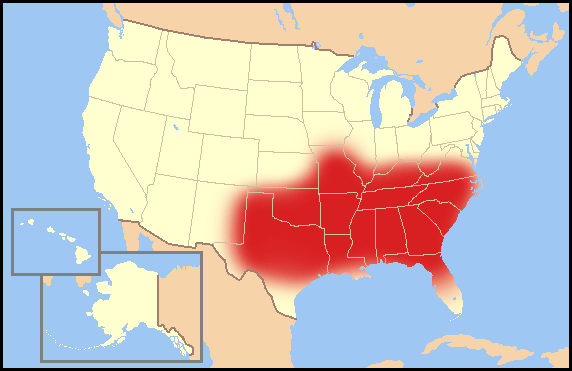
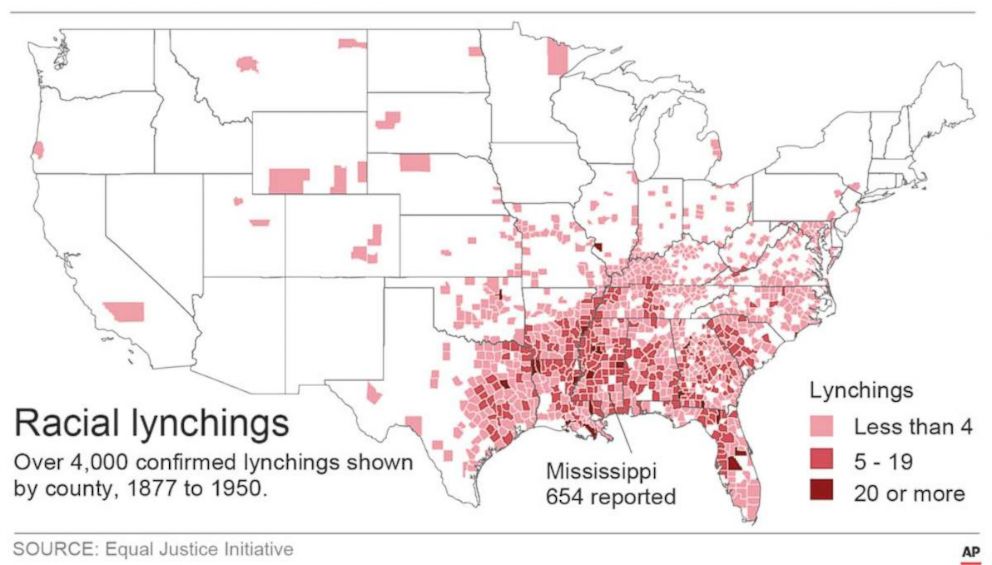
My point is that the last lynching was in 1981. That's utterly ridiculous. It only trailed off in the 1950's. Also here's a map of the lynchings[1], see a pattern? Maybe if you overlay a map of the bible belt[2] it becomes clearer. Love thy neighbour, right?

> Consider that the book (and movie) "The Shack" portrays the three parts of God as an African-American woman, a Middle-Eastern carpenter, and an Asian woman as the Father, Son, and Holy Spirit, respectively. "White Christian America" still ate it up.

To quote you: What's your point? These are outliers. They don't represent the majority view. Maybe they ate it up because it was "wacky" to see a brown Jesus on screen. Only on screen mind you, I don't expect many of them would want that imagery taught in churches! God forbid.

> Maybe those people just see the world from a different perspective than you.

Yeah, I expect their tax-excempt churches had a pretty fair and balanced discussion about both sides. No wait, riling people up about abortion then using that as a device to get people to vote your party into power, so you and your tax-excempt gravy train can continue to benefit is far too much of a good thing to risk. Especially by discussing how we can adapt society for the future rather than harking back to the good, clean family-friendly past (lynchings or not).

Everything is about control. Some people form opinions from TV, some from church. Just because a man stands at a pulpit doesn't make his words any different from a news anchor behind a desk. It's just unfortunate for their followers that they support such a regressive party. And as certain segments of the population age out and Christianity continues to shrink you'll see them ratchet up the furor to stay in control. Control people like you.

But hey, hold your nose and vote for the candidate that was sent from god[3], right?

1. https://s.abcnews.com/images/US/lynching-memorial-graphic-ap...

2. https://upload.wikimedia.org/wikipedia/commons/c/c2/BibleBel...

3. https://www.theguardian.com/us-news/2020/jan/03/trump-florid...
Re: A Sick Giant

#109

I've been reading Tim Urban's writing for a while. One of the most valuable things in his writing isn't originality, but delivery. He might not be coming up with original ideas (he regularly references the research he consulted to form his writing) but he _does_ do a great job of breaking down complex ideas into a form that's easily digestible. The first several chapters of this series (worth a read, even if it's the…

It seems to me like most of the topics Tim covers are not very complex at all. His most famous articles are on procrastination, which pretty much everyone already understands. The main value was in adding characters that people could use to visualize the problem. Likewise, all the ideas presented in this series are either obvious (eg. US politics are very polarized these days) or dubious (eg. The rational mind is politically centrist).

Re: A Sick Giant

#110

Earlier quoted context omitted.

I think to gain anything from long form articles, you need to read and consider what's being written, rather than skimming, looking for the holy grail.

I read a lot, but since there's always so much more to read than I could ever handle, I need some way of doing triage. I skim stuff to get a sense of if it's worthwhile. The claim that you have to read the whole thing in order to evaluate it reminds me of the claim by some religions that you can't refute them unless you've invested many years learning their sacred scriptures. It absolutely could be a true claim; it j…

I understand your perspective on it. But I don't think I'm claiming that you can't refute what's in the article, and you certainly don't have to read it all to refute something.

But bambataa did not refute anything from the article, just saying that it doesn't contain anything "big", without actually reading it. I think that's a fairly different situation than the one you used as a example.

It would more be equal to "You can't criticize religion if you haven't read anything about it", which I think it fine. You have to at least understand what you are critiquing, otherwise you're basing your arguments on something that you could have misunderstood.

Post reply on HN