Live data from Hacker News

WiFi deauthentication attacks and home security

mjg59.dreamwidth.org

131–140 of 232 posts

Re: WiFi deauthentication attacks and home security

#131
post #110
post #97

Earlier quoted context omitted.

This is fascinating that some manufacturers may have gone down this Darwinian path in "improving" their products. Is there any such law against this or any efforts in introducing such laws, either in Norway or elsewhere?

The WiFi frequencies are unlicensed in afaik every jurisdiction (note that the precise frequencies aren’t de jure the same in every country) so it’s legal to send whatever packets you like within certain power constraints.

>so it’s legal to send whatever packets you like within certain power constraints.

No. https://boingboing.net/2014/10/03/fcc-fines-marriott-for-jam...

>No person shall willfully or maliciously interfere with or cause interference to any radio communications of any station licensed or authorized by or under this chapter or operated by the United States Government.
https://www.law.cornell.edu/uscode/text/47/333

Re: WiFi deauthentication attacks and home security

#132

Earlier quoted context omitted.

Use the guide I posted here to locate the device responsible using the signal-strength in Wireshark (search for NKOM). Could be you can break the device by flooding it with fake SSID, using AirPlay-ng. A bit more technical but should be possible with every Mac or most WIFi dongles that support monitor-mode (could be illegal).

I did follow it and found roughly where it is. But, have not talked to that landlord. It is a 3 story building with a handful of apartments in an old stone and brick building locked at the ground floor (i.e. refection is a problem but I imagine signal strength outside the door would be a good indicator once inside). Not sure about breaking the device by flooding with SSIDs? Sorry, not my area here. From what I know,…

"Flooding with SSIDs" means generating lots of fake SSIDs each second to trick that device into attacking those fake SSIDs and keep it busy. Keept it genrating even more (use several wifi adapters) until the other device goes crazy. You can use some of the tools (like aireplay) from the aircrack-ng suite for generating fake SSIDs

Re: WiFi deauthentication attacks and home security

#133

Earlier quoted context omitted.

You might find it interesting that some German universities [1] actively send out deauthentication packages to clients that connect to SSIDs that are not on their internal whitelist to "protect" the clients from "rogue APs". A lecturer from my Hochschule was fired for protesting this practice. [1]: https://meinehochschulebehindertdaswlan.de/

From a network admin's perspective- this is necessary to protect the integrity of the air space. It discourages the use of rogue AP's which wreck the channel utilization for everyone. It's common to find this feature in enterprise wifi systems. Some actively spoof the SSID of the rogue AP in order to draw the client back to the institution's network.

And what about the people who don't/can't use the institution's network? Why should the institution be allowed to effectively monopolize the unlicensed airwaves?

Re: WiFi deauthentication attacks and home security

#134
post #86

I am NOT a laywer, but I checked how much of what the article describes is illegal in Germany. The answer is just about everything. Installing a doorbell with a camera that looks into the hallway is illegal. You may not record what happens in public spaces on security cameras. And even inside your home, you still have to ask for consent to make an audio recording. Otherwise, this constitutes a crime. Also, sniffing W…

> Also, sniffing Wifi for data not aimed at you is illegal.

Ugh, yuck, I hate when lawmakers write laws like that. What does that even mean? All WiFi that I can hear is aimed at me. That's how radio works.

No, I'm not being disingenuous or obtuse, this is a legitimate concern with the way we're allowing artistic liberty into the written law. It's really badly ambiguous, not to mention the ridiculous violation of autonomy that you can't listen to broadcasts you can hear is.

Re: WiFi deauthentication attacks and home security

#135

Earlier quoted context omitted.

Maybe an unethical Wi-Fi manufacturer thought they were clever to deauth clients of APs with MACs not in their own range, to clear other traffic off the band they use and have their products perform better than others by means of sabotage.

That surely would be noticed in any sort of rigorous certification program.

What 'rigorous certification program'? Aren't the only regulations that they comply with FCC rules about creating/accepting interference, frequency ranges, and transmission power? These regulations do not have any say on what is actually transmitted on those frequencies.

Re: WiFi deauthentication attacks and home security

#136
post #133

Earlier quoted context omitted.

From a network admin's perspective- this is necessary to protect the integrity of the air space. It discourages the use of rogue AP's which wreck the channel utilization for everyone. It's common to find this feature in enterprise wifi systems. Some actively spoof the SSID of the rogue AP in order to draw the client back to the institution's network.

And what about the people who don't/can't use the institution's network? Why should the institution be allowed to effectively monopolize the unlicensed airwaves?

Why not? It's unlicensed, so it's a free-for-all. If we don't like that, the answer is to license it. Which doesn't seem better to me.

Re: WiFi deauthentication attacks and home security

#137
post #86

I am NOT a laywer, but I checked how much of what the article describes is illegal in Germany. The answer is just about everything. Installing a doorbell with a camera that looks into the hallway is illegal. You may not record what happens in public spaces on security cameras. And even inside your home, you still have to ask for consent to make an audio recording. Otherwise, this constitutes a crime. Also, sniffing W…

You might find it interesting that some German universities [1] actively send out deauthentication packages to clients that connect to SSIDs that are not on their internal whitelist to "protect" the clients from "rogue APs". A lecturer from my Hochschule was fired for protesting this practice. [1]: https://meinehochschulebehindertdaswlan.de/

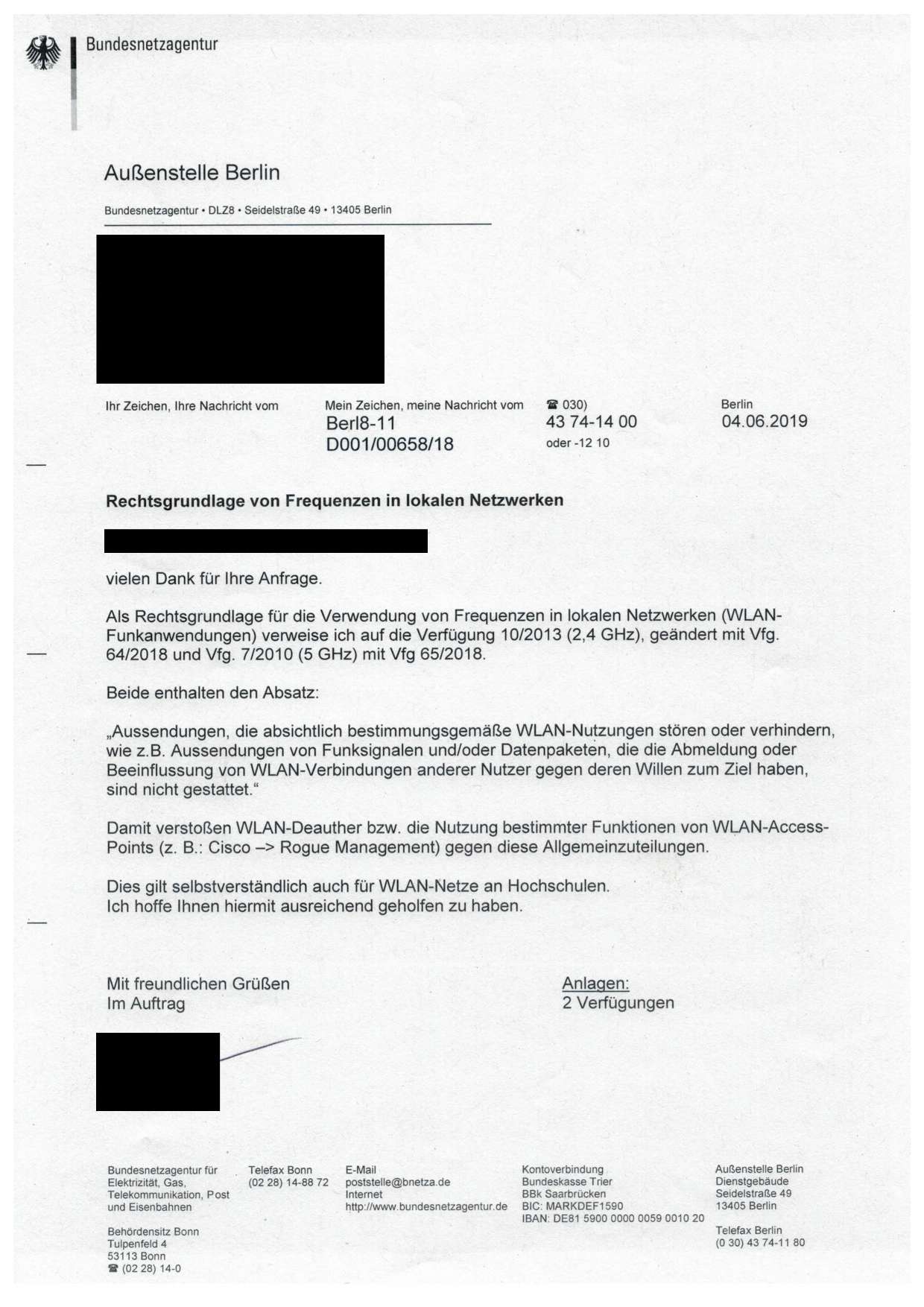
This letter from the BNetzA, which is in charge of regulating the use of the EM frequency spectrum in Germany, specifically states that sending deauthentication packages to disrupt other wireless networks is not allowed. It's in German, naturally:

https://meinehochschulebehindertdaswlan.de/BnetzAStellungnah...

Re: WiFi deauthentication attacks and home security

#138
post #123

Earlier quoted context omitted.

Anywhere you don't have reasonable expectation of privacy.

Strange example - in a hotel, with an open window, on the 45th floor. If paparazzi with a telephoto lens can see you, it is considered fair game.

If you're standing in front of a window and can see out (and can be seen), you don't really have a reasonable expectation of privacy. This applies to my single floor single family residence. If I want privacy, I close the blinds and/or drapes.

As a matter of courtesy, I never aim a telephoto at windows. Paparazzi are an entirely different class though in that most have no "class" anymore it seems.

Re: WiFi deauthentication attacks and home security

#139
post #86

I am NOT a laywer, but I checked how much of what the article describes is illegal in Germany. The answer is just about everything. Installing a doorbell with a camera that looks into the hallway is illegal. You may not record what happens in public spaces on security cameras. And even inside your home, you still have to ask for consent to make an audio recording. Otherwise, this constitutes a crime. Also, sniffing W…

> Also, sniffing Wifi for data not aimed at you is illegal. Ugh, yuck, I hate when lawmakers write laws like that. What does that even mean ? All WiFi that I can hear is aimed at me. That's how radio works. No, I'm not being disingenuous or obtuse, this is a legitimate concern with the way we're allowing artistic liberty into the written law. It's really badly ambiguous, not to mention the ridiculous violation of aut…

Poor word choice on my part. You are only free to capture and process information that either a broadcast without target or addressed specifically to you in some form. And that makes total sense. There is some leeway in the interpretation so that the mandatory reception and decoding as part of the technical implementation are not illegal in themselves, but any further processing of data clearly addressed at someone/something else is not legal.

Re: WiFi deauthentication attacks and home security

#140
post #131
post #110

Earlier quoted context omitted.

The WiFi frequencies are unlicensed in afaik every jurisdiction (note that the precise frequencies aren’t de jure the same in every country) so it’s legal to send whatever packets you like within certain power constraints.

>so it’s legal to send whatever packets you like within certain power constraints. No. https://boingboing.net/2014/10/03/fcc-fines-marriott-for-jam... >No person shall willfully or maliciously interfere with or cause interference to any radio communications of any station licensed or authorized by or under this chapter or operated by the United States Government. https://www.law.cornell.edu/uscode/text/47/333

I really disagree with that ruling and interpretation of that quoted part of the law. Jamming to me means radio interference via indiscriminate analog noise. If we expand the definition of jamming to the protocol level like exemplified here, the law gains broad authority to interpret any online interaction that makes your experience worse as "jamming." The law should really should stick to radio frequency enforcement, and stay out of protocol-level concerns - it's just too big a can of worms.
Post reply on HN