Live data from Hacker News

Browser-based climate change simulation

en-roads.climateinteractive.org

31–40 of 276 posts

Re: Browser-based climate change simulation

#31
This is a fantastic use of science communication using design principles - particularly when you use the minigraphs and you can see the small multiples the impact and outcomes.

I've always felt like more stuff like this would help bring home the imperceptible nuances of this complex web. It'd be cool to see some of this stuff for personal daily things. Just now I figured out that each time I charge my macbook pro, it's about equivalent to burning a quarter of a charcoal briquette in raw energy. It would be cool to see something like this for things like riding the bus, buying a new car, flying, eating meat, etc.
Re: Browser-based climate change simulation

#32
About 5 or 6 years ago towards the end of my undergrad my professor picked up on this and we held some mock UN Climate assemblies using this tool.[1] The class divided up into first world, developing, and poorer nations and each had to bring their needs to the table while trying to compromise. I got to actually lead a session at MIT for some incoming freshman which was fun.

The dashboard is super handy to drive home the numbers on our energy production/use and its effect on the climate but the workshop really drives home the political implications and how hard it will be to actually implement these changes.

[1] https://www.climateinteractive.org/tools/climate-action-simu...

Re: Browser-based climate change simulation

#33

0,5 degrees difference only for a population change of 5 billion people? Not very plausible (low vs. high growth). These simplistic models are counter-productive IMHO.

Any option introduces well delayed output in temperature, I don't see why population would be any different.

Why is the model overly simplistic, because it didn't match your expectation?

Re: Browser-based climate change simulation

#34
post #21

Earlier quoted context omitted.

There comes a point where the model no longer accepts any progress beyond a +1.0C increase. No matter how many additional actions taken, the floor is +1.0C. It seems the immediate extinction of the human race would still result in an increase in temperature. Is there research that backs this up?

Remember this is relative to temperature at the start of the graph (2000) not 2020. But yes, there is a delay between "stop producing emissions" and "temperature starts going down". CO2 is already high, simply stopping additional output doesn't make the current amount go away overnight and there is still plenty of ice to melt over the seasons in the meantime.

Specifically there's a delay of 10 to 30 years between releasing CO2 and getting the full temperature increase from it, just like there's a delay between turning on a stove burner and boiling water in a pot.

On top of that simple heating time, there are feedback effects like melting permafrost releasing additional greenhouse gases, and (as you mentioned) melting ice reducing the planetary albedo.

Re: Browser-based climate change simulation

#35
post #2

If you drag all of the bars to their ideal position (lowest on the bad things, highest on the good things) the temperature still goes up by more than a degree.

I'm fairly sure it's representing the fact that if we all died tomorrow, we're still in for a 1 degree increase due to all the CO2 we've already dumped into the atmosphere.

Re: Browser-based climate change simulation

#36
post #21
post #13

Interesting tool. It basically says you can: - Tax coal, oil, natural gas, bioenergy - Subsidize renewables, nuclear, new technology - Increase efficiency and electrification of transports, buildings, and industry - Reduce population growth - Reduce economic growth - Reduce deforestation - Increase afforestation For an effect that puts us at +2.1C by 2100 https://en-roads.climateinteractive.org/scenario.html?p1=120..…

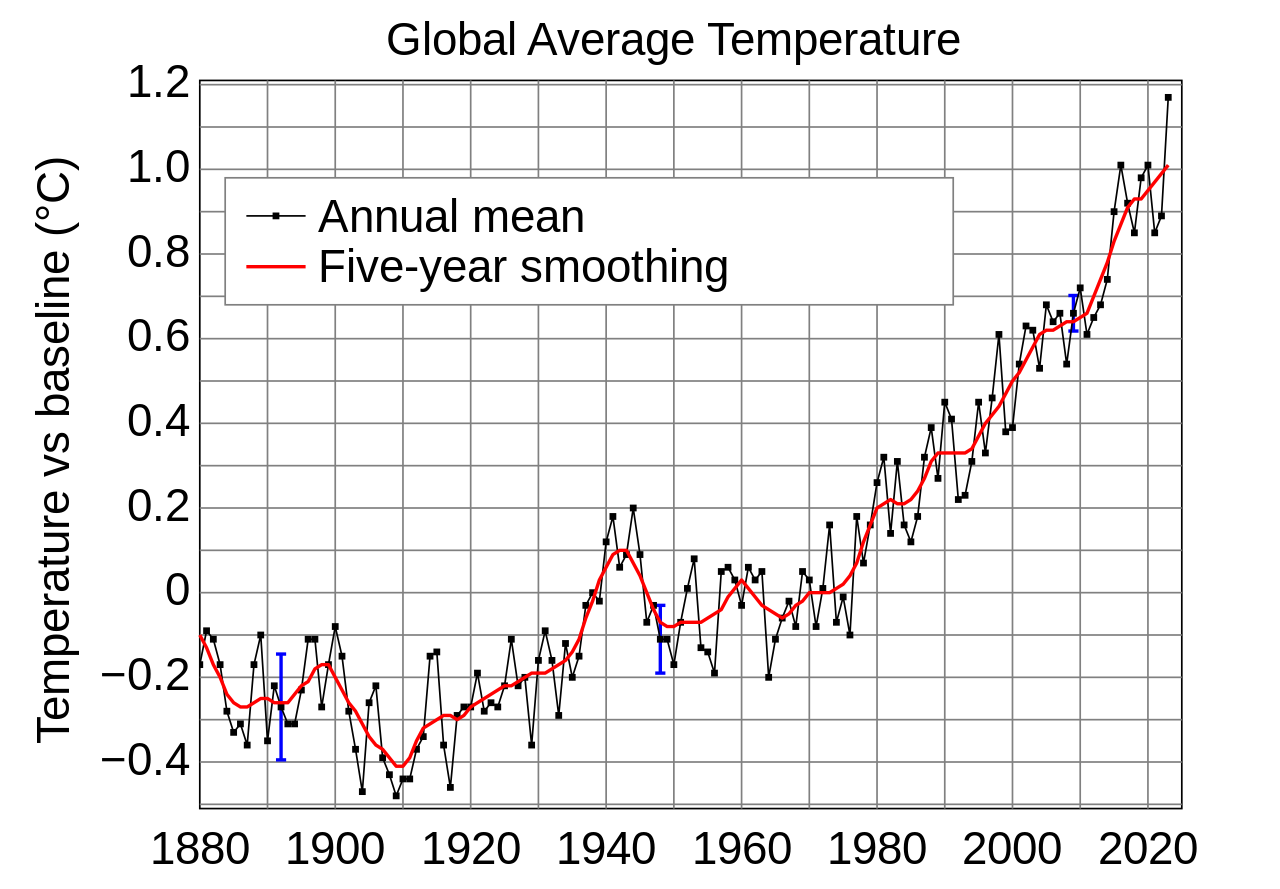
There comes a point where the model no longer accepts any progress beyond a +1.0C increase. No matter how many additional actions taken, the floor is +1.0C. It seems the immediate extinction of the human race would still result in an increase in temperature. Is there research that backs this up?

The anomaly is already approximately 1 degree C.

https://upload.wikimedia.org/wikipedia/commons/thumb/f/f8/Gl...

Re: Browser-based climate change simulation

#38
post #11

Earlier quoted context omitted.

Buildings and Industry is the heading, which covers a lot more than just housing.

Correct but there is nothing preventing the use of Passivhaus technology in commercial buildings.

Includes heavy industry presumably? e.g. no such thing as passivhaus blast furnance or a passivhaus lime kiln.

Re: Browser-based climate change simulation

#40
The authors don't include some extremely nasty feedback loops the appear to currently be happening. For example, methane release from permafrost melt.

As a result, the simulation appears to be misleadingly optimistic.

- This tool is based on climate interactive's previous one, C-Road.

- in the C-Road simulation when you click on parameters -> assumptions to add parameters about methane release through permafrost melting and human activities. By default, it's set to zero, but even their maximum values don't seem as impactful as I would expect.

- in EN-Road simulation (this one) the methane release parameters are removed! So, no possibility to add any positive feedback loops. It feels like the relation between CO2 and temperature is a simple linear equation, or close to it.

Post reply on HN