Live data from Hacker News

Ask HN: Books you plan to read in 2020?

news.ycombinator.com

291–300 of 335 posts

Re: Ask HN: Books you plan to read in 2020?

#291

Earlier quoted context omitted.

Skip design patterns, I think it locks developers into a sort of religious loyalty towards OOP abstractions. When you understand the pattern it describes you get a sort of catharsis for discovering a new interesting thing. In reality, any of these patterns are just bad despite the cleverness. Modern programming is heading in a different direction already so it'd be better to move forward without it.

Thanks for the heads up. I'm going to read it soon despite your warnings, but I'll keep what you're saying in mind while going through it.

I agree with crimsonalucard but for different reasons. This book is catalog. It's like reading a dictionary from start to finish. This becomes dull fast and you don't learn efficiently. Sure you can just use it to look a pattern up once in a while but then again you might as well read the Wikipedia article.
Re: Ask HN: Books you plan to read in 2020?

#292
post #276

Earlier quoted context omitted.

Thanks for the suggestion - I'll add Plato's works to my list. I tried to get into Republic when I was a bit younger but couldn't digest it at the time, but I wasn't very familiar with philosophy (or reading dry books in general) at the time so it would be worth another go round. I'm roughly familiar with Camus' ideas as presented in the Myth of Sisyphus, and I like the idea that one can make the fight against suffer…

That does sound very similar. I know that in my interpretation Camus is one of the possible outcomes of Nietzsche's thoughts, and that his thoughts afford for many... I think that is something that resonated with me - that _my_ philosophy does not need to be yours, but that we can still find some common ground to survive with one another. Do you have good recommendations for Zen Buddhism and systems theories? I have…

> in my interpretation Camus is one of the possible outcomes of Nietzsche's thoughts, and that his thoughts afford for many

Yeah that makes total sense. How do you respond to a meaningless universe? By imagining up our own meaning and putting value in that.

> I think that is something that resonated with me - that _my_ philosophy does not need to be yours, but that we can still find some common ground to survive with one another.

Yeah I totally agree, and I think we could benefit from more people who viewed our existence in that way.

> Do you have good recommendations for Zen Buddhism and systems theories?

Unfortunately I'm not generally that bookish - a lot of the knowledge I have on these subjects, I've picked up from thinking and practicing the ideas within, odd sources on the internet and in conversations rather than reading books. However, I can recommend Alan Watts' "The Way of Zen" and Donella Meadows' "Thinking in Systems", which I have read and both of which are fantastic.

Unfortunately sometimes systems theorists get caught up in the fine grained details such as "stock and flow" and "causal loop" diagrams and specific types of loop structure, which happens in Donella Meadows' book - the wiki page for complex systems (https://en.wikipedia.org/wiki/Complex_system) is a good entry point for the high level concerns in systems theory.

[edit] I'm also told that Godel Escher Bach is an interesting book for approaching systems concepts like self-reference and emergence in a more esoteric, example-driven way.

Re: Ask HN: Books you plan to read in 2020?

#293
AH! So many books to read.. I always get excited when I see these type of threads (because I can get new worthy books to add to my list), but on the other hand I get depressed that it is pretty damn hard to catch up with everything that I want to read.

My list would be too long to post, but these are the ones next in line: - Meditations - Digital Minimalism - I Ching - Art of War - Tao Te King - Steppenwolf - Think and grow rich

In general want to focus on books of: business, leadership, self development, productivity and spiritualism (mostly buddhism).

Re: Ask HN: Books you plan to read in 2020?

#294
post #3

I look forward to read “Meditations”[1] by Marcus Aurelius and re-read “Black Swan”[2]. On the _craftsperson_ front I’ve heard good things about “Designing Data-Intensive Applications”[3] by Martin Kleppman. Also hope to get some good recommendations here :) [1]: https://www.goodreads.com/book/show/30659.Meditations?ac=1&f... [2]: https://www.goodreads.com/book/show/242472.The_Black_Swan?ac... [3]: https://www.goodre…

Get a few different translations of "Meditations". I recommend the ones by Gregory Hays, Martin Hammond and Robin Hard. The book is basically a collection of thoughts on various aspects of cultivating one's character and developing a "stoic" approach to whatever life may throw at you. It has no overarching framework/grand theory and thus you can read the individual thoughts in random order as the mood strikes you. It…

Hey, is any of this version with modern english? The one I'm reading includes this words "thy" or similar, which makes it super hard for me to understand (english is not my native)

Re: Ask HN: Books you plan to read in 2020?

#295

Earlier quoted context omitted.

The description of Caro's books as "Harry Potter for adults" is accurate. Highly accessible, no preparation necessary

I just wish there were a Kindle edition. Eventually I'l break down and buy it but I do so much of my reading on commutes that I strongly bias towards a digital copy.

I can highly recommend the Audible version.

Re: Ask HN: Books you plan to read in 2020?

#296
post #216

Earlier quoted context omitted.

I've had this book recommended to me so many times, I might try and tackle it over the Christmas break.

I found it less interesting than I anticipated, but I think it was because we watched the PBS documentary in HS. So if you're short on time, then you could try that, it seemed to cover all the key bits :)

Oh cool, I wasn’t aware of the PBS documentary, I’ll definitely check it out. Thank you!

Re: Ask HN: Books you plan to read in 2020?

#297

I hilariously overestimate the number of books I can get through when I make these lists, but my current list for 2020 is as follows: Digital Minimalism: Choosing a Focused Life in a Noisy World The Man Who Solved the Market: How Jim Simons Launched the Quant Revolution Book of Proof Designing Data-Intensive Applications: The Big Ideas Behind Reliable, Scalable, and Maintainable Systems Seeing Like a State: How Certa…

I read Seeing Like A State exactly around this time last year, and boy did I enjoy it. It somehow went well while reading Nassim Taleb’s Skin In The Game. One was an application of the other.

Re: Ask HN: Books you plan to read in 2020?

#298

I hilariously overestimate the number of books I can get through when I make these lists, but my current list for 2020 is as follows: Digital Minimalism: Choosing a Focused Life in a Noisy World The Man Who Solved the Market: How Jim Simons Launched the Quant Revolution Book of Proof Designing Data-Intensive Applications: The Big Ideas Behind Reliable, Scalable, and Maintainable Systems Seeing Like a State: How Certa…

I am interested in what others think of Educated. I made it 3/4 of the way through and struggled to get that far. The stories seemed very repetitive.

Re: Ask HN: Books you plan to read in 2020?

#299

My top priority books: Software Requirements - Karl Wiegers Programming TypeScript - Boris Cherny Associate Cloud Engineer Study - Dan Sullivan Design Patterns - Gang of Four Refactoring - Kent Beck, Martin Fowler Programming Pearls - Jon Bentley Patterns of Enterprise Application Architecture - Martin Fowler The Pragmatic Programmer - David Thomas, Andrew Hunt CSS: The Definitive Guide - Eric A. Meyer, Estelle Weyl…

Looking at your top priority books I recalled a slide from one of Brian Will's videos on object oriented programming: "Object Oriented Programming is Bad" https://www.youtube.com/watch?v=QM1iUe6IofM&t=326s. At around the 43:51 he pulls up a slide picturing several of these (and similar) books. Here is a rough quote: "I can tell you from personal experience of having read these books that you don't need to read them. They don't have answers, they aren't going to square the circle, and you are going to waste productive years of your life trying to live up to their ideals." Now that is just one rather controversial opinion, but we are talking about potentially wasting productive years of your life so I wanted to let you know that opinion is out there. That being said, it would probably be hugely beneficial to read a few of those books and then watch a few of Brian's videos (he has three or four on the topic) and sort out your own opinion. Also, Brian's other (not controversial) videos (dozens) are excellent for learning about programming. Also, Steve Krug's Don't Make Me Think is a keeper. I thought of it last night when I was checking out at a store. I stuck my debit card into the thing, entered my PIN number, then clicked the big blue button that said "Skip PIN". The woman behind the counter said "don't worry about it; everybody does that!"

Re: Ask HN: Books you plan to read in 2020?

#300

Earlier quoted context omitted.

Times have changed where few non-greenfield projects use these patterns as well. Languages like Go and javascript will rarely have these patterns. I would avoid depending on the programming language. If you are working with Java or C++ these are the two languages where these patterns will appear, even in greenfield projects due to developer loyalty. If you are working with languages other than this, then you are more…

What has replaced them? Presumably some of the problems they intend to solve still exist. Is there some resource you can point to that says in the past when faced with situation X developers tended to use pattern Y, these days that has been superseded with way of doing things Z? I've seen some of those patterns leveraged to great effect in modern software. But genuinely curious about alternative ways to solve the sam…

This isn't about OOP vs. FP.

This is about OOP vs. everything else.

Rust, Go and javascript are three languages that are moving away from the OOP paradigm. None of those three languages are classified as functional.

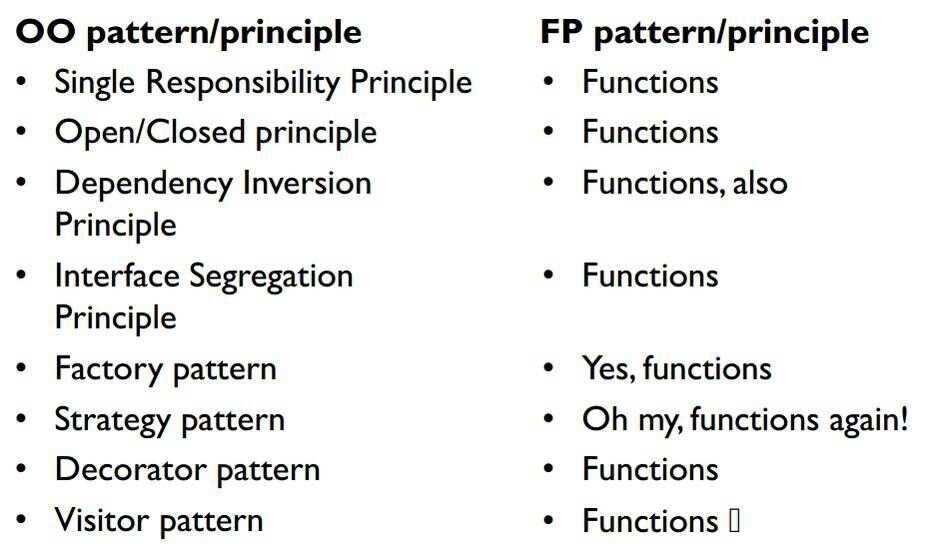
>Is there some resource you can point to that says in the past when faced with situation X developers tended to use pattern Y, these days that has been superseded with way of doing things Z?

No. A general trend is an anecdotal observation. Still a quick google search yielded: https://blog.cleancoder.com/uncle-bob/images/fpvsoo.jpg

Take a look at the following video:

https://www.youtube.com/watch?v=QM1iUe6IofM

While I don't agree with a lot of it, I think it sums up my opinion really clearly. It's not about DP's but because DP's focus around OOP and the video is a criticism of OOP therefore the arguments apply to DPs.

Post reply on HN