Test Scores Cast Doubt on U.S. Education Reform
1–10 of 64 posts
Re: Test Scores Cast Doubt on U.S. Education Reform
#2> The top performers in reading were four provinces of China — Beijing, Shanghai, Jiangsu and Zhejiang
I am not stunned at all. The comprehensive vision of the Chinese government is incredible (and reflects the brilliance of the Chinese people). The Chinese economy continues to grow at a blistering pace (with actual productivity growth unlike in the west) despite the naysayers. They use a state-sponsored industrial policy to force investment in key areas, and soon they will become the world's biggest R and D hub. They also essentially have a eugenic birth policy (with payments that can be made for more children), unlike American which is (let's face it) pretty much dysgenic with the poorest having the most kids and that burden becoming larger and larger on the greater populace. The gap in scores is only going to get bigger as America (already a much diminished country) becomes more and more irrelevant on the world stage.
Re: Test Scores Cast Doubt on U.S. Education Reform
#3Chart of PISA results of all participating countries from the source:
https://www.oecd.org/pisa/PISA-results_ENGLISH.png
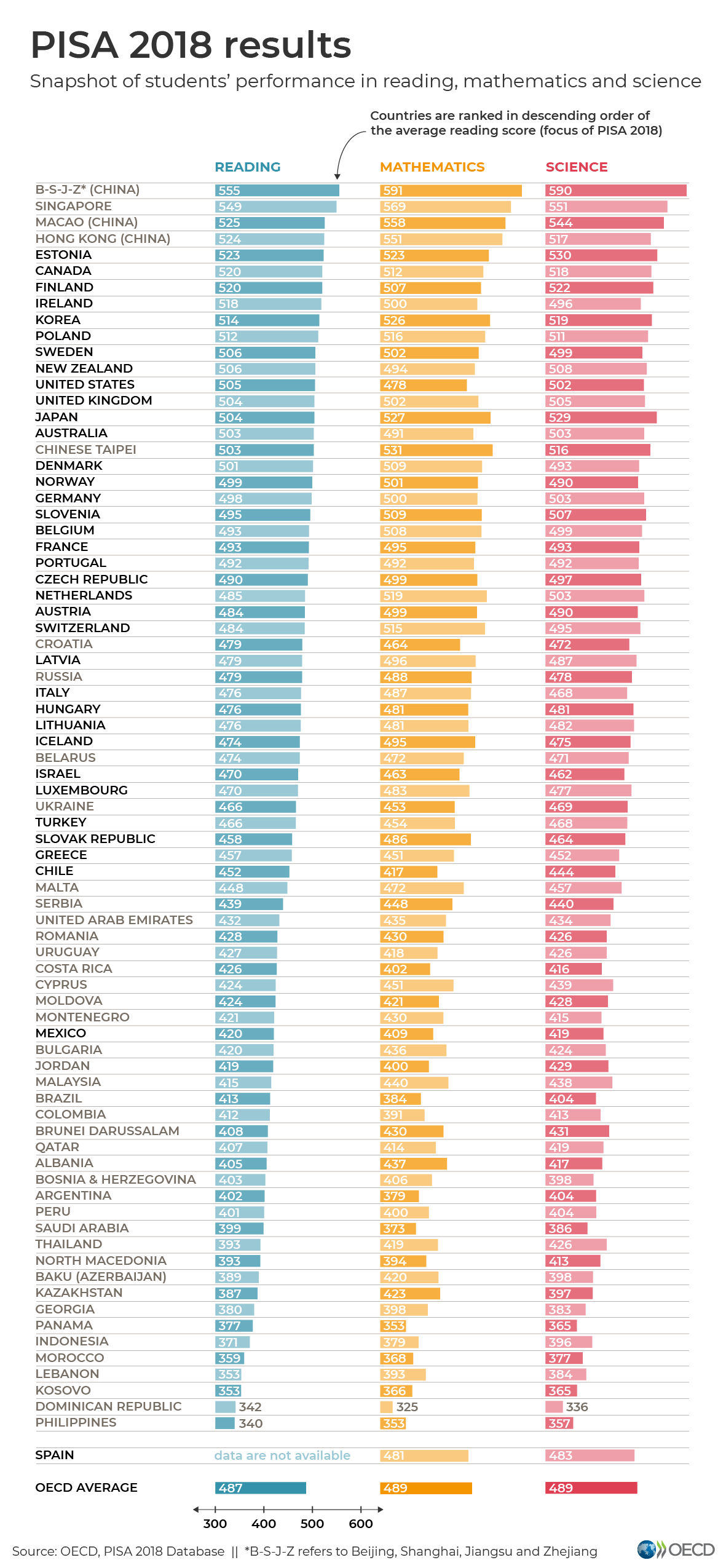
A quote from the Economist article on PISA results (which the NYT article is also based on):
“In these parts of China the average pupil’s maths score is 591, compared with an OECD average of 489, suggesting local teenagers are roughly three years ahead of the OECD average.”
Note that the total population of the four Chinese provinces that rank global top in all three PISA core subjects is about 180 million.
This following bit of insight from the same article can be implemented and should have impact over time. I would add that small class size might be more important for younger kids. At the junior high and high school levels, larger classes are acceptable when the teacher is engaging.
“Andreas Schleicher, head of education at the OECD, bemoans the fact that lots of countries have, for instance, prioritised shrinking classes over hiring and training excellent teachers, despite evidence suggesting this is a bad idea. As he points out, one place that has given the quality of the teacher priority over the size of the class is Shanghai. Another is Singapore. And they are reaping the benefits.”
https://www.economist.com/international/2019/12/03/after-two...
To handle a larger class, Singapore schools use technology such as an in-class messaging system that allows students to submit answers individually and show them all at once on screen, thus reducing the bandwagon effect and promoting independent thinking. (I saw a YouTube video on it and it was used really well.)
Re: Test Scores Cast Doubt on U.S. Education Reform
#4> Because the United States lacks a centralized system for teacher training or distributing quality instructional materials to schools, Professor Koretz said, states and districts did not always effectively carry out the Common Core or other reforms.
I’ve only got a decent sample for one state, but here the state decides what its common core standards and teaching methods will be (rewriting the national standards, I suppose to justify someone’s job) then those are filtered through districts (admin, curriculum advisors) which hopefully turn that into something useful for classroom teachers, who are to use what the district provides. Materials, plans, and so on, are typically not among what’s provided.
Districts usually whip their focus or emphasis between tested subjects (fuck untested ones, who cares, obviously) based on whatever did worst in the most recent test results. Districts can implement all kinds of their own practices or frameworks for discipline and classroom management, materials, teaching methods, class scheduling, class structure in a broad sense, and so on. These are often drawn from popular or trendy books from education researchers and consultants. Admin (principals, superintendents) are often not much on systems or game thinking so tend to partially implement whichever of these they’ve decided on (because some part is inconvenient or otherwise not something they want to do) usually in such a way as to cripple them.
Nepotism is common. Small- to medium-scale fraud is common. Administrators will find a way to spin all their decisions as positive to protect their jobs and pad their résumés for the next one, and no one with the power to correct the record will do so because it’d make the district look bad. Principals do similar things as they all want to be superintendents or at least a principal in some district easier & better known than the one they’re in now.
It’s a mess and it’s impressive it works as well as it does.
Re: Test Scores Cast Doubt on U.S. Education Reform
#5> The top performers in reading were four provinces of China — Beijing, Shanghai, Jiangsu and Zhejiang I am not stunned at all. The comprehensive vision of the Chinese government is incredible (and reflects the brilliance of the Chinese people). The Chinese economy continues to grow at a blistering pace (with actual productivity growth unlike in the west) despite the naysayers. They use a state-sponsored industrial p…
"They also essentially have a eugenic birth policy (with payments that can be made for more children), unlike American which is (let's face it) pretty much dysgenic with the poorest having the most kids and that burden becoming larger and larger on the greater populace."
Um. I don't think any of this is correct, which casts doubt on the factual validity of the rest of the post. Firstly, China's "one child policy" was never as widely spread as the government would like to think or how it appears in international media. In many places, it was "one child, except if you gave bith a girl, try again for free, afterwards there's an affordable raising in taxes, only in sectors that enforce it and you can't grease a palm to look the other way". Furthermore, even if one child policy was effective, it doesn't exist anymore- it stopped being in effect years ago.
As for America and its relationship to the poor and children, this isn't really the case. America's population is broadly shrinking, and its largest burden is actually its elderly. The only population growth in America is from immigration.
Re: Test Scores Cast Doubt on U.S. Education Reform
#6If America wants to be competitive, it has to throw away the disastrous neocon NCLBA, adapt to what works (including Finnish edu reforms covered in Where To Invade Next? ) and stop trying to "innovate" at the expense of quality or follow some moronic political mandates:
- replace most multiple choice tests with those that require specific answers and/or explanations
- almost no homework
- six years of a practical foreign language: Chinese (Mandarin), French, Spanish, Arabic or Hindi/Punjabi
- phonics (English class-specific)
- philosophy and ethics should be required
- bring back art, drama and music classes
Re: Test Scores Cast Doubt on U.S. Education Reform
#7> Because the United States lacks a centralized system for teacher training or distributing quality instructional materials to schools, Professor Koretz said, states and districts did not always effectively carry out the Common Core or other reforms. I’ve only got a decent sample for one state, but here the state decides what its common core standards and teaching methods will be (rewriting the national standards, I…
Most of your comment also acutely describes the NYC Department of Education (DOE).
Re: Test Scores Cast Doubt on U.S. Education Reform
#8It’s still baffling to me how much emphasis we still place on test scores.
Re: Test Scores Cast Doubt on U.S. Education Reform
#9[deleted]
Re: Test Scores Cast Doubt on U.S. Education Reform
#10It’s still baffling to me how much emphasis we still place on test scores.
No one can come up with anything better that provides feedback at least annually for all grades upper elementary and higher, and can be used to compare districts and schools across a state.