Live data from Hacker News

The next generation of wall chargers

theverge.com

151–160 of 203 posts

Re: The next generation of wall chargers

#151

Not seeing UL or CSA approval numbers on those. That's important for switching power supplies, especially small ones. A switching power supply is always a few milliseconds from being a short circuit across the input. And FETs fail in the ON state. That's why those things are inherently fire risks and need protection circuitry. Really tiny ones make it worse; if they fail, there's not much space to dissipate heat befo…

Consider that this article is from January 30, 2019.

There have been a lot of improvements in this space in the past 11 months.

Re: The next generation of wall chargers

#152

Earlier quoted context omitted.

??? The UK plug is gargantuan and unwieldy, and the inbuilt fuse a pointless anachronism grandfathered in via historical momentum. The Euro plug is better in every way.

I don't get why this person is being downvoted. He's right. There is such a thing as overengineering, and the UK plug is the poster child.

I don't get why either of these people are being downvoted.

So please, downvote me too. Downvotes make me feel less lonely.

Re: The next generation of wall chargers

#153
post #60
post #36

I asked a year ago When could we expect GaN to be more widely available and it seems the answer is still true as of today. GaN mosfet costs 10x more [1] than a silicon one of similar power rating. And the multiples gets wider at 15x for 1K units. I doubt we will see Apple include a GaN charger as default for quite some time. [1]: IPAW60R380CEXKSA1 (silicon) costs $1.26, IGT60R190D1SATMA1 (GaN) costs $13.

I just got a new 16" MacBook Pro and the power brick is 96W, but the same size as the 60W from a few years ago. I'd say this is likely a GaN unit, but I don't have any proof of that.

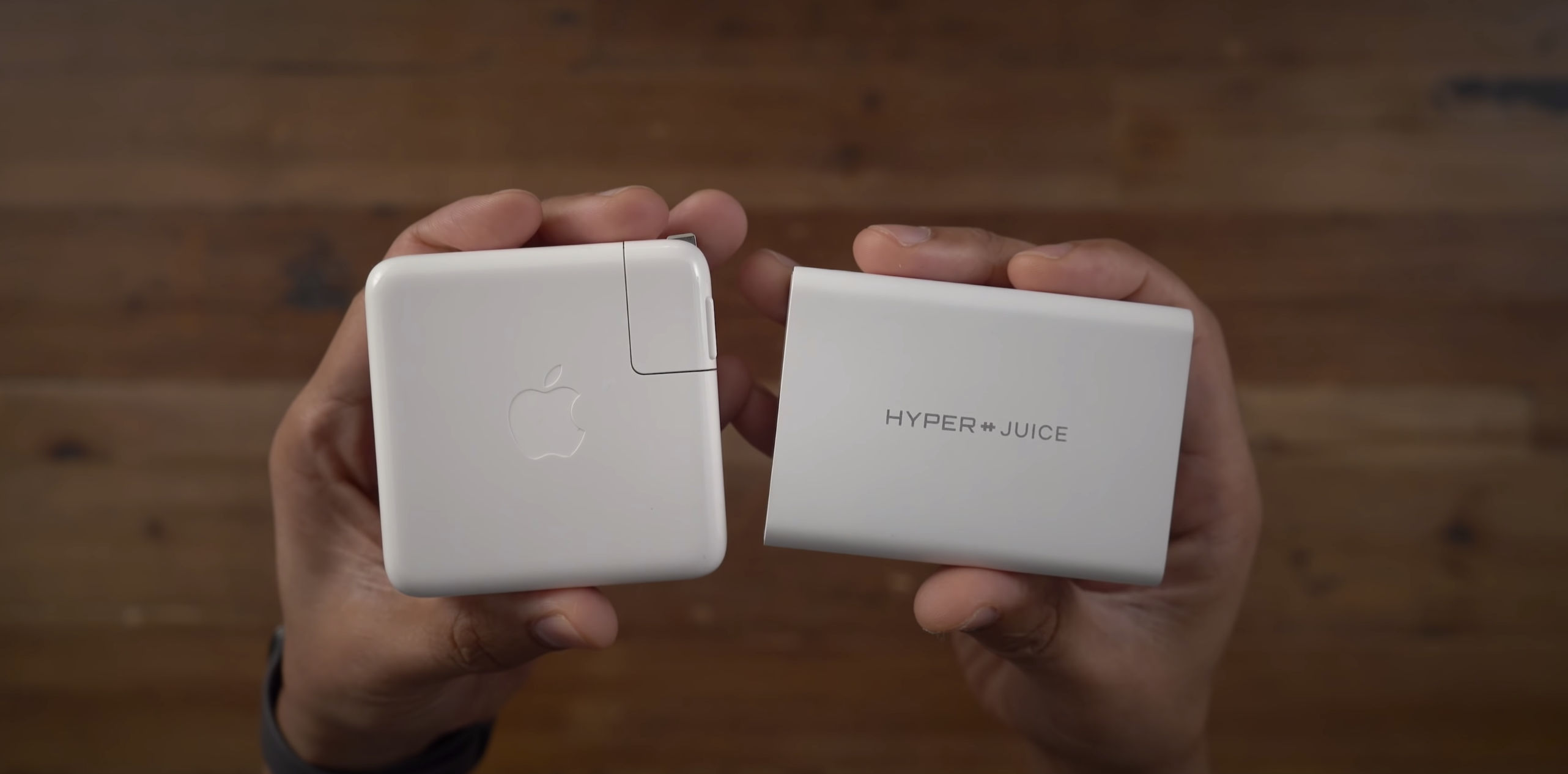
Well no, it is not, [1] is the world smallest 100W Charger with GaN and 4 Ports. And it is even smaller than the 61W MBP Charger with 1 Port.

And the link to my previous question's answer [2] from an electrical engineer. I will paste it here as well.

Cost, and the fact that it doesn't actually buy you much. I've evaluated GaN for a couple recent designs I've been involved in and found that its benefits simply didn't justify its costs. What GaN actually does is, mainly, decrease switching losses. That means switching frequency can go up, or efficiency, or power density. These are all good things, to be sure, but the magnitude of improvement GaN brings to most designs is simply not large enough to justify the cost of the parts and the increased design attention needed to use them. (They're fussy little things.) That said, I'm bullish on GaN in the medium-term. There are some cool tricks that are infeasible or impossible without them, and they really are better in a lot of ways. It'll just take a while for them to trickle downmarket, and even still they're not going to be replacing Si FETs anytime soon. (Part of the lag in GaN adoption is simply that Si FETs have gotten really, really good.)

Yes, size is the main product-level advantage of GaN. But it only lets some of the system shrink; for something like a mains charger, you still need the isolation magnetics, so your overall size is still constrained. And at the power levels of a few watts that many chargers work with, Si FETs are simply good enough. A 5W USB charger isn't going to get any smaller with GaN. It only starts to get interesting with really high power densities.

[1] https://9to5mac.com/wp-content/uploads/sites/6/2019/11/Hyper...

[2] https://news.ycombinator.com/item?id=18853313
Re: The next generation of wall chargers

#154

Earlier quoted context omitted.

I have the RAVPower 61W GaN USB-C charger for my backpack. No UL, but no noise and no issues. It's currently five stars on Amazon, for whatever that's worth. https://www.amazon.com/dp/B07TC53ZYD/

It has a fakespot rating of F, for what it's worth: https://www.fakespot.com/product/usb-c-wall-charger-ravpower...

That's a rating that indicates many online reviews from buyers are not trustworthy. Ok.

I bought the RavPower 61W, the 40W one, and some non-GaN USB C PD chargers.

They all seem really good.

Re: The next generation of wall chargers

#155

Earlier quoted context omitted.

If it's a good quality charger it shouldn't be feeding the battery enough power to impact its lifetime.

A phone will charge as rapidly as it can without undue risk to the battery's longevity. But, it's still a trade-off. If you charged slower, you would decrease risk to longevity. But when you to bed, your phone doesn't know that rapid charging convenience doesn't matter. So it will still make the same trade-off. If you use a less-powerful charger, you can force it to take its time in charging.

> But when you to bed, your phone doesn't know that rapid charging convenience doesn't matter

iPhones now know that you're going to bed and adjusts the charging to match https://support.apple.com/en-us/HT210512

I believe some Android phones have had the same feature for years now, dunno about the base android OS

Re: The next generation of wall chargers

#156
post #12

Earlier quoted context omitted.

For your bedroom you'd really want an old 5W charger. Why turbo charge and put permanent strain on your battery when anything that takes 6+ hours will do.

If it's a good quality charger it shouldn't be feeding the battery enough power to impact its lifetime.

While charging circuits are much smarter now, and the difference might be minimal, you want lower charging currents to minimize the amount of damage that is done to the materials in the battery. It is universal that higher charge rates cause more damage to the crystal structure that holds the lithium ions.

Re: The next generation of wall chargers

#157
post #89

Earlier quoted context omitted.

Schuko/Europlug is a very good system.

No, they don't distinguish hot and neutral.

I've never understood why that is important?

Incorrectly wired outlets do occur even in the US, so it seems like it's safer to take that possibility into account and just design the whole system to allow them to be interchanged (e.g. make power switches open/close both lines)

Re: The next generation of wall chargers

#158

Earlier quoted context omitted.

It has a fakespot rating of F, for what it's worth: https://www.fakespot.com/product/usb-c-wall-charger-ravpower...

That's a rating that indicates many online reviews from buyers are not trustworthy. Ok. I bought the RavPower 61W, the 40W one, and some non-GaN USB C PD chargers. They all seem really good.

> They all seem really good.

the question is what you're basing this assumption on. Fake Apple chargers also "seem really good" until they blow up or are disassembled to unveil the obvious electrical issues.

Re: The next generation of wall chargers

#159

Not seeing UL or CSA approval numbers on those. That's important for switching power supplies, especially small ones. A switching power supply is always a few milliseconds from being a short circuit across the input. And FETs fail in the ON state. That's why those things are inherently fire risks and need protection circuitry. Really tiny ones make it worse; if they fail, there's not much space to dissipate heat befo…

For anyone else not familiar with UL or CSA

https://en.wikipedia.org/wiki/UL_(safety_organization)

https://en.wikipedia.org/wiki/CSA_Group

Re: The next generation of wall chargers

#160
post #38

For Brits and visitors to our shores there's https://www.themu.co.uk/collections/muone and https://www.kickstarter.com/projects/muone/mu-two-next-gener...

The Anker box mentioned is £20 on Amazon.co.uk

I mentioned the Mu because it has a folding UK plug. Small chargers lose much of their smallness when using a standard UK plug.
Post reply on HN