Live data from Hacker News

Cut global emissions by 7.6% per year for next decade to meet 1.5°C Paris target

unenvironment.org

31–40 of 205 posts

Re: Cut global emissions by 7.6% per year for next decade to meet 1.5°C Paris target

#31
post #24

Earlier quoted context omitted.

If you break ground today on a nuclear generator, you will not see your first kwh generated for at least a decade, and that kwh will not be cost competitive with anything else on the spot market. At the same time, you could replace all nuclear in the US currently operating in around three years (even compensating for capacity factor), solely from PV manufacturing capacity in the US. It is plainly obvious why nuclear…

> If you break ground today on a nuclear generator, you will not see your first kwh generated for at least a decade. If Climate Change is so important, declare a total war against it like during WW2 against the Axis. With most production geared toward nuclear energy, you should have generator up and running a lot faster.

[deleted]

Re: Cut global emissions by 7.6% per year for next decade to meet 1.5°C Paris target

#32
post #24

Earlier quoted context omitted.

If you break ground today on a nuclear generator, you will not see your first kwh generated for at least a decade, and that kwh will not be cost competitive with anything else on the spot market. At the same time, you could replace all nuclear in the US currently operating in around three years (even compensating for capacity factor), solely from PV manufacturing capacity in the US. It is plainly obvious why nuclear…

> If you break ground today on a nuclear generator, you will not see your first kwh generated for at least a decade. If Climate Change is so important, declare a total war against it like during WW2 against the Axis. With most production geared toward nuclear energy, you should have generator up and running a lot faster.

The list of things I don't want built in a rush definitely includes nuclear reactors!

Re: Cut global emissions by 7.6% per year for next decade to meet 1.5°C Paris target

#33
post #28

Over the last 40M years, when CO2 was at current levels (400ppm), sea level was +9 to +31 meters higher. We need to reduce to 280ppm to start rebuilding ice. https://www.pnas.org/content/110/4/1209 Coastal cities are going to move.

This is not representative by current trends nor simulations (which themselves have huge error bars)

Re: Cut global emissions by 7.6% per year for next decade to meet 1.5°C Paris target

#34

I searched for 'nuclear' on that page, and found no mention of the word at all. Whatever you might think of nuclear energy, I don't think such a drastic energy cut is even possible to implement without it. (After all, I see little point in cutting CO2 emissions in the US if people in other countries emit an amount equivalent to whatever gets cut here.)

Greenpeace and the environmental movement have a lot to answer for, thanks to their knee jerk reaction to nuclear one of the technologies (note that I say "one of", there is a range of choices, not an either/or black/white choice, as is so often case on internet discussions nowadays) we ended up with more coal/oil power plants contributing towards climate change nuclear could have been the bridging technology buying…

> Greenpeace and the environmental movement have a lot to answer for

Gut instinct is that they were sponsored by shell corporations / charities to go after nuclear et. al. and leave other vested interests alone.

Re: Cut global emissions by 7.6% per year for next decade to meet 1.5°C Paris target

#35
post #30

Earlier quoted context omitted.

If you break ground today on a nuclear generator, you will not see your first kwh generated for at least a decade, and that kwh will not be cost competitive with anything else on the spot market. At the same time, you could replace all nuclear in the US currently operating in around three years (even compensating for capacity factor), solely from PV manufacturing capacity in the US. It is plainly obvious why nuclear…

Nuclear power is 20% of electricity in the United States. If you could replace it all in 3 years, wouldn’t we be better off replacing 20% of coal power over 3 years and wait a little longer on the nuclear power? If your math is right, half the grid would be zero carbon in 5 years.

Yes, you would absolutely want to stave off nuclear generator retirements as long as (safely) possible to displace carbon producing generators. I use the example only to demonstrate the ease of renewable deployments versus nuclear. You could go do a green bond offer (or PPA contract), bid out the construction project, and build a solar generation facility next to a nuclear power plant to replace its capacity. You cannot do this to build a new nuclear plant.

Coal power is going away, full stop, due to the cheap cost of natural gas and renewables. It is not cost competitive. Natural gas throttles fast; it's why California can have such a steep Duck Curve [1] and support GWs of solar generation capacity. It is a great stop gap until batteries catch up.

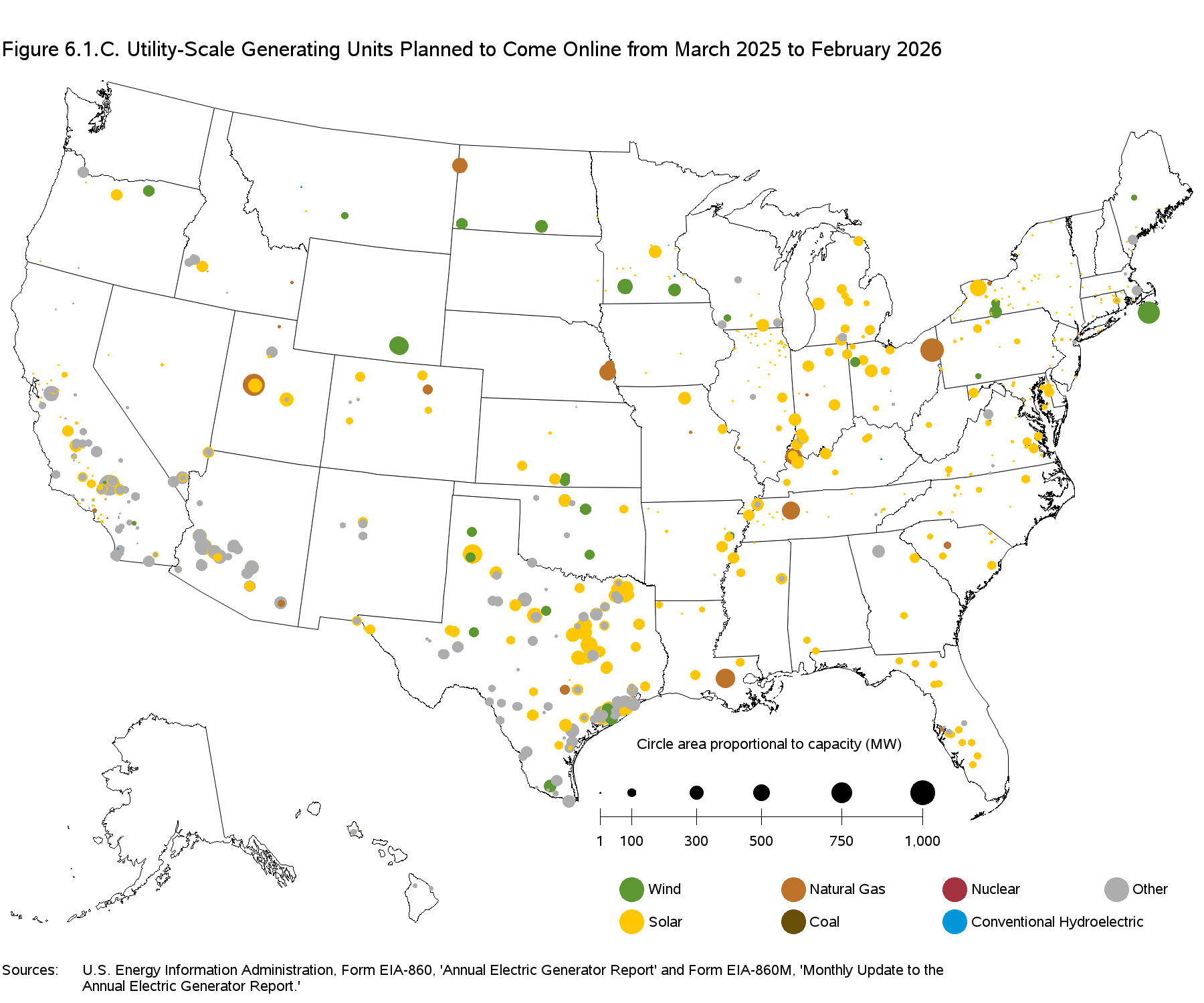
Utility scale generating plants coming online over the next year (green = wind, yellow = solar) https://www.eia.gov/electricity/monthly/images/figure_6_01_c...

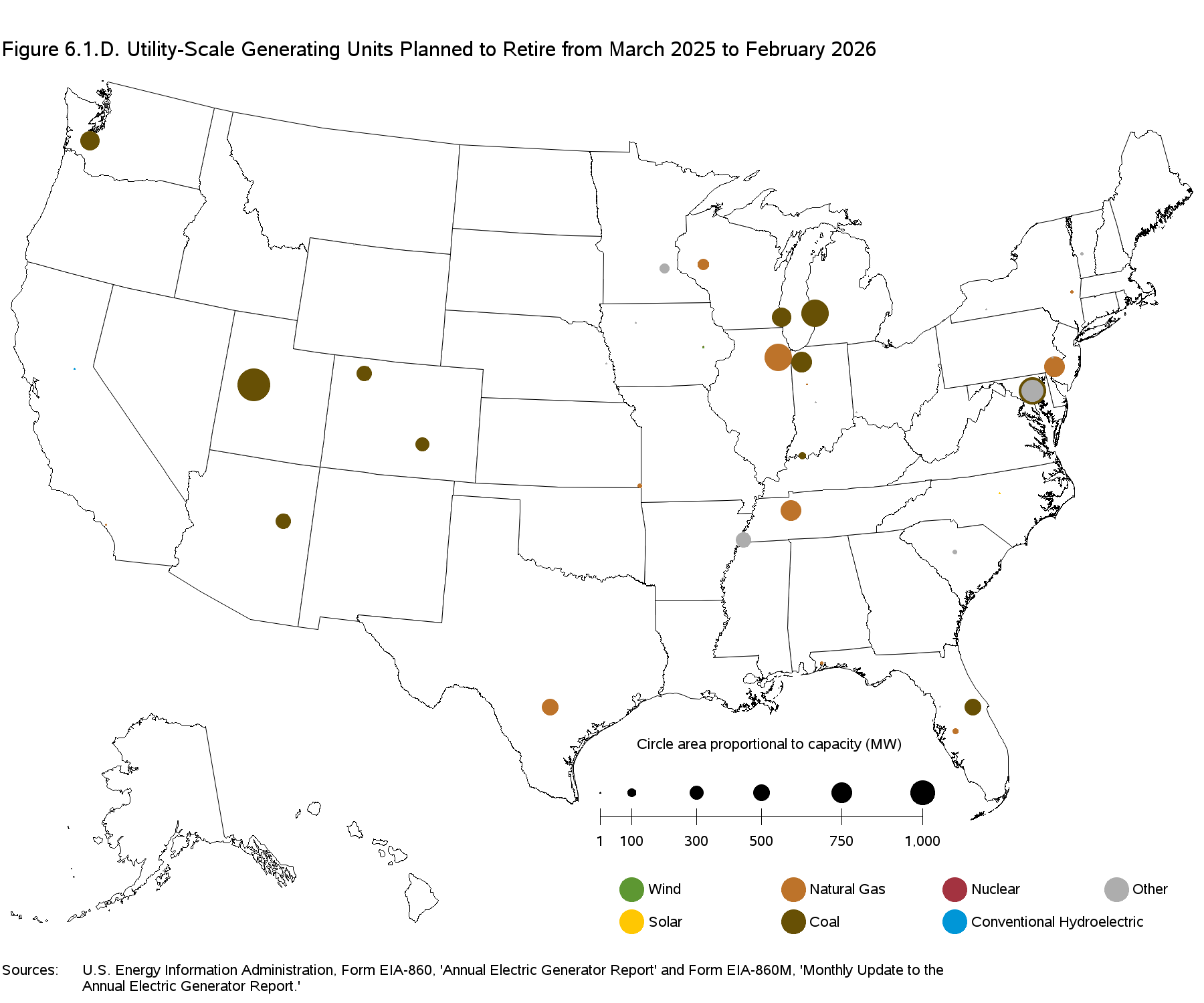
Utility scale generating retirements over the next year (gray = coal) https://www.eia.gov/electricity/monthly/images/figure_6_01_d...

[1] https://www.nrel.gov/news/program/2018/10-years-duck-curve.h... (Ten Years of Analyzing the Duck Chart: How an NREL Discovery in 2008 Is Helping Enable More Solar on the Grid Today)

Re: Cut global emissions by 7.6% per year for next decade to meet 1.5°C Paris target

#37

I searched for 'nuclear' on that page, and found no mention of the word at all. Whatever you might think of nuclear energy, I don't think such a drastic energy cut is even possible to implement without it. (After all, I see little point in cutting CO2 emissions in the US if people in other countries emit an amount equivalent to whatever gets cut here.)

The time for nuclear has passed (at least fission. Fusion may still be a good future energy source). I say this because the cost of building a new nuclear plant is more expensive than wind and solar. Nuclear might still be a good solution for northern and southern habitats. But, at this point, where most pollution is produced, solar and wind are viable. https://en.wikipedia.org/wiki/Cost_of_electricity_by_source With…

I'm not sure why the parent comment is being downvoted, it seems like a compelling argument backed up by data.

Re: Cut global emissions by 7.6% per year for next decade to meet 1.5°C Paris target

#39
post #28

Over the last 40M years, when CO2 was at current levels (400ppm), sea level was +9 to +31 meters higher. We need to reduce to 280ppm to start rebuilding ice. https://www.pnas.org/content/110/4/1209 Coastal cities are going to move.

This is not representative by current trends nor simulations (which themselves have huge error bars)

Do you have a citation for current simulations?

The +9m to +31m isn't from simulations. It's from ice core sample and sediment analysis.

Re: Cut global emissions by 7.6% per year for next decade to meet 1.5°C Paris target

#40

I searched for 'nuclear' on that page, and found no mention of the word at all. Whatever you might think of nuclear energy, I don't think such a drastic energy cut is even possible to implement without it. (After all, I see little point in cutting CO2 emissions in the US if people in other countries emit an amount equivalent to whatever gets cut here.)

Nuclear power seems to be considered too powerful to trust in the hands of many nations, making it kind of a non starter globally. My understanding is that with any type of nuclear plant, in a non trustworthy country, it would still be dependent on importing the fuel from a nuclear state, making it quite unappealing and a security risk for the purchasing state.

I kinda wish there was a NASA equivalent for nuclear that would be given 10s of billions of dollars per year to R&D safer, next gen nuclear power plants. The organization could build/run those plants around the world in order to provide less developed countries with power while preventing proliferation.
Post reply on HN