Live data from Hacker News

Offshore wind will be a $1T industry by 2040, but it's needed now

utilitydive.com

151–160 of 182 posts

Re: Offshore wind will be a $1T industry by 2040, but it's needed now

#151
post #102

Earlier quoted context omitted.

Transmission!!! A huge appeal of offshore for densely populated areas is you can put the huge turbines far off the coast of a dense area and then have very effective transmission, something which onshore is vastly limited by due to NIMBYism and lobbying and regulation.

Unfortunately, offshore gets hit by NIMBYism a lot more than it should. Senator Ted Kennedy axed wind off the Massachussetts coast because it would interfere with his view.

Anyone who complains wind-turbines being unsightly should be forced to live next to an oil-refinery :-(

Re: Offshore wind will be a $1T industry by 2040, but it's needed now

#152
post #133
post #58

This is nuts. I wonder what the effect of spending $1T on nuclear would be in comparison. I bet it's enough money to get to practical nuclear fusion in a decade, which would largely obviate the need in most other energy generation methods.

I am watching right now a conference [1] on youtube precisely on the comparison of hypothetical 100% wind vs 100% nuclear. Basically it explains that wind has a typical average utilisation of about 20% vs 70% for full nuclear. A turbine lasts about 20-30y vs 60 for a nuclear reactor. In addition, wind is producing the electricity at the edge of the network, and you loose the diversification effect of having a network…

> A turbine lasts about 20-30y

Half that.

Re: Offshore wind will be a $1T industry by 2040, but it's needed now

#153
post #87
post #60

Earlier quoted context omitted.

It's going to take a lot more than $1T and a decade for fusion to be cost-competitive with wind and solar.

How are wind and solar cost-competitive when they can exist in Germany only with extreme high subsidies? Look at the new windfarm called "Wikinger" that Germany built near the island of Ruegen: https://de.wikipedia.org/wiki/Offshore-Windpark_Wikinger Cost: 1.4 billion Euros Lifetime: 20 years Power: 350 MW Max. capacity: 0.4 (40%) Price at the electricity stock exchange Leipzig: 36 Euro/MWh Thus: 350 0.4 24 365 20*36…

> Cost: 1.4 billion Euros Lifetime: 20 years Power: 350 MW Max. capacity: 0.4 (40%) Price at the electricity stock exchange Leipzig: 36 Euro/MWh

Because wind farms have 0 fuel costs, they will operate at any price above a few eurocents per MWH. Which means once a critical mass of wind farms is operating in an area, the price frequently dives all the way to near 0. Sucks if you operate wind farms. Sucks less if you ALSO operate natural gas generators which you can then idle. And sucks a lot less if you're a consumer with dispatch able loads.

Re: Offshore wind will be a $1T industry by 2040, but it's needed now

#154
post #58

This is nuts. I wonder what the effect of spending $1T on nuclear would be in comparison. I bet it's enough money to get to practical nuclear fusion in a decade, which would largely obviate the need in most other energy generation methods.

According to the Lazard estimate of levelized cost of energy, spending the same money on nuclear fission would produce one third of the power.

Germany vs France

Full research http://www.oecd-nea.org/ndd/pubs/2019/7299-system-costs.pdf

Short https://www.forbes.com/sites/michaelshellenberger/2019/02/05...

Nuclear safer, cheaper (in short and long term) and produce less carbon emission

Re: Offshore wind will be a $1T industry by 2040, but it's needed now

#155
post #43

Earlier quoted context omitted.

You are not removing it, it is just converted to heat (in several steps).

Ok yeah, I guess the only way to remove it for now would be something like solar or wind powered carbon sequestration?

The current problem we have is the energy imbalance between incoming solar radiation and outgoing thermal radiation, since a growing proportion of the latter is blocked.

Any quantity influencing this balance could theoretically be used to get back to the old point.

The discussed options are either solar radiation management which lowers the amount of incoming radiation or carbon capture which would allow more outgoing thermal radiation to escape.

The first option has ideas such as stratospheric sulfur injections (increasing albedo leading to more reflected incoming sunlight), deploying a sunscreen in space or simply painting areas white. (It should be noted that humanity has been causing albedo changes for a long time simply by changing land cover. Forests have lower albedo than fields, for example.) The problem with the ideas is that they are very unstable. Many need constant renewal and management to be kept active. There are also side effects apparent in the model such as changed atmospheric circulation patterns for some of them, and the ocean acidification due to dissolved CO2 etc are not addressed either.

The second option, carbon capture, can be achieved by different means. Basically, carbon needs to be stored in one of the sinks available. The natural sinks are the biosphere (quite small, but increasing it will help) and chemical weathering. If we wait long enough, chemical weathering will lower the CO2 concentrations sufficiently. [0] So one of the ideas here is to increase the speed of the weathering by increasing the surface and availability of the the stone to weather. Others are increasing the biomass sink by planting more of it or fertilizing the oceans so the algae can grow faster and take a part to the ocean floors.

Then there is technical carbon sequestration, which needs energy input (you're talking about this, right?). Where the energy comes from shouldn't matter as long as the carbon emission is smaller than the sequestration. I guess all renewable energies and nuclear should work fine. (Maybe there will be a better technology at some point in the future as well, but better not rely on it.)

However, now this carbon needs to be stored, which is a problem in itself. Ideas are simply pumping it into the ground, for example depleted natural gas fields (unstable!) or changing it to other forms which needs more energy. (Any energy that can be changed to chemical energy is actually removed from the system, but that will probably not be very much. I'd have to check up on this though, I've found my intuition is not that good yet for these numbers.) There is not a lot of money in it yet, which makes research slow. This is still most probably our best shot.

All but one scenarios of the IPCC-1.5°C report have carbon sequestration from 2030 - in 10 years - (in the worst case on the order of half of current emissions!), and the one that doesn't uses biomass capture. We cannot reach a path of [0] https://skepticalscience.com/weathering.html

[1] https://www.ipcc.ch/site/assets/uploads/sites/2/2019/02/SPM3...
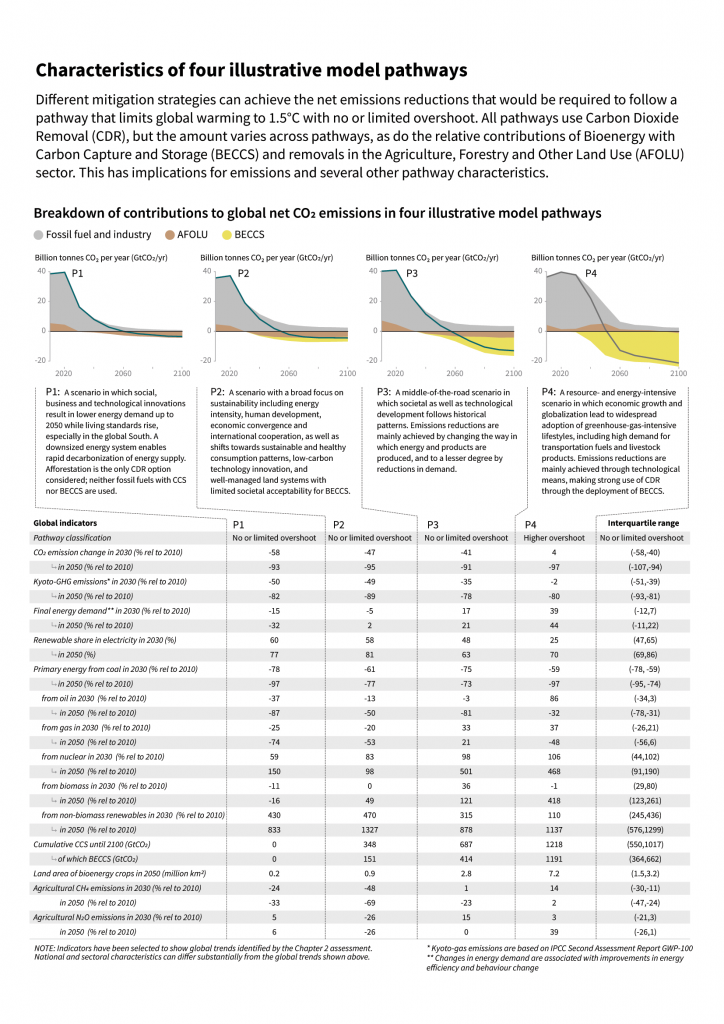
Re: Offshore wind will be a $1T industry by 2040, but it's needed now

#156
post #53

Earlier quoted context omitted.

Interesting question, seems it's still open but has been found worthy of study. There are probably research groups working on it right now. Review paper (2015): 'Impact of wind-energy generation on climate: A rising spectre' https://www.sciencedirect.com/science/article/pii/S136403211... 'Potential climatic impacts and reliability of very large-scale windfarms' https://www.pnas.org/content/101/46/16115.short#sec-2 'P…

Thanks for the links! The "green ... greeen!" guys just downvoted me to hell.

The papers all stress that wind farms are considerably better than fossil fuels no matter what, so 'accelerate' is maybe not the best way to put it. I propose 'influence'.

However, the consequences from each technology should still be debatable, and are an interesting question in itself I think. The problems start when questions become political - what are the implications? In the hard sciences we usually don't concern ourselves with that unless we have to, but when discussing sensitive research topics in public one has to be more careful since many people tend to deduce intentions where there were none. (I need to remind myself frequently.) I think your post fell victim to that.

Re: Offshore wind will be a $1T industry by 2040, but it's needed now

#157
post #87

Earlier quoted context omitted.

How are wind and solar cost-competitive when they can exist in Germany only with extreme high subsidies? Look at the new windfarm called "Wikinger" that Germany built near the island of Ruegen: https://de.wikipedia.org/wiki/Offshore-Windpark_Wikinger Cost: 1.4 billion Euros Lifetime: 20 years Power: 350 MW Max. capacity: 0.4 (40%) Price at the electricity stock exchange Leipzig: 36 Euro/MWh Thus: 350 0.4 24 365 20*36…

Why do you set a fixed price of 36 Euro / MWh for the next 20 years. At least take the phelix Futures to get a somewhat reasonable picture: https://www.eex.com/en/market-data/power/futures/phelix-de-f... (45€ Base / 53€ Peak). With the EU-ETS Certs getting more an more sparse and expensive over time, coal will be phased out more and more which will increase the price.

Germany already has the highest power prices in Europe. How much higher can this really go?

Re: Offshore wind will be a $1T industry by 2040, but it's needed now

#158

Earlier quoted context omitted.

Rooftop solar costs 2x+ as much as utility scale.

Any hope of seeing costs go down ?

Sure, costs will come down. Soft costs like permitting and marketing are high in the US compared to Europe and Australia, there's room there. The biggest way to cut costs would be to design solar into houses when they are built rather than retrofit them afterwards. In California with the solar mandate for new construction we should see both of those costs go way down.

But it will always be more expensive because of efficiency that goes with scale.

Re: Offshore wind will be a $1T industry by 2040, but it's needed now

#159
post #58

This is nuts. I wonder what the effect of spending $1T on nuclear would be in comparison. I bet it's enough money to get to practical nuclear fusion in a decade, which would largely obviate the need in most other energy generation methods.

"Bet" is the operative term here. Maybe, maybe not.

Re: Offshore wind will be a $1T industry by 2040, but it's needed now

#160
post #83

Earlier quoted context omitted.

Looks like a single fission plant costs around 6 to 9 billion and construction costs tend to go up. There's not a lot of room for iteration and learning from experience; you have to get it right the first time. Compare that with a competitive industry that's manufacturing in bulk and improving every year. Where do the lines cross?

When you spend $1T on building nuclear plants, you will be manufacturing in bulk and improving every year. Let's assume that a single fission plant costs $5B (if you're building hundreds of them, you can take advantage of some economies of scale). For $1T, you can build 200 of them. New fission plants have something like 2 GW capacity on average. 2 GW times 200 is 400 GW. Now, US uses 13 quads of BTU worth of electri…

> if you're building hundreds of them

Where is the waste being stored and how safe is that location against the drastic climate change which is now beginning to occur?

Post reply on HN