Earlier quoted context omitted.
Rather than trying to poke holes in my response you could look at all cause mortality tables for birds. You can compare wind turbines with the many other sources - heavy metal poising, car and plane collisions, habitat loss - and you can compare it to estimated turbine collisions. Cornell Ornithology Lab is a great resource. This isn't an ideal situation, but you can't talk about this sensibly without the background…
Oh I hear you on the planetary emergency, and I'm all about having multiple irons in the fire. But each pillar of the strategy should stand on its own merits. You don't get to lead with "meh the birds are not a big deal, they're mostly common ones" and then when challenged, pivot to "so what if it's endangered predatory birds? We're in an emergency here!"
Offshore wind will be a $1T industry by 2040, but it's needed now
121–130 of 182 posts
Re: Offshore wind will be a $1T industry by 2040, but it's needed now
#122how "stupid" would it be to turn all building roofs as solar surfaces and wind tunnels ?
It's also a question of retrofit vs new construction. Building it right into a new building is definitely going to be cheaper than adding it to an existing building.
What I expect to see more of is solar panels in parking lots. Easy to build over, and lots of otherwise wasted space. Plus you're getting power during business hours.
Re: Offshore wind will be a $1T industry by 2040, but it's needed now
#123Earlier quoted context omitted.
Transmission!!! A huge appeal of offshore for densely populated areas is you can put the huge turbines far off the coast of a dense area and then have very effective transmission, something which onshore is vastly limited by due to NIMBYism and lobbying and regulation.
Unfortunately, offshore gets hit by NIMBYism a lot more than it should. Senator Ted Kennedy axed wind off the Massachussetts coast because it would interfere with his view.
"NIMBYism" is a word that turns off critical thought in some people and ruins discussions.
There is a large inventory of coastlines with wind energy potential. There will be many distractions as they are developed by coal companies trying to derail those projects. That may be through astroturfing which will present itself as "NIMBYism" and divides people to weaken them.
Re: Offshore wind will be a $1T industry by 2040, but it's needed now
#124Earlier quoted context omitted.
> How many birds is it worth sacrificing to build huge wind turbine farms instead of compact nuclear reactors? As many as it takes to keep even more birds being sacrificed to keep fossil fuel plants (and in particular coal) running longer. I certainly support nuclear for non-terrestrial-power reasons, but the fact of the matter is that it just doesn't have the free market power going for it that solar and wind do and…
Solar and wind won't be the solution for the foreseeable future. The price of energy creation is good, but storage just isn't there. Consider a city like New York. How much solar power are you going to get in the winter when a big blizzard rolls through. Or how about Miami when a slow moving tropical storm comes through. You need to be able to store a more than a week's worth of energy for these huge cities. Nuclear…
Re: Offshore wind will be a $1T industry by 2040, but it's needed now
#125How easy to maintain are these? Have they gotten better in the last decade? I see these things failing all the time around me but perhaps they are just shitty and better manufacturing saves the day?
> I see these things failing all the time around me You do? Where?
Re: Offshore wind will be a $1T industry by 2040, but it's needed now
#126By far the most wind turbines have been built on land and for good reason: it's much cheaper. As long as there is space/not too many people complaining it makes more sense to build on land. Not sure exactly but on land installed wind is probably ~10x the installed capacity offshore. However on land turbines are pretty much maxed out at about 7,5MW, due to logistical difficulties of getting larger blades, towers and n…
Transmission!!! A huge appeal of offshore for densely populated areas is you can put the huge turbines far off the coast of a dense area and then have very effective transmission, something which onshore is vastly limited by due to NIMBYism and lobbying and regulation.
Additionally, a lot of densely populate coastal areas are populated quite a ways inland. You need open space around the big wind turbines for safety reasons - farmland is best.
Re: Offshore wind will be a $1T industry by 2040, but it's needed now
#127Earlier quoted context omitted.
Any hope of seeing costs go down ?
Probably not. Most of that cost is having a professional sort out the specifics of your particular installation, plus paying the dudes to scramble around on your roof and actually do the work (plus the associated liability). And even once it's all done, you take an efficiency hit because no one's roof will be at the ideal angle the way panels installed at ground level can be.
Also, a lot of ground level panels are on single-axis trackers, at least in my country, which boosts efficiency even more.
Re: Offshore wind will be a $1T industry by 2040, but it's needed now
#128Earlier quoted context omitted.
Looks like a single fission plant costs around 6 to 9 billion and construction costs tend to go up. There's not a lot of room for iteration and learning from experience; you have to get it right the first time. Compare that with a competitive industry that's manufacturing in bulk and improving every year. Where do the lines cross?
When you spend $1T on building nuclear plants, you will be manufacturing in bulk and improving every year. Let's assume that a single fission plant costs $5B (if you're building hundreds of them, you can take advantage of some economies of scale). For $1T, you can build 200 of them. New fission plants have something like 2 GW capacity on average. 2 GW times 200 is 400 GW. Now, US uses 13 quads of BTU worth of electri…
Re: Offshore wind will be a $1T industry by 2040, but it's needed now
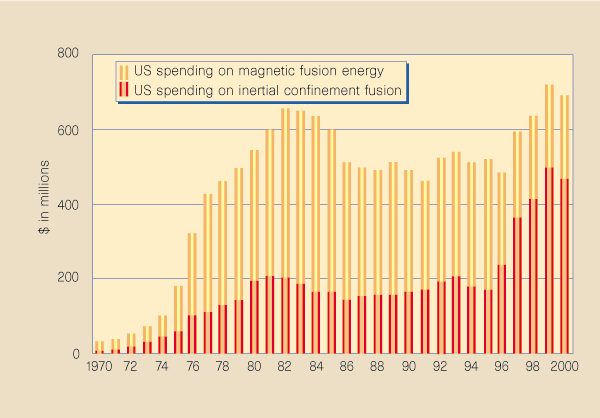
#129This is nuts. I wonder what the effect of spending $1T on nuclear would be in comparison. I bet it's enough money to get to practical nuclear fusion in a decade, which would largely obviate the need in most other energy generation methods.
[0] https://www.nature.com/articles/19368
[1] https://media.springernature.com/full/springer-static/image/...
Re: Offshore wind will be a $1T industry by 2040, but it's needed now
#130Earlier quoted context omitted.
It's going to take a lot more than $1T and a decade for fusion to be cost-competitive with wind and solar.
> It's going to take a lot more than $1T and a decade for fusion to be cost-competitive with wind and solar. Wind and solar don't even compete in the same category as nuclear until you include storage. Cheap, bursty energy is useless for base-load. Wind/solar are still far more expensive than fossil and nuclear when you take into account the over-provisioning and energy storage requirements to provide reliable base-l…
Do you have a source for that? Cost comparisons I've seen between nuclear and renewable energy doesn't reach that conclusion. https://news.ycombinator.com/item?id=21479651