Live data from Hacker News

Google Begins Testing Extension Manifest V3 in Chrome Canary

bleepingcomputer.com

11–20 of 448 posts

Re: Google Begins Testing Extension Manifest V3 in Chrome Canary

#11
post #7

Does it really kill adblockers though?

In current form, yes. The article pretty clearly states:

>Instead Google wants developers to use the declarativeNetRequest API, which has the browser, not the extension, strip content or resources from a visited web sites. This API, though, has a limit of 30,000 rules that can be created.

>Unfortunately, this change will break popular ad blockers such as uBlock Origin, which rely on the original functionality of the webRequest API and need more rules than are available in the declarativeNetRequest API.

Looking at an old picture of ublock origin block lists: https://www.bleepstatic.com/images/news/u/1100723/uBlockOrig... we can see 150,000 rules. The whole point of a rules list (easylist/easyprivacy) is that they're easy to maintain, since it should be a surprise to no one that adding new ad domains is trivially trivial. EasyList alone is 30,000 rules and it alone is woefully insufficient for a modern-day browser. The declarativeNetRequest only allows for ONE type of filter to work. The static kind, i.e. the old, deprecated, bad, insufficient kind.
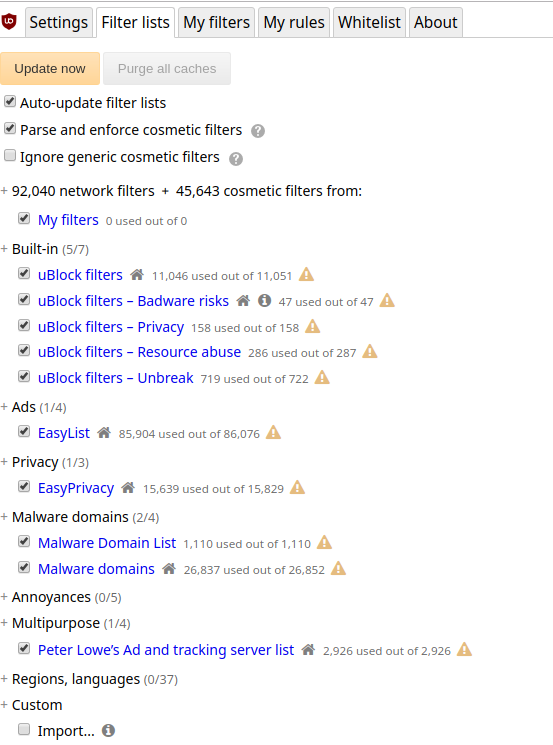
Recommended reading: uBlock Origin developer's comments on this change (unanswered by google ofc) https://bugs.chromium.org/p/chromium/issues/detail?id=896897...

Re: Google Begins Testing Extension Manifest V3 in Chrome Canary

#13

I wonder how much of this is actually about Adblockers... vs Googlers just wanting to make some performance numbers go up in aggregate to make their own internal company stats better. Cos sure as hell no user is waiting for this.

Google's internal motivation doesn't really matter.

Re: Google Begins Testing Extension Manifest V3 in Chrome Canary

#14

I wonder how much of this is actually about Adblockers... vs Googlers just wanting to make some performance numbers go up in aggregate to make their own internal company stats better. Cos sure as hell no user is waiting for this.

Given that they added an arbitrary limit to the number of rules that is high but not quite high enough for modern adblockers I'm gonna assume this was intentional.

Re: Google Begins Testing Extension Manifest V3 in Chrome Canary

#15
This is the point in the dominance cycle where the dominant player decides they no longer need to be the fastest or the most secure and that their dominance will allow them to coast along doing their thing.

There’s nothing particularly inevitable about what happens next, but let’s hope they get an IE6-sized kick in the teeth.

Re: Google Begins Testing Extension Manifest V3 in Chrome Canary

#16
post #7

Does it really kill adblockers though?

In current form, yes. The article pretty clearly states: >Instead Google wants developers to use the declarativeNetRequest API, which has the browser, not the extension, strip content or resources from a visited web sites. This API, though, has a limit of 30,000 rules that can be created. >Unfortunately, this change will break popular ad blockers such as uBlock Origin, which rely on the original functionality of the…

The way ad-blockers work at the moment is that the authors of ad-blockers work hard to not break the websites they block adverts on. This is good for users. This change means ad-blockers will need a different, simpler approach that probably will break far more websites. For example, you could write a very simple ad-blocking script that just denied requests to load JS from any third-party domain. That would break a lot of websites, but you wouldn't see many adverts.

I'd rather have lots of broken websites than websites with adverts. I suspect a lot of web users feel the same way.

Re: Google Begins Testing Extension Manifest V3 in Chrome Canary

#17

I wonder how much of this is actually about Adblockers... vs Googlers just wanting to make some performance numbers go up in aggregate to make their own internal company stats better. Cos sure as hell no user is waiting for this.

Apple/Safari adopted pretty much the same architecture on Ad Blockers. Maybe just maybe the conspiracy theories are all wrong, and there was actually a legitimate, technical reason for choosing a restricted API.

Safari has a much larger limit for blocking list entries though.
Post reply on HN