Live data from Hacker News

Leonard Kleinrock on what went wrong with the internet

latimes.com

171–180 of 327 posts

Re: Leonard Kleinrock on what went wrong with the internet

#171

Personally, I think the internet has changed millions if not billions of lives for the better. Yes, it has introduced quite a few bad things like spam, malware, surveillance etc. but with most good things, comes a few bad things. Overall though, Internet has been tremendous in lifting so many people out of poverty AND creating jobs that otherwise people could not dream of before the internet. I can work for anyone ov…

I don't understand your theory of how the internet has "lifted so many people out of poverty". I'm not saying I disagree with it necessarily, I don't even understand what you're suggesting enough to disagree or agree with it. It's definitely not _obvious_ to me that the internet has somehow lifted so many people out of poverty, I just don't understand what you mean.

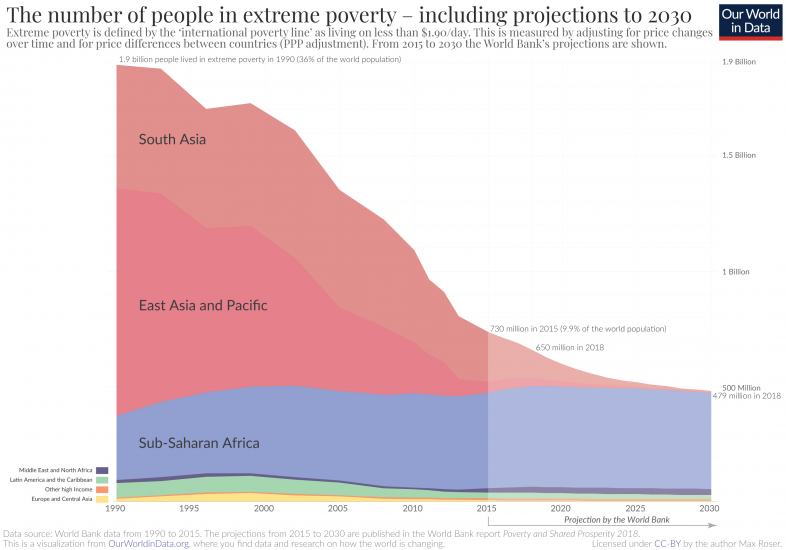
The number of people in extreme poverty globally have dropped roughly 650m since 1990. Some part of that is probably due to the internet though I'm not sure you could say how much exactly. (Our World in Data graph https://ourworldindata.org/uploads/2019/04/Extreme-Poverty-p...)
Re: Leonard Kleinrock on what went wrong with the internet

#172

Personally, I think the internet has changed millions if not billions of lives for the better. Yes, it has introduced quite a few bad things like spam, malware, surveillance etc. but with most good things, comes a few bad things. Overall though, Internet has been tremendous in lifting so many people out of poverty AND creating jobs that otherwise people could not dream of before the internet. I can work for anyone ov…

>With all the hate social media gets for example, imagine a life without them again.

Easy, that's my life right now

>I say this as someone who hardly uses it but knows that it is there if I want to communicate with someone I care about. Do you really want to send physical letters again ? Yes they have their charm and nostalgia but I am not willing to trade the convenience of internet for something worse or outdated.

That all fits in the original, "utopian" if you want, view of the internet espoused in the article. You can do that with email, IMs like IRC, personal webpages. Facebook-style social media, with its surveillance, addictiveness, toxic feedback loops, is irrelevant to this task.

Re: Leonard Kleinrock on what went wrong with the internet

#173
post #124

Earlier quoted context omitted.

Small nit - a person can learn Hindi (the language) or Hinduism (the religion) but not Hindu.

And there’s our smudgeness.

It's not clear to me how the correction of a cultural nature is being smug. The poster in question even admitted it was a "small nit", but it's still useful information for both the poster, and other readers.

Re: Leonard Kleinrock on what went wrong with the internet

#175

Earlier quoted context omitted.

Very insightful. No, I'm not being sarcastic. The internet has in general been great for literally billions of people, but it's not an unalloyed good. It has a dark side, which Adams foresaw. Some people need to be kept isolated. It's great that people who suffer from some rare condition can find and support each other. It's not so great that Nazis can. I don't know the solution. I'm not sure anyone does, or even tha…

The darker phenomenon is that there seem to be a lot more Nazis (sympathizers at least) than one would deem normal.

I think they've always been there. They've just been quiet about it, because they've been relatively isolated. The internet has allowed them to find each other, form stronger communities, and coordinate their actions (of which upvote/downvote brigades on sites like this one are the least of our worries BTW), making the whole much more potent than the sum of its parts. As I said, this same ease of communication is wonderful when it's all in a good cause, but it can also be used in a bad one.

Re: Leonard Kleinrock on what went wrong with the internet

#176
post #121
post #110

Earlier quoted context omitted.

Well, a homeless person with a smartphone has a hell of a lot better chance of getting a job than they did pre-smartphone, right? Maybe this can count as more of a smartphone thing an internet thing.. but it's still largely an internet thing that would allow someone in a rough spot to still be able to connect with people online and look/apply for jobs.

> Well, a homeless person with a smartphone has a hell of a lot better chance of getting a job than they did pre-smartphone, right? Not that I know the answer, but I would have to see a source on this. Why would a device that may increase access to job postings, but a non-homeless job candidate is much more likely to have than a homeless person, increase the chances of said homeless person in getting a job? I'm not e…

I’ve worked with and volunteered with an org who among other things got smart phones to our local homeless.

Yes, it does help quite a bit. It’s a $50-100 setup and even without data they can go to any million places with free WiFi and get emails, call job listings, keep in touch with family members. It’s a pretty big deal to them.

Re: Leonard Kleinrock on what went wrong with the internet

#177
post #103

I find this post quite disappointing. I don't mean to come off harsh but it is quite naive and utopian and I cannot take the call to arms seriously. Saying the internet went wrong is like saying the invention of cars went wrong cause we still have car accidents. For every powerful force in the world, it will be a source of good and bad things. The internet has changed the world, increased communication, allowed peopl…

>A person in Nigeria can teach themselves Hindu, just from pure curiosity and no budget Again, these are poor examples. It's not terribly easy to learn a language for free using just the internet. Everything is freemium and it's only getting worse. It's arguably easier to go to your local library and use their resources. Many people have this idea that some things would be impossible if not for the internet, but that…

I've been using the internet to learn a language for a month now, and have had far more success then I had in multiple years of high school language classes.

Between tools that provide Spaced Repetition learning, to websites that are basically textbooks, to youtube videos both meant to teach and others that are native media, and finally people who curate all these materials, this is way better.

Re: Leonard Kleinrock on what went wrong with the internet

#178

Earlier quoted context omitted.

I don't understand your theory of how the internet has "lifted so many people out of poverty". I'm not saying I disagree with it necessarily, I don't even understand what you're suggesting enough to disagree or agree with it. It's definitely not _obvious_ to me that the internet has somehow lifted so many people out of poverty, I just don't understand what you mean.

Created jobs, increased global trade, allowed for people to teach themselves, new types of products available, higher awareness about what is going on around you, technology share, open source, free products etc.

Creating jobs isn't good by itself if the work being done is to a bad end. Despite how much promise the internet has for free information, lots of people have been paid to pollute it with garbage that is the opposite of helpful. Or to spy on people so that knowledge can be used against them. The internet is a great thing technology wise, but it has enabled bad actors as much as enabling humble and well intentioned people.

Re: Leonard Kleinrock on what went wrong with the internet

#179
In summary, the internet initially reflected the values of its socially conscientious creators, but as the community diversified it was used for business (making money, marketing, spam), it suffered cyber attacks, nations are balkanizing regions of it with censorship firewalls, and businesses are exploiting our privacy. Users need to spend more time reviewing privacy agreements. Scientists need to work harder on encryption.

Simply the internet has always reflected the segment of society that used it. Now that everyone uses it it reflects society at large. So I don’t think this is an internet problem, but rather an opportunity to see the worlds social problems being translated into a more transparent codified form. I reject the author’s two solutions as being low effort addendums. Let us acknowledge we are not seeing new problems, but rather we are seeing old problems with a new lens.

Re: Leonard Kleinrock on what went wrong with the internet

#180
post #171

Earlier quoted context omitted.

I don't understand your theory of how the internet has "lifted so many people out of poverty". I'm not saying I disagree with it necessarily, I don't even understand what you're suggesting enough to disagree or agree with it. It's definitely not _obvious_ to me that the internet has somehow lifted so many people out of poverty, I just don't understand what you mean.

The number of people in extreme poverty globally have dropped roughly 650m since 1990. Some part of that is probably due to the internet though I'm not sure you could say how much exactly. (Our World in Data graph https://ourworldindata.org/uploads/2019/04/Extreme-Poverty-p... )

The often-repeated trope, touted as an achievement of capitalism, relies on defining "not poor" as earning 2$ PPP per day, or 60 bucks a month, or 700$ = 0.7k per year.

Not to mention, ignoring any other measures of quality of life or progress besides raw dollars. It's judging capitalism via a metric internal to capitalism. Pure circular reasoning. E.g. subsistence farmers in rural areas made 0$ and were "poor" by that metric, now they work 14h a day at factories for 2$ a day and are "not in poverty" anymore. Congratulatory handshakes all around!

Post reply on HN