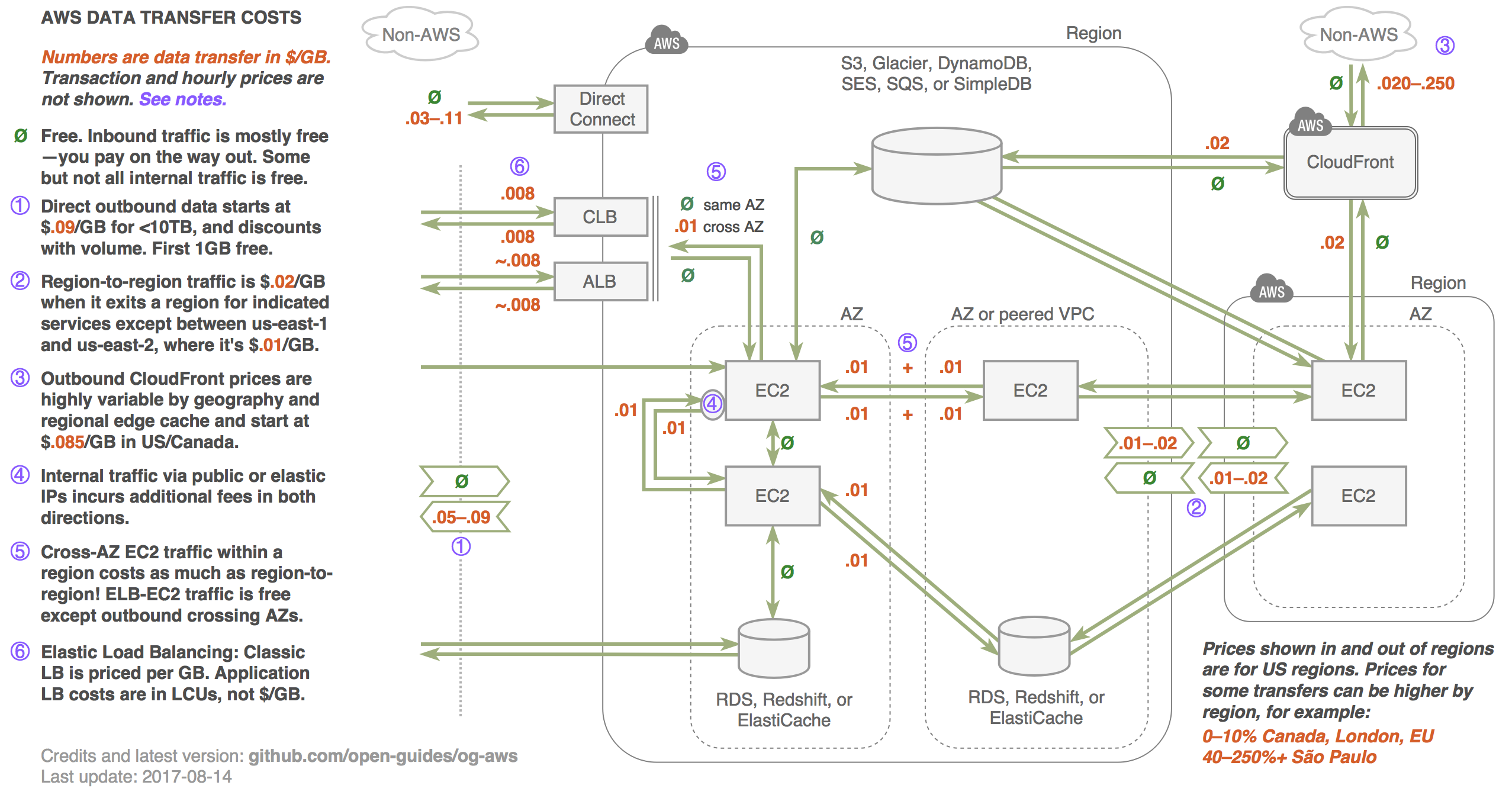
"The charges don’t appear to be a case of cloud providers gouging their customers" I disagree on this one. The margins on egress are, well...egregious.
The point is to make it easy to move data in and hard to move it out.
Just like a roach motel!
21–30 of 252 posts
Earlier quoted context omitted.
At some point everyone realized they could charge a massive premium per bit and as long as everyone did it, customers would have to pay. So here we are.
Customers are also to blame, when comparing the costs of two services they tend to look at the cost of an instance hour, or lambda execution and often don't look at transfer costs. Even if a cloud provider had competitive transfer costs they likely wouldn't attract any new customers and would have less margin left over to subsidize the main cost customers look at, $ per instance hour. The less attention is paid to tr…
(Source Open Guide to AWS - https://github.com/open-guides/og-aws)
As far as I know, Apple would never share cost data like this, nor would a lot of others on this list. Apple doesn’t even publicly acknowledge that they are customers.
Is there a plausible explanation why egress fees from cloud providers costs around $0.1/GB? "Traditional" server providers such as Hetzner are able to offer bandwidth at orders of magnitude lower price (eg. $1.1/TB). I understand that cloud providers may have better interconnects or better uptimes, but that doesn't justify the magnitudes higher pricing.
They want you to keep all of your data in their cloud, do all your processing there using their services (because doing it elsewhere incurs expensive egress fees), and get paid handsomely for your need to actually serve the data to your customers.
This also makes a migration additionally expensive, because you would need to egress all your data (old logs, some fresh backups, etc) in a short while.
So it's basically a soft lock-in.
For a service I built on AWS lambda, the far majority of the cost was just data egress. Unfortunately I haven’t found a competitor that offers the same kind of features that I’m using lambda for (running golang with additional custom binaries)
Is there a plausible explanation why egress fees from cloud providers costs around $0.1/GB? "Traditional" server providers such as Hetzner are able to offer bandwidth at orders of magnitude lower price (eg. $1.1/TB). I understand that cloud providers may have better interconnects or better uptimes, but that doesn't justify the magnitudes higher pricing.
ie a $20/mo instance on linode gets you 4TB of transfer -- $0.005 per gig. Scale enough of these in various DCs around the world and you have a pretty cheap self-hosted CDN.
Earlier quoted context omitted.
At some point everyone realized they could charge a massive premium per bit and as long as everyone did it, customers would have to pay. So here we are.
Customers are also to blame, when comparing the costs of two services they tend to look at the cost of an instance hour, or lambda execution and often don't look at transfer costs. Even if a cloud provider had competitive transfer costs they likely wouldn't attract any new customers and would have less margin left over to subsidize the main cost customers look at, $ per instance hour. The less attention is paid to tr…
The issue with per-bit pricing is that a fair agreement for network use would probably look like paying a fee that makes up for the amortization of the network equipment. Anything else is an artificially restricted market created in an attempt to extract more value out of consumers by having them bid against each other.
At some point, yes, we will run out of places to put the switches and routers and then the cost of connectivity will be closer to the cost of land use and will mimic rent, but we are a ways away from that.