Tangentially related; I can't fathom why the US insists on stop signs and traffic lights everywhere. A neighborhood I used to drive through on my way to work had 4 way stops sprouting up constantly. The massive waste of resources involved in hauling 2 tons of steel and glass down from speed to 0, for _absolutely no reason 99% of the time_, accelerating it back up to speed again, just to do the same, over and over, bo…
> The massive waste of resources involved in hauling 2 tons of steel and glass down from speed to 0 Even without slowing down this is huge waste of resources. The fact we allow people to do this is insane. > When I rule the world, there will be a ban on 4-way stops, red arrows, and parking lots without walkways. You are insane if you think you can make cars safe. They should just not be around people at all.
Car tires biggest likely source of microplastics in California coastal waters
221–230 of 232 posts
Re: Car tires biggest likely source of microplastics in California coastal waters
#222Earlier quoted context omitted.
I dunno about no plastic but there may be less plastic tires. Maybe. When I last bought new tires, I found out that tires lose a ton of their performance even at 50% wear rating. I thought I was doing well picking better tires than factory for my vehicles but it turns out any new tire would have had better handling because it was new. As is common, people don't talk about the problems with their product until they ha…
There are also significant decreases in performance due to wear isn't due to the material itself, but also the change in geometry. For instance, when rain grooves wear down, they're not able to channel away as much water.
Re: Car tires biggest likely source of microplastics in California coastal waters
#223Earlier quoted context omitted.
Current technologies are too far behind in speed though. Passengers will trade better wifi, food, space, etc, in exchange for longer travel times but only up to a point. If a New York to LA trip goes from 5 to 25 hours then it's no longer viable. Unfortunately the radius that trains can be competitive barely reaches from LA to SF.
>Current technologies are too far behind in speed though. That depends entirely on the distance traveled; no one is suggesting a replacement of transcontinental flights with trains. But there's plenty of medium and short haul flights (for example) that would be far more comfortable on a train with little difference in total travel time once you've factored airport security overhead. I'll give you a practical example:…
Adding a train line requires an immense real-estate investment, likely with lots of battles with existing land owners who don't want to sell. After that, you're stuck with that route whether it makes money or not, and how many riders really travel between those cities in the first place?
This is the problem with CA's high speed rail line. They ended up placing both ends in the middle of nowhere when even the LA->SF route would have barely gotten the ridership needed to work.
Planes can reroute all the time and independently control schedules and payloads to account for actual passenger demand, while also only needing an airport on either end which already exist.
If a train was built, you'd be paying 10x more for a ticket than the airline. Is that something you would do? Something many others would do?
Re: Car tires biggest likely source of microplastics in California coastal waters
#224Earlier quoted context omitted.
Current technologies are too far behind in speed though. Passengers will trade better wifi, food, space, etc, in exchange for longer travel times but only up to a point. If a New York to LA trip goes from 5 to 25 hours then it's no longer viable. Unfortunately the radius that trains can be competitive barely reaches from LA to SF.
>Current technologies are too far behind in speed though. That depends entirely on the distance traveled; no one is suggesting a replacement of transcontinental flights with trains. But there's plenty of medium and short haul flights (for example) that would be far more comfortable on a train with little difference in total travel time once you've factored airport security overhead. I'll give you a practical example:…
Adding a train line requires an immense real-estate investment, likely with lots of battles with existing land owners who don't want to sell. After that, you're stuck with that route whether it makes money or not, and how many riders really travel between those cities in the first place?
Planes can reroute all the time and independently control schedules and payloads to account for actual passenger demand, while also only needing an airport on either end which already exist.
If a train was built, you'd be paying 10x more for a ticket than the airline. Is that something you would do? Something many others would do? Just to get there at basically the same time in the end?
Re: Car tires biggest likely source of microplastics in California coastal waters
#225Earlier quoted context omitted.
Maybe California should worry about having adequate affordable housing before worrying about where said housing is located.
yeah fuck em, lets just put them next to the oil distilleries in Richmond. freeway and air pollutants.
Re: Car tires biggest likely source of microplastics in California coastal waters
#226Earlier quoted context omitted.
Ford was shipping cars with asbestos brakes in 1993. Asbestos brakes are still readily available on the aftermarket. Brake pads since 2015 sold in California and Washington must have less than 0.1% asbestos by weight (it's unclear to me if that's asbestos alone, or asbestos and other heavy metals like cadmium or mercury). Since the ban was put into place in 2015, you can reasonably infer a) that there were brake pads…
the subway brakes in washington dc are abestos brakes. you can smell them quite strongly.
Re: Car tires biggest likely source of microplastics in California coastal waters
#227Earlier quoted context omitted.
>Current technologies are too far behind in speed though. That depends entirely on the distance traveled; no one is suggesting a replacement of transcontinental flights with trains. But there's plenty of medium and short haul flights (for example) that would be far more comfortable on a train with little difference in total travel time once you've factored airport security overhead. I'll give you a practical example:…
Sure, but then I'll point to my other comments that politically and economically this isn't viable. Adding a train line requires an immense real-estate investment, likely with lots of battles with existing land owners who don't want to sell. After that, you're stuck with that route whether it makes money or not, and how many riders really travel between those cities in the first place? This is the problem with CA's h…
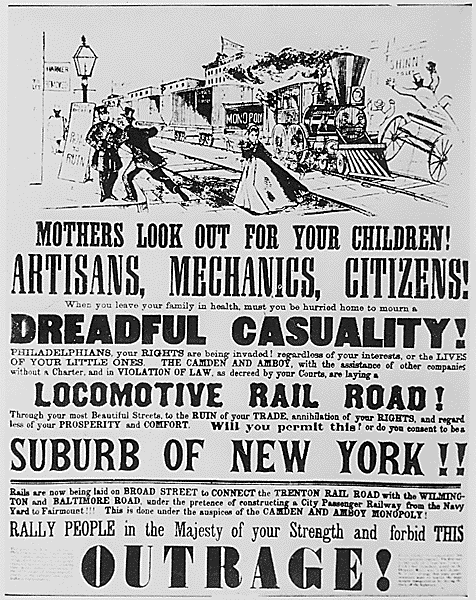
https://www.archives.gov/files/education/lessons/anti-rail/i...
The same arguments against rail can be made (for example) against new roads and exactly for the same reasons: they just go one place, you have to fight land owners to put them in and what if no one uses them?
Re: Car tires biggest likely source of microplastics in California coastal waters
#228Earlier quoted context omitted.
I may be being a bit of a pedant but do you mean roundabout? Traffic circles and roundabouts are different. A traffic circle, in the modern sense, does not have much horizontal deflection on the entering legs. The diameter is also smaller and there is not a truck apron. A roundabout on the other hand has some form of horizontal deflection and a truck apron. Often times a traffic circle can be installed by placing a r…
You are correct, it is technically a roundabout. $1.3 million for a single lane roundabout with a raised median. Does that cost sound reasonable?
Re: Car tires biggest likely source of microplastics in California coastal waters
#229Earlier quoted context omitted.
I may be being a bit of a pedant but do you mean roundabout? Traffic circles and roundabouts are different. A traffic circle, in the modern sense, does not have much horizontal deflection on the entering legs. The diameter is also smaller and there is not a truck apron. A roundabout on the other hand has some form of horizontal deflection and a truck apron. Often times a traffic circle can be installed by placing a r…
Traffic circles and roundabouts don't exist. Those things are all called rotaries. The tiny ones are inherently defective, especially for large vehicles. The larger rotaries can be nice, especially when installed above a freeway that intersects with low-volume roads, but they are too costly unless the land is very cheap. A decent use of a rotary is in Massachusetts where Drum Hill Road and Old Westford Road meet US 4…