As a long term user of Anki, I think the hype here is too much. Spaced repetition helps you learn facts, but that is such a limited representation of what learning something means. I get that the point of a mnemonic medium is to improve your memory, but the focus on memory in and of itself is reductive. Memorising things helps no one gain a better understanding. If anything, it’s just a way to avoid the mental effort…
How can we develop transformative tools for thought?
21–30 of 79 posts
Re: How can we develop transformative tools for thought?
#22Earlier quoted context omitted.
Particularly interesting to think about the memory feats of the ancients--who didn't even have computers. It really makes you wonder what kind of secret techniques ancient bards and philosophers used.
There's a few factors at play. To name a couple: 1) A lack of ability to outsource memory to the written word. I forget who it was, but either Plato or Aristotle was famously against writing because they said it would degrade human's capacity for memory (and "learning" if I recall correctly, though this was arguably wrong). 2) Perhaps even more importantly, the content of the time was shaped to the available medium.…
Re: How can we develop transformative tools for thought?
#23As a long term user of Anki, I think the hype here is too much. Spaced repetition helps you learn facts, but that is such a limited representation of what learning something means. I get that the point of a mnemonic medium is to improve your memory, but the focus on memory in and of itself is reductive. Memorising things helps no one gain a better understanding. If anything, it’s just a way to avoid the mental effort…
The key insight that Nielsen is advocating for is to use spaced repetition for concepts , not just facts. Understanding comes first, and then you deliberately try to cement a rich network that understanding in your long term memory. Personally, I’ve found this a revolutionary approach to learning.
Re: How can we develop transformative tools for thought?
#24As a long term user of Anki, I think the hype here is too much. Spaced repetition helps you learn facts, but that is such a limited representation of what learning something means. I get that the point of a mnemonic medium is to improve your memory, but the focus on memory in and of itself is reductive. Memorising things helps no one gain a better understanding. If anything, it’s just a way to avoid the mental effort…
"these kinds of results should be taken with a grain of salt. The mnemonic medium is in its early days, has many deficiencies, and needs improvement in many ways... is this medium really working? What effect is it actually having on people? ... are there blockers that make this an irredeemably bad or at best mediocre idea? How important a role does memory play in cognition, anyway?"
The essay continues at great length in this vein, getting gradually into more and more detail. We have detailed discussion of common ways spaced repetition fails, of ways it may inevitably fail or needs to be redesigned (a different issue), of ways it falls short of the goal of understanding, of ways spaced repetition is a poor lens for memory systems, and so on. I haven't counted, but believe there's several thousand words in this vein.
The conclusion is that: (a) we are some ways from having really good memory systems; but if we did it would (b) likely to be extremely helpful, including in lots of ways people don't commonly appreciate; and (c) be far from a panacea. The essay has a lengthy discussion of points (a) and (c), in addition to (b).
I don't think it's reasonably characterized as hype.
Re: How can we develop transformative tools for thought?
#25As a long term user of Anki, I think the hype here is too much. Spaced repetition helps you learn facts, but that is such a limited representation of what learning something means. I get that the point of a mnemonic medium is to improve your memory, but the focus on memory in and of itself is reductive. Memorising things helps no one gain a better understanding. If anything, it’s just a way to avoid the mental effort…
The best way to learn something is by contextualizing it. For example it doesn't matter if you forget a math formula if you know how to re-derive it. If the formula is truly important, every time you access it, the entire DAG of knowledge leading up to that formula will be "refreshed". This is a very natural spaced repetition that erodes from the edge of your knowledge graph since the basic building blocks are refreshed so often. New knowledge is extremely easy to acquire, and your graph can be "refactored" every so often.
The space repetition apps I have use doesn't have a similar concept of interrelationship. For example it's possible for you to learn the flashcards for "three" and "one" but not know the word for "two". This is insane way of doing things. You are just refreshing random isolated nodes. Not only does it make it a lot harder to learn (since random out of order information is harder to compress), the knowledge graph you build is a tangled mess that's not as usable and doesn't degrade gracefully.
Re: How can we develop transformative tools for thought?
#26Review
The bulk of the essay is on what the authors refer to as "the mnemonic medium". A mnemonic medium, of which they use their work, Quantum Country, as a motivating case-study is an essay format which embeds flash cards containing carefully constructed questions and combines them with spaced-repetition to improve recall of the presented material.
The authors argue very convincingly that memory is an important and undervalued aspect of expertise. Much of the initial struggle in learners is from a lack of basic fluency in the vocabulary of an area. They show, including with supporting data from the aforementioned work, that this significantly increases recall of material (nearly all if the reviews were done properly). Even if you want creativity and think you can just look things up as needed, having the material readily available in memory will serve as a potent catalyst to one's creativity. The over-head is reasonable, they estimate 4 hours to read the material and ~100 minutes of spaced review to achieve months or more of retention on material.
They talk about the more typical sense of mnemonics, such as the method of loci and memory palaces. Such methods they argue, do not generalize well to different learning domains, especially more abstract areas.
They also point out the weaknesses of their method. Including requiring general motivation, a reason to learn the material and difficulty of crafting good atomic connected questions. Finally, they discuss why not much progress has been made in the area (funding of public goods problem), other mediums such as video and the executable book/notebook format and what inspirations can be drawn from video-games interface-wise and art generally from an evocative and emotional perspective.
Criticism
The simplest criticism is if the results will generalize. The topic matter on the technical aspects of quantum computing has already selected for a probably uncommon sort of person.
It is the authors' stated goal that they produce a method with broad applicability. Although they spend some time on the weaknesses of their approach, they could have spent a bit more on nearby failures. Engelbart had a bootstrap program, where each set of tools propelled us to ever more powerful augmentations. One major problem Engelbart found was that once people reached proficiency at one level, they had no interest in further gains. The complexity of peripherals has gone down over time (from multibutton mice and chorded keyboards to pointing with fingers) and people simply were not interested in learning complex peripherals. Some discussion of the difficulties faced by http://witheve.com/ at getting something with broad applicability and lessons from it would have been informative.
There is much work to be done in ending the dumb users trope and also in educating people that many things worth doing will be difficult. Engelbart often pointed (he was against voice as a primary control) out that you can't talk your way down a ski-slope yet people are happy to learn the difficult task of skiing. How to get that engagement generally?
The next major criticism is the difficulty of content creation. Writing a text is already difficult but writing one that is clear and with carefully crafted embedded questions will be much more difficult again. We can see hints of this in the quite low publishing rate of the Distill publication where a large aspect of the low rate is due to the difficulty of content creation. We are still several generations out from tools which ease the creation of interactive and tasteful (where interactivity is actually illuminating rather than a distraction as is often the case) executable notebooks.
The authors mention differential geometry as an example. Such texts are difficult not only from subject matter but also because they are often presented in a user hostile manner. With key information, including on notation, left out. This has been fine historically because these books are meant to be used in a supporting environment with lecturers and assistants. However, learning these autodidactically adds in an immense artificial layer of difficulty from ambiguity. It seems like an obvious thing but material written in a clear manner with no external support needed is already rare. Going beyond that will be a tall ask.
The fairly self-contained aspect of quantum computing might not transfer to differential geometry. To do that properly, one would also need to have material for adjacent topics such as multilinear algebra, differential forms, calculus of variations (for some motivating problems), analysis and some topology. That is a very large stack to get through and can be quite discouraging for the learner even with the dream of near perfect recall. The time investment might scale differently too and might require more of a fraction of study time.
For the creators, by the time you get to multimedia, and the need to do this is an accessible (accessible to blind, deaf, etc) manner, an already difficult task becomes nearly unmanageable. Perhaps, narrow AI tools (the authors do point this out too but also see Rainbows End by Vinge for a fictional take on this) will ease some of this but basic UX and API design for interactive education will also be pivotal and are sorely lacking. I do not believe the authors sufficiently acknowledge this.
The authors seem to make the mistake that experts will be the best authors of such media. I am skeptical of this. Very few experts maintain the empathy required to communicate with novices. I suspect the best approach and this is hinted at by the author with their example of Norvig's notebook, is someone either with exceptional empathy or who has just mastered the material, recording notes for themselves and then sharing. But it will take a while yet before such tools are in place.
Finally, the authors also discuss BCIs. Their examples of new modes of thought suffer from the same criticisms they have for the Logo programming language and creating properly motivated and connected questions, perhaps worse. From what little we know, this will not be just a matter of interfacing with visual areas but also with broad wide reaching networks in the intraparietal sulcus, inferior temporal cortex, angular gyrus, hippocampus and frontal areas just for a start. These are all involved in complex problem solving and will differ in detail from person to person. How to get a non-superficial interface beyond super low latency I/O is a great challenge and simply beyond the horizon of what is today imagineable.
This is as long as I'd feared it would be but I hope someone finds it useful.
Re: How can we develop transformative tools for thought?
#27As a long term user of Anki, I think the hype here is too much. Spaced repetition helps you learn facts, but that is such a limited representation of what learning something means. I get that the point of a mnemonic medium is to improve your memory, but the focus on memory in and of itself is reductive. Memorising things helps no one gain a better understanding. If anything, it’s just a way to avoid the mental effort…
I am one of those guys who had a 4.0 GPA in college but I never used spaced repetition because what I was doing seemed to work well enough. Post-college I tried it for learning japanese and it seems like a downgrade from my usual approach. The best way to learn something is by contextualizing it. For example it doesn't matter if you forget a math formula if you know how to re-derive it. If the formula is truly import…
They don’t even learn how to approach non-trivial but eminently solvable problems other people have posed, much less how how to “refactor” past understanding, how to investigate completely new subjects, how to hunt for problems to work on, how to manage projects that take longer than a day, etc.
I think SRS software can be profitably used, but it would take a lot of thought and planning. For example, an SRS software system which randomly assigned difficult exercises from different past chapters of a math textbook could be pretty helpful, to keep the student occasionally revisiting topics instead of working through a chapter in a week or two and never returning to it again.
Re: How can we develop transformative tools for thought?
#28As a long term user of Anki, I think the hype here is too much. Spaced repetition helps you learn facts, but that is such a limited representation of what learning something means. I get that the point of a mnemonic medium is to improve your memory, but the focus on memory in and of itself is reductive. Memorising things helps no one gain a better understanding. If anything, it’s just a way to avoid the mental effort…
The key insight that Nielsen is advocating for is to use spaced repetition for concepts , not just facts. Understanding comes first, and then you deliberately try to cement a rich network that understanding in your long term memory. Personally, I’ve found this a revolutionary approach to learning.
Perhaps, a bit like writing a very clear and well thought-out solution on SO... and later googling for it.
Re: How can we develop transformative tools for thought?
#29As a long term user of Anki, I think the hype here is too much. Spaced repetition helps you learn facts, but that is such a limited representation of what learning something means. I get that the point of a mnemonic medium is to improve your memory, but the focus on memory in and of itself is reductive. Memorising things helps no one gain a better understanding. If anything, it’s just a way to avoid the mental effort…
I am one of those guys who had a 4.0 GPA in college but I never used spaced repetition because what I was doing seemed to work well enough. Post-college I tried it for learning japanese and it seems like a downgrade from my usual approach. The best way to learn something is by contextualizing it. For example it doesn't matter if you forget a math formula if you know how to re-derive it. If the formula is truly import…
I found it helpful to break content down into constituent parts, but also to make cards unify those constituent parts. So, there will be cards about individual facts, but also cards that relate those individual facts. And eventually cards that related the cards that related the cards that related the individual facts.
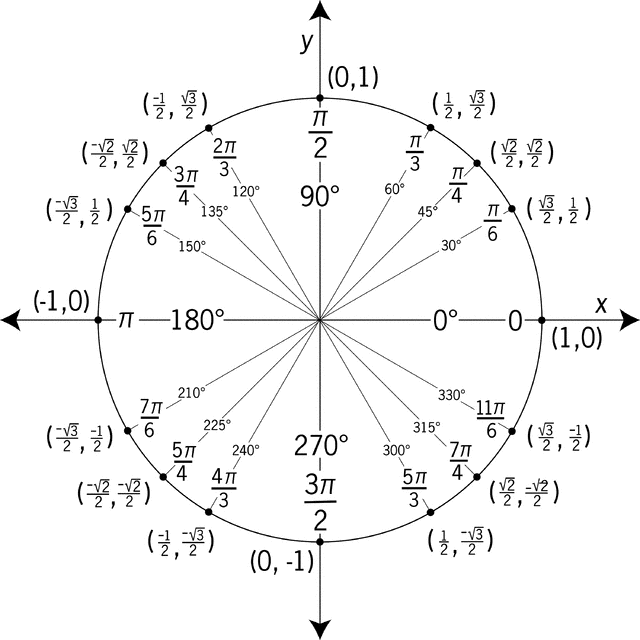
Also, I cemented my understanding and intuition of the Unit Circle using this approach.
Re: How can we develop transformative tools for thought?
#30Earlier quoted context omitted.
I am one of those guys who had a 4.0 GPA in college but I never used spaced repetition because what I was doing seemed to work well enough. Post-college I tried it for learning japanese and it seems like a downgrade from my usual approach. The best way to learn something is by contextualizing it. For example it doesn't matter if you forget a math formula if you know how to re-derive it. If the formula is truly import…
The space repetition apps I have use doesn't have a similar concept of interrelationship. For example it's possible for you to learn the flashcards for "three" and "one" but not know the word for "two". This is insane way of doing things. You are just refreshing random isolated nodes. Not only does it make it a lot harder to learn (since random out of order information is harder to compress), the knowledge graph you…
What do you need to do to “cement understanding and intuition of the unit circle”?
The common diagrams shown in high school trigonometry courses – e.g. https://etc.usf.edu/clipart/43200/43215/unit-circle7_43215_m... – basically involve only 2 meaningful facts: a rhombus made of two equilateral triangles has a long diagonal with squared length of 3, and a square has a diagonal with a squared length of 2. (a) These are fairly easy to figure out, and once understood are quite easy to remember, and (b) all of the derived factoids are pretty much trivial.
Students are typically taught this material in a quite terrible way, unfortunately.