Live data from Hacker News

AMD Ryzen Threadripper 3000 32-core CPU is more bad news for Intel

zdnet.com

91–100 of 165 posts

Re: AMD Ryzen Threadripper 3000 32-core CPU is more bad news for Intel

#91

But what processor is best for Dwarf Fortress?

Dwarf Fortress is IIRC mainly limited by RAM latency. So you really should be trying to get 3600 MHz RAM with as tight timings (maybe CL16 timings?) as possible. Dwarf Fortress's simulation is all about pointer-indirection and jumping around memory. The CPU doesn't really do much except wait for RAM most of the time. It takes ~50ns to talk to RAM, but the CPU is clocked at 4GHz (0.25 nanoseconds), giving you an idea…

Interesting! Is there a simple way to measure memory latency?

Re: AMD Ryzen Threadripper 3000 32-core CPU is more bad news for Intel

#92
post #87
post #2

AMD is in a really good position right now. Intel still has the lead in low idle power which is good in laptops. Ryzen lets different cores have different max frequencies so if your code is single threaded and your operating system isn't the newest that could be a reason to go Intel. Likewise if its single threaded and can take advantage of AVX-512 or the Intel Math Kernel Library. But otherwise?

I think most server operators look at overall performance. Once you start buying hardware specifically for one purpose you're cornering yourself. Besides, who spends $15,000 on a mid-high end server to run single threaded applications anyway?

I happen to know of several companies doing physics problems that scale poorly across cores that spend far north of that, usually building out small clusters. Then you run 100s of independent simulations since each individual one doesn't really scale.

Re: AMD Ryzen Threadripper 3000 32-core CPU is more bad news for Intel

#94
I just built a new workstation and went AMD. I'm amazed by the performances. I have a threadripper 1920 and it performs really well under many different loads (compiling, gaming, video editing). It also handles my dev vms very well. Of course this is purely based on my feeling, but I had an i7-9700 before and while I had faster FPS in some games, it was really bad at handling vms.

This is subjective, but I have a really good feeling about AMD, both on CPU and GPU side.

Only thing I could ask is for more open source (open source CPU firmware), but I think this is only a dream.

Re: AMD Ryzen Threadripper 3000 32-core CPU is more bad news for Intel

#95

Earlier quoted context omitted.

Intel optimizes these libraries down to the stepping level of the CPUs. So not surprising if they are not optimized at all for AMD

Is it anything like the way their compiler detected SSEn in a way that guaranteed it wouldn't use those instructions on AMD processors even if they supported them?

Yes but it wasn't a (if not amd). It was a series of checks based on specific families of Intel cpus, such as haswell, sandy bridge, etc. So it was never actually querying whether the cpu supported instruction x, it was asking what family it belonged to and then applying static rules based on that. Maybe nuance, but it also has the potential to hurt their processors if not kept up on so maybe less malice and more convenience?

Re: AMD Ryzen Threadripper 3000 32-core CPU is more bad news for Intel

#96

Worth noting AMD just announced that the first third-gen Threadripper will come out in Nov with 24 cores, and the planned 16-core mainstream chip (the 3950X) is delayed to November: https://www.tomshardware.com/news/amd-ryzen-9-3950x-delay-la... A 32-core chip is still almost certain to show up, since benchmarks have leaked, and folks have also leaked some pics of 3950X's and packaging, but I guess supply/demand have…

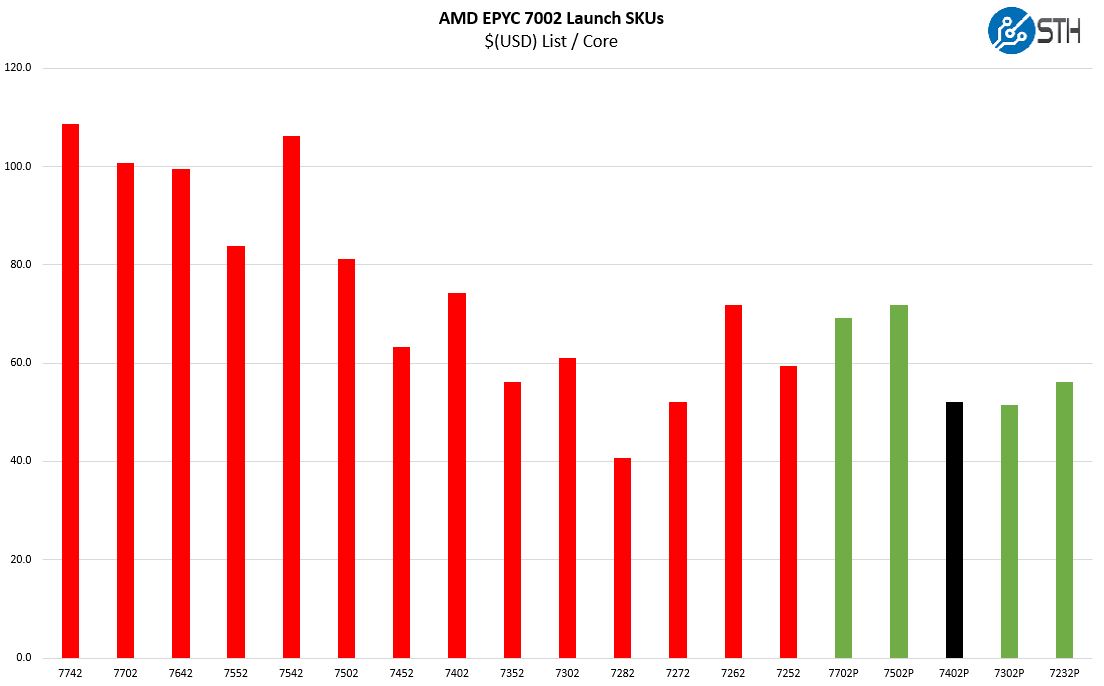
> As the Tom's post notes, server and client chips use the same chiplets, so it could be that most of the higher-binned ones are going to server parts; some are higher-margin (7742 is almost $100/core, vs. 3950X under $50/core) The 7742 is the "halo" chip, though. Or was, rather, until the Epyc 7H12 was announced. Other Epycs have much lower $/core. For example the 24-core EPYC 7352 is $1350, making it $56/core. The…

I don't really hard-disagree with any of that; we're all guessing. The co. sending chiplets where they fetch the most also doesn't seem outlandish as a factor, though.

FWIW, here's the price-per-core chart for the whole second-gen server line:

https://www.servethehome.com/wp-content/uploads/2019/09/AMD-...

(Doesn't factor in voltage/freq needs for different SKUs, some of them needing fully-working chiplets, etc. Still.)

The low pricing on the 7282 and a few others is interesting, too. Wonder if it's a factor that it can use partially-working chiplets since the server I/O die can take up to eight chiplets and the client die only two, or if that's totally unrelated.

Re: AMD Ryzen Threadripper 3000 32-core CPU is more bad news for Intel

#97
> The single-core score of 1,275 is pretty much the same as for the current flagship Threadripper 2990WX, and is actually slightly lower than the 1,334 that the Intel i9-9900K scores.

In what world is this a valid comparison? No one shopping for a $500 8 core consumer cpu is looking at a $1700 32 core hedt chip. They're entirely different markets. If you can use 32 cores you'd be looking at intels x series at a minimum, if not xeons. This is silly at best, if not intentionally misleading.

Re: AMD Ryzen Threadripper 3000 32-core CPU is more bad news for Intel

#98
post #12

Earlier quoted context omitted.

One challenge with AVX-512 is that it can actually _slow down_ your code. It's so power hungry that if you're using it on more than one core it almost immediately incurs significant throttling. Now, if everything you're doing is 512 bits at a time, you're still winning. But if you're interleaving scalar and vector arithmetic, the drop in clock speeds could slow down the scalar code quite substantially. https://blog.c…

How fast does the CPU step up and down the throttling caused by AVX-512? Basically, if you are interleaving like you suggest, does the processor detect this and reduce the throttling by the "duty cycle" of 512-bit operations? If not, could there be a way to tell the CPU to do this?

>How fast does the CPU step up and down the throttling caused by AVX-512?

It's actually really, really slow. On newer (I think around Skylake-X, which is when AVX-512 was introduced) CPUs it takes up to 500 microseconds i.e. millions of cycles to activate AVX-512. This can't really be made faster because they actually need to give the voltage regulators time to adjust or the chip literally brows out. During this time AVX-512 instructions execute on the AVX-256 datapath¹.

Once AVX-512 is activated the clock of that core is reduced by about 25% and it starts a 2ms timer which is reset whenever another AVX-512 instruction is issued. AFAIK Intel doesn't say how long it takes to raise the frequency again once the timer expires.

(This is something of a simplification because there are actually two AVX power licenses, the first allowing AVX-256 and a limited set² of AVX-512 instructions, reducing clock by about 15%, and the second allowing everything. Also, executing a single AVX-512 instruction doesn't immediately request a higher power license, you have to execute a certain number of them.)

This is actually the better version. On Haswell executing any AVX-256 instruction would reduce the frequency of every core by about 15-20%. But hey, at least it only takes about 150k cycles to activate (not much of a consolation, I know). Beats me how long it stays throttled for.

(I don't know what exactly Broadwell did. I don't think it throttled all cores, but it didn't have the additional power license with reduced throttling that Skylake has.)

¹ Or the 128-bit datapath if the core is at the lowest power license (which still lets you use 128-bit SSE instructions, and basic AVX-256 instructions).

² Basically anything that doesn't execute on the floating-point unit, which means no floating point and no integer multiplication (which uses the FPU). This is actually kinda the saving grace of the whole thing, since it means you can vectorize things like memcmp and strlen without requiring the highest power license.
Re: AMD Ryzen Threadripper 3000 32-core CPU is more bad news for Intel

#99

Earlier quoted context omitted.

This is a very outdated complaint, we are using all cores these days, just not on all systems. Backend software is concurrent & distributed, and although utilization is lower than we’d like, the extra cores are not going to waste. However, if you put this in a machine you use for playing games or checking Facebook then you might think that it’s a waste, and you’d be right. There is plenty of software out there which…

Honestly with the way chrome and firefox behave nowadays, even grandma looking at facebook benefits from multiple cores

Not really, any window/tab that is not in focus gets heavily throttled by the browser, gradma is probably not running any extensions and single websites are still single threaded for most parts (more and more are adding web workers for various parts though)

Re: AMD Ryzen Threadripper 3000 32-core CPU is more bad news for Intel

#100
post #69

Earlier quoted context omitted.

Probably the Mill CPU once the hardware actually exists.

Is the Mill CPU still happening? Haven't heard about it in a while...

There's activity on the forums, though rare; last posts from about a month ago. But still, Ivan is there dutifully responding to questions. I think interest has just died down a bit until they get more benchmarks (which, to be fair, the first ones just got released! https://millcomputing.com/topic/benchmarks/)
Post reply on HN