Live data from Hacker News

Team closes in on “holy grail” of room temperature quantum computing chips

osapublishing.org

21–30 of 33 posts

Re: Team closes in on “holy grail” of room temperature quantum computing chips

#21

Why is this the "holy grail"? Seems that room temperature quantum chips are not nearly as much of a big deal as, say, room temperature superconductors. You could keep a quantum chip in a special environment since they don't have to move around or span large areas.

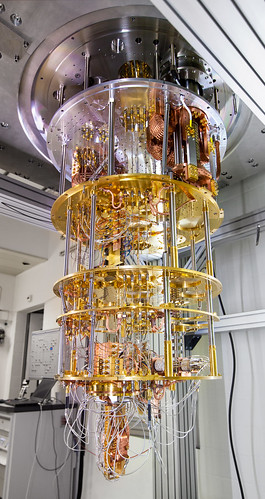
Have you seen the machinery needed to cool down IBM's tiny qubit chip at the bottom? [1] It would be nice if you could just stick these things into your PC over PCIe some day.

[1] https://c1.staticflickr.com/5/4403/23518086798_3d3af8313e.jp...
Re: Team closes in on “holy grail” of room temperature quantum computing chips

#22

Why is this the "holy grail"? Seems that room temperature quantum chips are not nearly as much of a big deal as, say, room temperature superconductors. You could keep a quantum chip in a special environment since they don't have to move around or span large areas.

Have you seen the machinery needed to cool down IBM's tiny qubit chip at the bottom? [1] It would be nice if you could just stick these things into your PC over PCIe some day. [1] https://c1.staticflickr.com/5/4403/23518086798_3d3af8313e.jp...

Don't they keep it close to absolute zero though? There's a large range between absolute zero and room temperature.

Re: Team closes in on “holy grail” of room temperature quantum computing chips

#23
post #4

Damnit, now I have to learn Q#...I've been putting it off for more than a year but I guess I need to stay competitive. Well, actually, maybe this would be the right audience to ask; if I wanted to do some stuff with quantum, would you recommend Q# or is there a cooler language to use now?

QisKit, in Python, is also a popular framework. Here is a tutorial:

An Introduction to Quantum Computing http://www.primaryobjects.com/2019/01/07/an-introduction-to-...

Re: Team closes in on “holy grail” of room temperature quantum computing chips

#24
post #4

Damnit, now I have to learn Q#...I've been putting it off for more than a year but I guess I need to stay competitive. Well, actually, maybe this would be the right audience to ask; if I wanted to do some stuff with quantum, would you recommend Q# or is there a cooler language to use now?

I do know the MS guy largely responsible for Q#. He's an honest fellow and adamant that there is nothing like it. I've never worked with it. If you do get serious with it I'm sure the team would be very interested in hearing from you. AFAIK the only "quantum computer" it currently interfaces with is LIQ𝑈𝑖⏐〉 (a simulator). http://stationq.github.io/Liquid/

That stylization is very exhausting (yes, I know what a "ket" is)

Re: Team closes in on “holy grail” of room temperature quantum computing chips

#25
post #18
post #13

Earlier quoted context omitted.

They're trying to make a computer that computes using light that bounces around inside the computer. The more the light bounces around, the dimmer it gets, and the less effective it becomes at computing things. They figured out a way to make the light bounce around twice as long (and so be able to compute more stuff) before it gets too dim to work any more. ("Dim" isn't quite the right word, but you did say five.)

What did that have to do with temperature?

I would guess the temperature typically causes the light to be less bouncy.

Re: Team closes in on “holy grail” of room temperature quantum computing chips

#26
post #4

Damnit, now I have to learn Q#...I've been putting it off for more than a year but I guess I need to stay competitive. Well, actually, maybe this would be the right audience to ask; if I wanted to do some stuff with quantum, would you recommend Q# or is there a cooler language to use now?

Honestly, how many money-making initiatives do you expect to require programming a quantum-computer in the next 5 years? I can't imagine many people outside the upper tiers of a University lab or some highly-funded security arm at Google using this tech in the near-future? (Asking an honest question, not accusing)

So shor's algorithm for factoring primes get's a lot of press in the software community because it unravels chunks of encryption, but grover's algorithm for inverting functions is also pretty neat and it would have lots of constructive applications in engineering contexts where you're trying to find configurations that satisfy non-linear constraints.

Re: Team closes in on “holy grail” of room temperature quantum computing chips

#27

Earlier quoted context omitted.

Have you seen the machinery needed to cool down IBM's tiny qubit chip at the bottom? [1] It would be nice if you could just stick these things into your PC over PCIe some day. [1] https://c1.staticflickr.com/5/4403/23518086798_3d3af8313e.jp...

Don't they keep it close to absolute zero though? There's a large range between absolute zero and room temperature.

[deleted]

Re: Team closes in on “holy grail” of room temperature quantum computing chips

#28
post #24

Earlier quoted context omitted.

I do know the MS guy largely responsible for Q#. He's an honest fellow and adamant that there is nothing like it. I've never worked with it. If you do get serious with it I'm sure the team would be very interested in hearing from you. AFAIK the only "quantum computer" it currently interfaces with is LIQ𝑈𝑖⏐〉 (a simulator). http://stationq.github.io/Liquid/

That stylization is very exhausting (yes, I know what a "ket" is)

TIL that the right angle bracket is called a 'ket', and the left part is called a 'bra'. The 14-year-old inside of me is now looking to use the word 'bra' with impunity more often.

Re: Team closes in on “holy grail” of room temperature quantum computing chips

#29
post #18
post #13

Earlier quoted context omitted.

They're trying to make a computer that computes using light that bounces around inside the computer. The more the light bounces around, the dimmer it gets, and the less effective it becomes at computing things. They figured out a way to make the light bounce around twice as long (and so be able to compute more stuff) before it gets too dim to work any more. ("Dim" isn't quite the right word, but you did say five.)

What did that have to do with temperature?

Light does quantum-y things at room temperature. Other quantum systems have to be very cold before they do quantum-y things.

Re: Team closes in on “holy grail” of room temperature quantum computing chips

#30
post #9
post #4

Damnit, now I have to learn Q#...I've been putting it off for more than a year but I guess I need to stay competitive. Well, actually, maybe this would be the right audience to ask; if I wanted to do some stuff with quantum, would you recommend Q# or is there a cooler language to use now?

Heh I thought you were making a joke but Q# is really a thing ?! Damn I'm old.

The joke is that Microsoft has a beautiful software stack and no hardware.
Post reply on HN