Live data from Hacker News

Dead Sea scrolls study raises new questions over texts' origins

theguardian.com

41–50 of 52 posts

Re: Dead Sea scrolls study raises new questions over texts' origins

#41
post #26
post #24

Earlier quoted context omitted.

Not a historian so I may be missing something, but how would one possibly differentiate between the origin being the Dead Sea or Jerusalem based on things like materials used? I mean, Jerusalem and the Dead Sea are less than 35km apart (according to google). Even thousands of years ago, it would have been a non-issue to transport materials or techniques between these two locations. I can't imagine that our knowledge…

Yeah the scale of trade always seems to surprise everyone. It's hard for me often to understand how folks draw the archaeological lines here. Materials could have been traded and the scrolls written near the Dead Sea ... or even folks from the Dead Sea traveled to Jerusalem, used local materials and made some scrolls, and traveled back.

You basically have to look at the availability and cost of transport of the goods. Salt was abundant in the Dead Sea area so the need to import salt would have been pretty low.

As for the movement of writers, or the scrolls post creation, you'd look at where scripts were generated and where they sourced their materials. Just speculating, as I haven't read the background material on this new discovery, but it would make sense that the monasteries in Jerusalem would have a reproducible sourcing process since they would be generating manuscripts often. Same would go for monasteries around the Dead Sea.

Re: Dead Sea scrolls study raises new questions over texts' origins

#42

It's now not far-fetched to believe they're fake.

I don't believe any of the scrolls that overlap with biblical canon are believed to be originals, so what do you mean by fake? It sounds like you just want to take a jab at them because they're of religious significance, which is just as irrational as religious people who don't like scientific theories they don't even understand because they feel it's an enemy to their rrligion.

@CelestialTeapot - that's my point - this is like claiming someone's Bible is fake. Well... fake like it's not true? Because that's irrelevant to this evidence. Fake like it's an unlicensed forgery or something?

Re: Dead Sea scrolls study raises new questions over texts' origins

#43
post #36

Earlier quoted context omitted.

Would arsenic bronze have any added toxic effects?

More to the people producing it than using it. But metallurgy and mining must have been awfully dangerous industries to be in back then regardless of the arsenic.

I was thinking more along the lines of "added weapon poison damage", ex. https://worldbuilding.stackexchange.com/questions/99646/can-...

Seems that lethal dose for arsenic is likely too high to be transmitted by even a pure arsenic trioxide blade, unless it was manufactured with the intent of leaving bits inside the wound, like maybe a blade a rough brittle surface to leave grit. Even so, would have to introduce ~50+mgs worth, which sees like a tall order.

Seems arsenic bronze is even less toxic, so probably not poisoning anyone. I wonder if the minor local toxicity of arsenic blade cuts would reduce the chance of the wound causing sepsis.

Re: Dead Sea scrolls study raises new questions over texts' origins

#44
post #43

Earlier quoted context omitted.

More to the people producing it than using it. But metallurgy and mining must have been awfully dangerous industries to be in back then regardless of the arsenic.

I was thinking more along the lines of "added weapon poison damage", ex. https://worldbuilding.stackexchange.com/questions/99646/can-... Seems that lethal dose for arsenic is likely too high to be transmitted by even a pure arsenic trioxide blade, unless it was manufactured with the intent of leaving bits inside the wound, like maybe a blade a rough brittle surface to leave grit. Even so, would have to introduce ~50+…

Perhaps an arsenic bronze arrow head broken off inside of somebody could poison them slowly over time.

Re: Dead Sea scrolls study raises new questions over texts' origins

#45
post #9

Doesn't really mean anything if the materials aren't local to the region. People in bronze age scandinavia were trading for copper with the mediterranean so there was a "global" trade network already in place.

> People in bronze age scandinavia were trading for copper with the mediterranean Sorry to make a minor point, but while the goods scandinavian and mediterranean goods travelled that far, doesn't mean the people did. Perhaps more likely, each was traded a dozen times with someone 50km away, and the goods reached people the manufacturer had no idea existed.

Given that goods typically moved by water (far less energy than overland), possibilities of longer voyages are somewhat more credible.

I don't know the actual history / archaeology, or quantities involved.

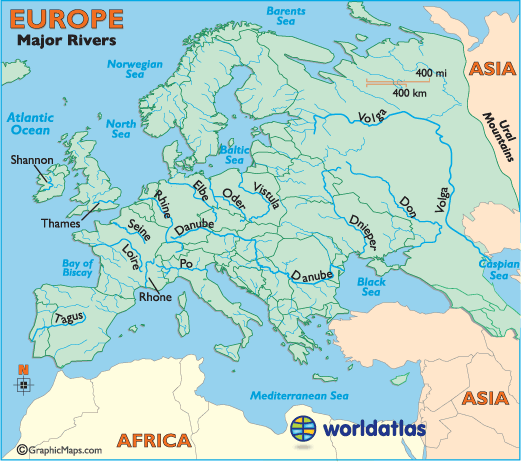
Europe does have a remarkably good inland navigable river network.

There's mention here that Scandinavians raided Mediterranian coastal towns and villages:

https://www.realmofhistory.com/2016/05/17/cypriot-copper-axe...

This map suggests a possible eastern route (the accompanying web page makes no mention of Sweden, scandinavia, or the Baltics):

http://theancientneareast.com/wp-content/uploads/2014/08/Tra...

(from: http://theancientneareast.com/the-bronze-age-world-system/)

Travel along the Donau, Dneiper, or Don rivers could have reached the Black Sea:

https://www.worldatlas.com/webimage/countrys/euriv.gif

This article and map suggest sea routes, through the Straits of Gibraltar:

https://www.speroforum.com/a/ROURBRXIJL49/77965-Ancient-trad...

Re: Dead Sea scrolls study raises new questions over texts' origins

#47
post #24

The "big picture" background here is that the scholarly consensus, established prematurely before all but the scrolls in the 1st cave were found, was that they belonged to an Essene "monastic" settlement at the ruins of Khirbet Qumran nearby. This has been challenged in a number of ways, yet the consensus of the local, Essene origin remains in tact. A Jerusalem origin hypothesis was developed principally by Norman Go…

Not a historian so I may be missing something, but how would one possibly differentiate between the origin being the Dead Sea or Jerusalem based on things like materials used? I mean, Jerusalem and the Dead Sea are less than 35km apart (according to google). Even thousands of years ago, it would have been a non-issue to transport materials or techniques between these two locations. I can't imagine that our knowledge…

Couple hours on a horse one way. I'm sure there were people who made the trip (and back) daily.

But, researchers have to find something to research or they're out of a job.

Re: Dead Sea scrolls study raises new questions over texts' origins

#48

It's now not far-fetched to believe they're fake.

I don't believe any of the scrolls that overlap with biblical canon are believed to be originals, so what do you mean by fake? It sounds like you just want to take a jab at them because they're of religious significance, which is just as irrational as religious people who don't like scientific theories they don't even understand because they feel it's an enemy to their rrligion.

On the contrary I'd like them to be genuine.

By fake I mean made to look older than they are; and possibly planted in the caves.

And note I said "not far-fetched"; not likely, just less improbable than previously.

Re: Dead Sea scrolls study raises new questions over texts' origins

#49

The Dead Sea scrolls need a serious re-examination by modern scholars not biased towards mainstream Christianity, similar to the work on Jesus mythicism that has been done over the past 20 years that draws on Gnostic, Essene, and other historically contemporary sources. John Allegro's work on the Dead Sea scrolls needs a non-biased re-examination: https://en.wikipedia.org/wiki/John_Allegro

The Christian bias on scroll scholarship was widely corrected in the 90s with the Scrolls' public release. Since then Jewish scholarship of the Scrolls has contributed an enormous amount, cf. Lawrence Schiffman, Emanuel Tov, et al.

How about research unencumbered by deeply held beliefs relating to the scrolls? Jewish scholars are hardly unbiased.

Re: Dead Sea scrolls study raises new questions over texts' origins

#50
post #27

Earlier quoted context omitted.

'Shwep.org' Is this a typo? Domain does not appear to exist.

Guessing it's https://shwep.net/

Thank you. Highly recommended. It's probably the most intellectually satisfying podcast I've ever listened to.
Post reply on HN