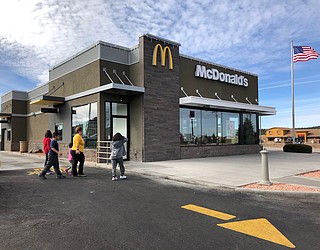
Here's one in Leavenworth, WA, a town where they have a Bavarian themed design requirements.
https://goo.gl/maps/LaCgUjQLbMX3nGuv5
The McDonalds is a bit subdued, the Starbucks is perhaps a better example.
21–30 of 56 posts
https://goo.gl/maps/LaCgUjQLbMX3nGuv5
The McDonalds is a bit subdued, the Starbucks is perhaps a better example.
Earlier quoted context omitted.
> There are so many examples of this sort of thing. I am frustrated by the ease with which buildings are declared historical sites and how often that designation happens after somebody The flip side of this is that developers don’t have a good record. Cheap, badly done developments and a history of buying, then revealing their true plans. “Oh, it turned out to be structurally unstable, so we have to demolish”.
Most new development in the US look terrible indeed. I’d rather get overprotection than those buildings everywhere in my city.
Earlier quoted context omitted.
Honest question: why do you think that the older buildings didn't "maximize profit" for their creators?
Here, have a look at a representative sample of images: https://duckduckgo.com/?q=new+orleans+french+quarter&bext=ms... Just look at any of those wrought iron railings. From a purely functional viewpoint they could do their job of being a railing to stop you from falling off the balcony with a series of plain vertical bars. But they are these elaborate concoctions of decoration and detail that someone had to cast, be…
Before WW2, labour was far cheaper then materials, especially in Europe.
The McDonalds (and other chain retail stores) have subdued colors and design in central Kyoto. They are most frequently brown/black based. https://news.mynavi.jp/article/20130903-a075/
https://westernnews.media.clients.ellingtoncms.com/img/photo...
Here's one in Leavenworth, WA, a town where they have a Bavarian themed design requirements. https://goo.gl/maps/LaCgUjQLbMX3nGuv5 The McDonalds is a bit subdued, the Starbucks is perhaps a better example. https://goo.gl/maps/nFemv8G1n7toUa4h6
https://upload.wikimedia.org/wikipedia/commons/d/d7/McDonald...
"At the golden M"
Earlier quoted context omitted.
Not the GP, but I think that the optimizations that lead each locality to have a distinct look came from local minima and maxima (e.g. availability of building materials, local construction practices, function of the building, desire to please the local population, as well as profit maximization), while the average McDonald's, as a for-instance of corporate design, comes from much more global minima and maxima. It's…
Right, the iconic look of the buildings in Paris is entirely a result of a regulatory loophole on building height and the Parisians “maximizing profit” in that environment.
(the prioritising appearance over economics applies to Parisian buildings built prior to Parisian building codes too, though obviously there's a lot of survivor bias there)
Earlier quoted context omitted.
Here, have a look at a representative sample of images: https://duckduckgo.com/?q=new+orleans+french+quarter&bext=ms... Just look at any of those wrought iron railings. From a purely functional viewpoint they could do their job of being a railing to stop you from falling off the balcony with a series of plain vertical bars. But they are these elaborate concoctions of decoration and detail that someone had to cast, be…
One of the supposed reasons for this is the relation between labour and product prices. Before WW2, labour was far cheaper then materials, especially in Europe.
Earlier quoted context omitted.
Not the GP, but I think that the optimizations that lead each locality to have a distinct look came from local minima and maxima (e.g. availability of building materials, local construction practices, function of the building, desire to please the local population, as well as profit maximization), while the average McDonald's, as a for-instance of corporate design, comes from much more global minima and maxima. It's…
Right, the iconic look of the buildings in Paris is entirely a result of a regulatory loophole on building height and the Parisians “maximizing profit” in that environment.
In fairness to your point, there are craftsmen and artisans who insist on doing things a certain way. That said, they usually have buyers for their products. Those buildings stand today because some one wants them there, are usually quite valuable, and have been re-sold numerous times.
There are so many examples of this sort of thing. I am frustrated by the ease with which buildings are declared historical sites and how often that designation happens after somebody buys a piece of property to develop it. I think it would be far fairer to the purchaser (and the seller, who makes out like a bandit unfairly) to mandate a 90 day stay when a large parcel is sold to allow for filing of historical paperwo…