In a similar fashion to the Warren Buffet, it would be nice for people who give advice to also post a high level asset overview like house, mortgage, stocks etc. It's hard to evaluate any comment without knowing some biases. I believe it would also help commenters to stop and think about their own biases before posting.
Maybe Warren Buffett Is Warning Us About Something
61–70 of 103 posts
Re: Maybe Warren Buffett Is Warning Us About Something
#62Earlier quoted context omitted.
If you want to diversify in a non correlated assets, you can put a part of your money from stocks into commodities, like gold/silver/Bitcoin (housing market is highly correlated with the stock market, so it's not a good diversification). All asset (and storage) types have their advantages / problems, you should read about it of course.
> All asset (and storage) types have their advantages / problems, you should read about it of course. Am I right in thinking that gold/silver are widely thought to be inflation proof? So I wasn't so concerned about growth could I just park my money in gold?
Gold is mostly inflation proof, but it has a volatility. The price of a cow in gold/silver hasn't changed that much in the last 5000 years (you can check the prices in ancient Egypt yourself). USD lost more than 99% of its value in a few hundred years.
There are still market cycles for gold, and also if you're going physical, there's 2-3% exchange cost as well.
Silver may or may not have a VAT problem in your country.
Re: Maybe Warren Buffett Is Warning Us About Something
#63I have no idea how money works. I have a 401k, it's got more in it than the median 60 year old in the united states, and I'm 20 years from that. And I am terrified of how little I know about how it exists or survives. I read these articles and get a sense of overwhelming urgency that, without any explicit indication, I should do something with my nest egg to make it safer to survive a crash. And then I keep reading,…
Have no idea the retirement account exists. 20 years from now a recession won't matter because the economy will have recovered.
There have been prolonged stagnations in the market. It took a couple of decades to recover from the Great Depression, and the if you invested in the 60s you might not be doing so hot by the 80s. The market isn’t a sure thing even in the long term, it’s just fairly reliable.
Re: Maybe Warren Buffett Is Warning Us About Something
#64The analogy that I have started to use recently is that of a pressure gauge. Money has to flow somewhere. The US just dumped a ton of money into the economy when the pipe (ability of the economy to move a lot of money between a large number of people, aka bandwidth) is essentially static, not much wage growth, little hiring, etc. That money has to go somewhere, so it goes to the stock market, because that is where the pressure is the lowest (very easy to call up a broker or go online and dump money into an account, compared to say, hiring and employee that can add real value to your company and the economy in exchange for a paycheck). Most of the time people assume that companies are going to take the money they get from stocks and invest it in growing the company or in paying salaries or paying for goods that pay salaries, etc. Unfortunately the corps are all sitting on loads of cash, and buying back stock, and not hiring or expanding (on average). As a result? Money that we normally expect to be growing the pipe, increasing the bandwidth of the economy to do real work, is instead flowing back into the pressure gauge and up goes the pressure, zoom! The economy is doing great! Right?? No. It is hard to get a good measure of the bandwidth of the pipe, and trying to interpret the pressure without it is folly, especially with regard to the impact of reducing the money supply (incoming volume of water). When the flow through the pipe is large and there is high bandwidth and the pressure is high, and the money supply drops, then we would expect the pressure to come down a bit, but in general to be stable essentially due to high inertia in the primary pipe, but if the total bandwidth is low? Then the pressure gauge is going to plummet, because the increased pressure (stock value) was due to a large flow trying to fit into a small pipe, and that pressure increase was due primarily to the change in the money supply, not due to fundamental soundness of the current economy (inertia).
Not a perfect analogy, with plenty of mixed metaphors, but simple enough to reason about and see where it breaks down.
tl;dr economy is flow in pipe, stock market is pressure gauge, if you don't know the flow through the primary pipe (hard to measure directly), then your pressure gauge could be extremely, dangerously misleading
Re: Maybe Warren Buffett Is Warning Us About Something
#65I have no idea how money works. I have a 401k, it's got more in it than the median 60 year old in the united states, and I'm 20 years from that. And I am terrified of how little I know about how it exists or survives. I read these articles and get a sense of overwhelming urgency that, without any explicit indication, I should do something with my nest egg to make it safer to survive a crash. And then I keep reading,…
I'll tell you something that nobody wants to admit to: Nobody really knows how money works. The average 401k holder has one because they don't have a good idea of how money works or what they should do with it. If they really understood their 401k, they'd know that they're probably getting ripped off in fees over their lifetime. If economists and financial analysts completely understood money, they wouldn't be in suc…
The average 401k holder knows that it's a tax advantaged savings vehicle and that there aren't many of those available to individual investors. The tax advantage completely outweighs all of the negatives that you listed in almost all cases.
Advocating that people not take advantage of a 401k because something about the government potentially seizing it is basically saying you shouldn't save money at all.
Re: Maybe Warren Buffett Is Warning Us About Something
#66I have no idea how money works. I have a 401k, it's got more in it than the median 60 year old in the united states, and I'm 20 years from that. And I am terrified of how little I know about how it exists or survives. I read these articles and get a sense of overwhelming urgency that, without any explicit indication, I should do something with my nest egg to make it safer to survive a crash. And then I keep reading,…
Start prepping.
Invest in some remote rural property, lay in plenty of supplies, educate yourself in the proper use and maintenance of various weapons.
It begins.
Re: Maybe Warren Buffett Is Warning Us About Something
#67It is important to recognize Buffett runs an absolutely massive amount of money and wants concentration. If you are limited by those factors you are limited to about 400 companies in the USA. Then among those, about half of them have weak returns on marginal capital invested. Among the remaining 200 or so, he doesn't like the price.
Most investors are not limited to about 200 companies. Keep looking. Look under 500M market caps. Plenty of companies trading for ev/ebits under 7, PEs under 10, price/books under 1, with decents ROICs.
Sure stocks on average are expensive, but bargains always exist.
Re: Maybe Warren Buffett Is Warning Us About Something
#68It’s important to remember that the stock market != the economy. You know who would be the first to say that? Warren Buffet. Warren Buffet is actually a big believer in not making macro economic predictions. It just so happens that if you pick stocks like he does (based on fundamentals and a certain proprietary “discount”) you’ll probably avoid having your investments tagged in a recession. Stocks in the Great Recess…
Additionally, the article doesn't really discuss how much cash he's holding relative to previous years. https://www.macrotrends.net/stocks/charts/BRK.B/berkshire-ha...
Your reference material is incorrect (it doesn't understand how to assess cash & cash equivalents properly).
Berkshire Hathaway's cash position was sitting at an all-time high of $122 billion as of early August. Your source claims $44 billion. Buffett will be distraught to find out $78 billion in cash is missing.
"The result was that the company’s cash hoard -- a major focus for investors in recent years -- surged to a record $122 billion."
https://www.bloomberg.com/news/articles/2019-08-03/buffett-s...
For further reference here is a chart of Berkshire's cash going back to 1996 from Reuters:

Re: Maybe Warren Buffett Is Warning Us About Something
#69Anybody else notice that, by the article's own plot, one could have said the same thing at almost any point between 1975 and 2000?
Once you include the data from Buffet's earlier career, total-market-cap to GDP makes more sense. For example: https://static.seekingalpha.com/uploads/2010/7/23/98115-1279...
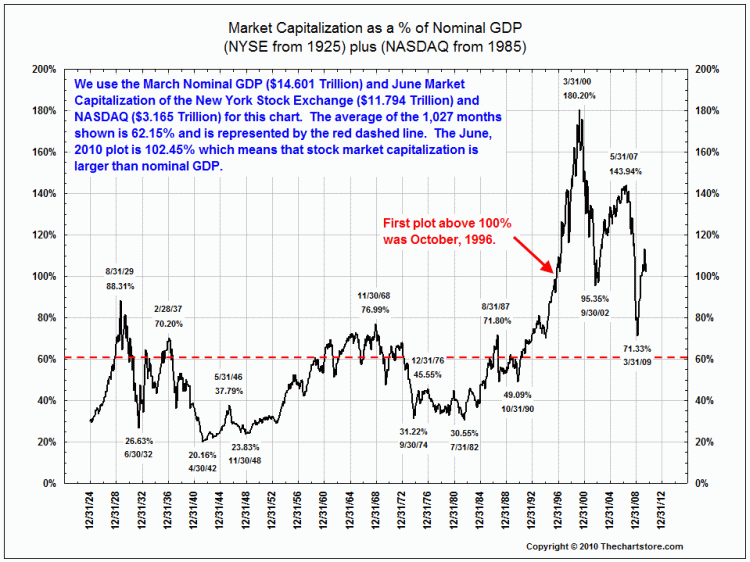
Edit: If it were up to me, I might work in monetary supply somehow too (The gold standard ended in 1972 or so). But maybe there's a reason they call him the Oracle of Omaha, and nobody calls me the Oracle of Santa Monica.
Re: Maybe Warren Buffett Is Warning Us About Something
#70I have no idea how money works. I have a 401k, it's got more in it than the median 60 year old in the united states, and I'm 20 years from that. And I am terrified of how little I know about how it exists or survives. I read these articles and get a sense of overwhelming urgency that, without any explicit indication, I should do something with my nest egg to make it safer to survive a crash. And then I keep reading,…
While sitting on cash isn't necessarily a bad idea -- when the market crashes you then buy a bunch of index funds, having a 401k is a very safe investment. Think of it this way, the only way you're losing that money is if the market crashes, permanently, and if it crashes permanently, then that money isn't worth shit anyway.
This sounds a lot like you're trying to time the market, which is great if it works, but it's a gamble. Dollar cost averaging is generally regarded as the safer option.
Remember, the market can remain irrational longer than you can remain solvent.
Also, how can you know when the market has bottomed out? Why not use that same strategy to invest now and figure out when the market has peaked and pull out then? Sitting on money loses value due to inflation.