Live data from Hacker News

Civilizational Collapse, Part 4

johncarlosbaez.wordpress.com

161–170 of 205 posts

Re: Civilizational Collapse, Part 4

#161

Isn't spacetime an all time storage system? You can't burn it, chafe it, erode it. Its is going to be there forever. Even if there's something that you think has been lost(like the library of Alexandria or the Roman empire) is waiting to be seen again. It is never lost. These `movies` of spacetime is being saved on a forever store.

Storage requires retrieval, as well as well as an encoding and preserving mechanism.

Much as users don't want backups, they want restores, authors don't want books, they want readers.

There's an interesting parallel between transmissions and recordings I'd noticed some time ago, that doesn't seem to be much commented on in discussions of information theory, though I'm not sure if it's because it's obscure or obvious:

A transmission utilises variations in time in a low-noise channel to deliver information over space to a receiver which does not have to move or sweep relative to the signal.

A recording utilises variations in space in a low-variance medium to deliver information through time, to a reader which must move or sweep relative to the encoding.

Each further relies on encoding, decoding, is subject to noise or deterioration, and may be subject to context or inference. Probably other factors as well.

Recordings can, of course, be moved through space (though a single recording can be in only a given location at a given time). Transmissions also travel through time at some rate, not exceeding the speed of light.

There are systems which combine transmission and recording (notably computers). Transmission and recording each play a role in virtually all message chains. And there may be some forms of encoding (possibly holographic?) which either combine both methods or utilise others (though I'm inclined to see holograms as forms of recordings).

"Spacetime" as an all-time storage system, by itself, either doesn't make sense or is so vague as to be meaningless. Perhaps you could clarify.

Also: there's no inherent conservation law of information. Quite the opposite.
Re: Civilizational Collapse, Part 4

#162
post #141

Earlier quoted context omitted.

Net of methane production from the cattle may affect that. I don't know if it does or doesn't, but you might want to incorporate that into your model. (NB: I'm not a vegitarian myself. I'm quite familiar with arguments. And have some familiarity with feedlots.)

If we didn't have cattle, would we have buffalo? Large wild herbivores in general? (Hmm, results of a quick google... there were 30-60m buffalo in the 19th century, and there are 94m cows in the US today. Given relative size, methane output has probably been more or less static over that period.)

That's a good question and I don't know.

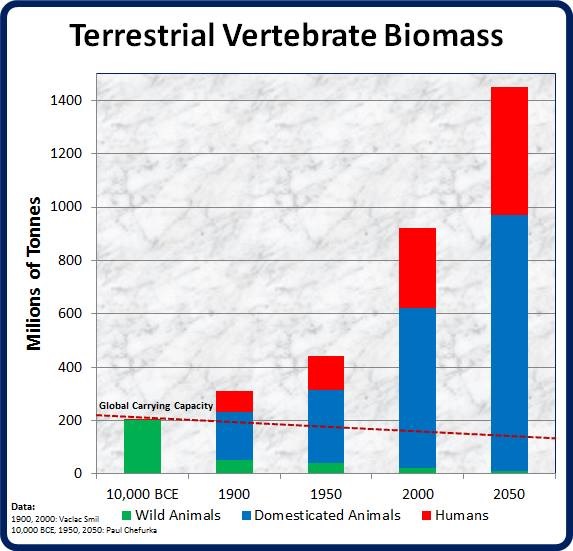
The net terrestrial vertebrate biomass has shifted markedly over the past century (and undoubtedly over the previous 50,000 years of the Human Diaspora). What the pre-Columbian American bison population was I have no idea.

Total pre-industrial wildlife biomass ~10,000 BCE, by estimates, was ~1/7 that of the present, and smaller than humans in total:

http://peakoilbarrel.com/wp-content/uploads/2015/04/Terrestr...

Re: Civilizational Collapse, Part 4

#163
If our current civilization collapses, I think it’s unlikely that another similar one would arise- or if it did it would happen much more slowly. There are no more easily accessible seams of rich ores of any kind in the world; the deposits remaining require a lot of energy and technology to use since they are low grade ores and it would be very difficult to get to a high enough technology level to use them without already having the refined minerals. A chicken and egg problem.

https://images.app.goo.gl/5aNH7AWvb3V745ZH6

Re: Civilizational Collapse, Part 4

#164

Earlier quoted context omitted.

As someone who grew up on a steep farm where grass, fruits and potatoes where the only options that worked out in practice (most of it is steep, summer is short and unpredictable) I'd say maybe you should reconsider. One easy thought experiment that helped me understand: given how extremely poor our ancestors where and how hard they worked to make ends meet there must have been some advantage to keeping animals. Othe…

> given how extremely poor our ancestors where and how hard they worked to make ends meet there must have been some advantage to keeping animals Our ancestors generally ate far less meat. They could also feed smaller animals like poultry on scraps of food, which doesn't really scale to feeding the billions of animals we currently raise for food.

I guess we agree.

I don't argue that we should continue todays consumption, only that going all vegan might not be a good idea.

Reducing consumption seems like a really good idea to me for several reasons. As does small scale poultry and animal farming (raising a pig or some poultry on scraps instead of throwing it away should be a good idea today as well if one could get away with it.)

Re: Civilizational Collapse, Part 4

#165

Earlier quoted context omitted.

Yup. Think I've heard them all over the course of 20 years. The obvious explanation is that people don't like the implication that their behaviour is unethical and look for clever outs. Rather than simply owning that benefits > costs from their point of view (a la 'I like bacon too much'). Of course questioning motivations is not a point to be made in an argument. However it is an entirely satisfactory Bayesian expla…

Any of your teachers/lecturers had a background from agriculture? I'm not saying this is not possible. But I am saying - as someone who has grown up on a farm and studied farming - that it might be somewhat more complicated. For a start, not all farmland is usable for anything but grass.

Do you know what fraction of world calories that type of land is?

Otherwise this objection is a case of 'an edge case exists, and I would like you to imagine that it is the major determining factor.'

Re: Civilizational Collapse, Part 4

#166
post #150

Earlier quoted context omitted.

Cultivation, selective breeding, and hybridisation of grains does not change the trophic level calculus. The bulk of livestock feed is corn (which has seen tremendous yield improvements since the 1960s through "green revolution" techniques), and for protein content, soyabeans, which have rather pointedly not . Additional silage provides some but AFAIU considerably less general nutritive content. And you will absolute…

And that's a totally legitimate point - but does it support your contention? You seem to be arguing that it is too expensive to raise meat. But food is driven largely by economics. Replacing the integrated farm with the sort of separation of duties you're talking about here is succeeding because it's cheaper. If you're talking about thermal efficiency.. what you're saying is true but irrelevant. Whether my food is th…

"Economics" unfortunately excludes numerous costs and risks associated with both provisioning and consumption of resources, including not only economic impacts, but fully-costed ecological inputs. Most especially in the accounting and market price mechanisms for utilisation of nonrenewable (or, read equivalently: nonsustainably-utilised) resources.

The alternatives to sustainable, integrated, ecological agricultural methods are "cheaper" because the market doesn't price in the 5-million-years-to-one rate at which we're extracting fossil fuels from the Earth over that at which they'd been put there,[1] of the strip-mining of topsoil at rates 100x - 1000x greater than those at which it had formed, of the natural-gas-fed fixing of atmospheric nitrogen (again at a roughly 5 million:1 ratio of inputs), of the mining of phosphorus, another critical fertiliser (potash is, for the moment, relatively abundant), of the impacts of eutrophication of rivers, wetlands, and oceans near ag-land outflows, of the systemic risks posed by monoculture cultivation, of the systemic ecological impacts of pesticide use, of the destruction of virgin ecosystems and biological diversity, and more.[2]

The "economic" costs are actually financialised costs, which include a long, peculiar, historically-contingent, largely malformed and false worldview model origin, which persists for numerous reasons, largely boiling down to being a highly convenient fiction for contemporary beneficiaries of this particular theology. Though the difficulty in moving to a more accurate, realistic, and one might hope sustainable model is severe. The convenience of the modern lie is profound.

Upshot: "cheaper" is based on invalid models heaped on invalid models. There's a vast unbooked debt accumulating.

________________________________

Notes:

1. Jeffrey S. Dukes, "Burning Buried Sunshine" (2003) https://dge.carnegiescience.edu/DGE/Dukes/Dukes_ClimChange1....

2. Lev Tolstoy has an early and fascinating discussion of cost accounting and factors of production in What Shall We Do Then (https://archive.org/details/whatshallwedothe00tolsrich/page/...), finding the standard three-factor model of the time, land, labour, and capital, insufficient.

The economic theory seems to derive directly from cost accounting, dating principally to Alexander Hamilton Church (https://en.wikipedia.org/wiki/Alexander_Hamilton_Church). The problem of defining economic theory to guide accounts based on what accounts tallied to inform economists seems ... problematic.

The legal and economic theory of extractive resources has a long, problematic, and almost entirely unscientific history, specifically the Rule of Capture and its logic, and the principle theory of pricing, which though largely dismissed doesn't seem to have found a replacement: Hotelling's Rule.

Re: Civilizational Collapse, Part 4

#167

Earlier quoted context omitted.

I don't think either "side" can claim any sort of moral high ground on this issue. In the case of the video I'm referencing above, the issue is decidedly from the left which has been trumpeting a post-truth, highly individualized, no-harm-freedom, and consent-based understanding of personal conduct. But on the other hand, I think you are right in that there are people who can and will say _X is unquestionably always…

I'm going to be honest with you, I won't sit through an hour and a half video that makes your point for you. I'll just say that the current president fired the director of the National Institute for Space Research (an MIT PhD) for saying satellite data indicated deforestation was on the rise, contradicting the minister of the environment. An Air Force official was temporarily put in his place. While the official is a…

> I think you'll agree that actually dismissing the director of an important research institution is very much more important than whatever new prank Boghossian has played on the “identitarian left”

I don't agree. Dismissing this discussion as a "prank" played on the "identitarian left" is not accurate or does it adequately convey the weight of the discussion.

So while I do agree what you are saying is troubling, both the "left" and the "right" are swing their axes at the bottom of the tree of civilization.

Re: Civilizational Collapse, Part 4

#168
post #159

Earlier quoted context omitted.

A set of mid-sized though significant quibbles. The United States no longer has the largest total national carbon footprint. That title now goes to China, which has exploded past the US. The total carbon emissions title, since 1970 (roughly half, probably somewhat more, of the total since the Industrial Revolution, given ~30-ish year doubling rates), remains the US, though China are on track to surpass this within a…

I’d say when we’re talking about a dietary choice an individual makes, looking at carbon on a per capita basis is the right way to look at it. Especially given that the US consumer is a very influential one in the world. China is set to put a substantial chunk of global emissions under a carbon tax in the near term, which should prove to be a market force which drives down meat consumption, among other things. The US…

Agreed.

Re: Civilizational Collapse, Part 4

#169
post #141

Earlier quoted context omitted.

Net of methane production from the cattle may affect that. I don't know if it does or doesn't, but you might want to incorporate that into your model. (NB: I'm not a vegitarian myself. I'm quite familiar with arguments. And have some familiarity with feedlots.)

If we didn't have cattle, would we have buffalo? Large wild herbivores in general? (Hmm, results of a quick google... there were 30-60m buffalo in the 19th century, and there are 94m cows in the US today. Given relative size, methane output has probably been more or less static over that period.)

Some people think buffalo herds exploded when native Americans died off.

The herds may not have been that big pre-columbus.

Re: Civilizational Collapse, Part 4

#170

Isn't spacetime an all time storage system? You can't burn it, chafe it, erode it. Its is going to be there forever. Even if there's something that you think has been lost(like the library of Alexandria or the Roman empire) is waiting to be seen again. It is never lost. These `movies` of spacetime is being saved on a forever store.

Storage requires retrieval, as well as well as an encoding and preserving mechanism. Much as users don't want backups, they want restores, authors don't want books, they want readers. There's an interesting parallel between transmissions and recordings I'd noticed some time ago, that doesn't seem to be much commented on in discussions of information theory, though I'm not sure if it's because it's obscure or obvious:…

https://en.wikipedia.org/wiki/No-hiding_theorem#Conservation...
Post reply on HN