I used to love encarta. The thing I remember most though were the entries on musical instruments from around the world. I remember being blown away by the different types of instruments and used to spent lots of time just clicking the interactive map and reading about them and listening to the different clips they had. That was where I first learned about and heard the difference between all the different types of ba…
I Miss Microsoft Encarta
211–220 of 419 posts
Re: I Miss Microsoft Encarta
#212I had Encarta '97 as an 11yo, purchased at a Malaysian street vendor market for probably all of 3 bucks. It felt incredible to have that much knowledge available for almost no money. And it wasn't just boring text like the paper versions, there were videos too! There was point in time where that truly felt like the future. Considering that we're now in the age of autoplaying, monetized "content" video nearly everywhe…
Pretty much same experience but in Argentina. I got Encarta 97 or 98 for 5 pesos, 5 dollars at that time, when I was 11 years old. Later I read about a Visual Basic course in a newspaper so I figured out that the way to build software was using this Visual Basic software. So I went to the same place where I bought Encarta and got Visual Basic 5, which was my first programming language.
Re: I Miss Microsoft Encarta
#213The thing about Encarta to me is that it felt so much more interactive than what we have today. Nowadays we read a Wikipedia article or watch a Youtube video on a topic but never interact with the content. It's all very passive. I was a child during the heyday of Encarta and I remember I had it and a few other specialized encyclopedias (one about animals, one about sea life, one about dinosaurs!!) and they were all i…
Re: I Miss Microsoft Encarta
#214Earlier quoted context omitted.
I never mess interactivity when browsing Wikipedia. I love that WP is text-based, so that I can read it in my own preferred tempo. I rarely watch videos since to me they always feel too slow compared to reading text. I understand on an intellectual level that Youtube is a great platform that provide lots of value and entertainment to lots of people, but I never feel that greatness since it’s not something that I pers…
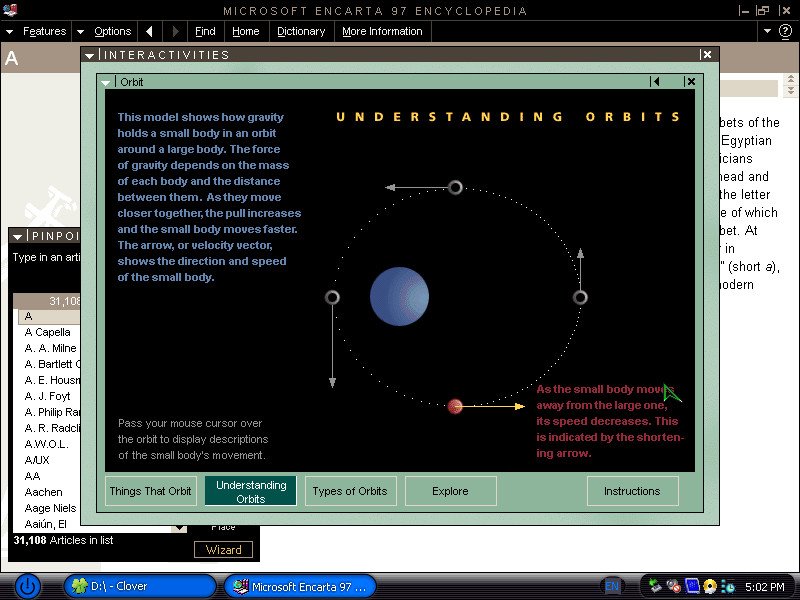
There is value in "all" information being text. However there's also value in having interactive elements. From the contextual fitting video to i.e. an embedded star map: Imagine reading the article about a solar eclipse and being able to navigate a 3D model of the stars. Imagine reading an article about the human body and having a 3D model right next to it: If you click on "heart" in the text it's being highlighted…
Re: I Miss Microsoft Encarta
#215Earlier quoted context omitted.
For a kid growing up, Encarta was far superior to anything Wikipedia offers today. Sure, Wikipedia wins in sheer volume but that's it. Encarta was a well curated collection of knowledge that was consistent and perfectly suited for its audience. More is not always better.
When it comes to knowledge and data more is by definition always better.
That is not the correct use of "by definition." More only means more, not better.
Re: I Miss Microsoft Encarta
#216Earlier quoted context omitted.
I remember getting Encarta 95 back when it first came out (I was 14 at the time) and the interactive elements and audio clips blew my mind. It changed how I thought about information and got me that much more invested in learning technology. Literally a week after getting Encarta a door to door encyclopedia salesmen came to our house and I showed him why I did not need his books. You could see the look of terror in h…
> a door to door encyclopedia salesmen came to our house That's an alien relic of an anecdote as there ever was. The world has profoundly changed in the last twenty five years. Cheap, ubiquitous, networked computing has almost completely rewired society and changed business, jobs, dating, friendship, travel. I really wonder what the next big changes will be. Cheap satellites in orbit and dramatically reduced LEO cost…
Temps up 2°C, marine ecosystems collapse, and hundreds of millions of refugees?
Re: I Miss Microsoft Encarta
#217Encarta is a great example of Microsoft winning a market, and after it was defeated, letting it fade out. Wikipedia in some ways beat it, but the interactivity elements of Encarta make it something that you kind of wish had a more direct role in the modern day. I wrote about this topic a few years ago ( https://tedium.co/2017/07/13/who-killed-the-encyclopedia/ ), and it led a former CEO of Encyclopaedia Britannica to…
I remember getting Encarta 95 back when it first came out (I was 14 at the time) and the interactive elements and audio clips blew my mind. It changed how I thought about information and got me that much more invested in learning technology. Literally a week after getting Encarta a door to door encyclopedia salesmen came to our house and I showed him why I did not need his books. You could see the look of terror in h…
Amusingly, many of the articles in Encarta were copied verbatim from there.
Re: I Miss Microsoft Encarta
#218Earlier quoted context omitted.
> a door to door encyclopedia salesmen came to our house That's an alien relic of an anecdote as there ever was. The world has profoundly changed in the last twenty five years. Cheap, ubiquitous, networked computing has almost completely rewired society and changed business, jobs, dating, friendship, travel. I really wonder what the next big changes will be. Cheap satellites in orbit and dramatically reduced LEO cost…
In Encarta’s case, cheap, high density storage mediums were passed by something that already existed and had existed for quite some time before, the internet. In other regards maybe the storage medium was just a side detail and the important part was what could be done with that data thanks to faster computers. There might be some parallels here today with machine learning. Neal Stephenson's quote about the future al…
The takeaways I get of this:
1. Exponentially-developing technology can pass you by quickly. The Internet went from exceedingly obscure to global in the ten years of the 1990s. Broadband wasn't ubiquitous by 1999, but it was increasingly available.
2. Standards matter. Even constructing a workstation that could handle reading Encarta was a challenge, and the tools to compose, render, and especially, present multimedia content (images, audio, video) were not common. Microsoft went the closed-source proprietary route, dooming them to the dustbin (though pieces were salvaged).
3. Standards are hard. Re-read above.
4. There are thresholds of utility that make or break things. I've been around infotech long enough (somewhat pre-dating the periods discussed here) that I've seen numerous technologies go from extreme cutting edge to widely adopted to passe. (And quite a few proposed but never gaining critical mass.) The reasons why any given tech fails right now are numerous. Luck plays a major role.
The present has exceptionally cheap bulk storage (my tablet has a 128GB removable microSD card for about $50), high-speed, ubiquitous, and wireless networking, and tools for sharding and distributing updated documents and file formats (git, rysnc, etc.). This makes distributed updatable large-scale works possible.
The technology of written works has undergone several seismic shifts, from clay tablet to papayrus roll to codex to moveable type. Less well-known (but only slightly) are the updatable formats: loose-leaf, three-ring, and replaceable bindings, all introduced in the late 19th century, which enabled updatable works. These were true "periodicals", where sections could be updated with amendments or replacements as information changed.
The database, digital file, early version control, Wiki, and distributed version control are, IMO, all legitimately novel forms of written works, which should be recognised as such. They have and will continue to change how content is created and used, and affects and interacts with society.
Re: I Miss Microsoft Encarta
#219Earlier quoted context omitted.
There is value in "all" information being text. However there's also value in having interactive elements. From the contextual fitting video to i.e. an embedded star map: Imagine reading the article about a solar eclipse and being able to navigate a 3D model of the stars. Imagine reading an article about the human body and having a 3D model right next to it: If you click on "heart" in the text it's being highlighted…
How close was Encarta to that? I never used it.
https://www.oldpcgaming.net/wp-content/gallery/encarta-97/Sn...
Re: I Miss Microsoft Encarta
#220I miss it and I also miss a real encyclopedia collection. They both offer a thing Wikipedia always lacks: consistency, in writing style, in topic depth, in error rate. I still remember the weekend in 90s when I had a copy of Encarta and threw the whole weekend to click through topics after topics, and amazed at things it offered. It’s so much fun.
>in error rate I dont have source at moment. But I remember reading a few years ago that wikipedia had fewer errors than most all encyclopedias on average. There is definitely something to be said about consistency and clustering but on average I believe wikipedia is still the best in fewest errors.