Live data from Hacker News

Ebola Is Now Curable

wired.com

11–20 of 172 posts

Re: Ebola Is Now Curable

#11

It's great news, but they're observing a 30% mortality rate for the "cure". Absent medical intervention there is still a nontrivial survival rate (mortality rate of 75-90%). With supporting medical treatment before this new treatment - fluid support, etc - I think it's up to 50%? It sounds like the monoclonal antibody treatment has improved odds of survival from 1:10-1:2 to 2:3. edit: The 6% figure is population rest…

Article says 6% unless I'm misunderstanding something.

Re: Ebola Is Now Curable

#13
post #10

It's great news, but they're observing a 30% mortality rate for the "cure". Absent medical intervention there is still a nontrivial survival rate (mortality rate of 75-90%). With supporting medical treatment before this new treatment - fluid support, etc - I think it's up to 50%? It sounds like the monoclonal antibody treatment has improved odds of survival from 1:10-1:2 to 2:3. edit: The 6% figure is population rest…

Other treatments mentioned in the same paragraph cut mortality rates to 34% or 29%.

If I'm reading this right, the 29% and 6% are the same drug. It has a 6% mortality rate when administered very early in the illness.

> The monoclonal antibody cocktail produced by a company called Regeneron Pharmaceuticals had the biggest impact on lowering death rates, down to 29 percent, while NIAID’s monoclonal antibody, called mAb114, had a mortality rate of 34 percent. The results were most striking for patients who received treatments soon after becoming sick, when their viral loads were still low—death rates dropped to 11 percent with mAb114 and just 6 percent with Regeneron’s drug, compared with 24 percent with ZMapp and 33 percent with Remdesivir.

Re: Ebola Is Now Curable

#16
The title calling it "curable" feels a bit misleading. To explain...

Ebola's a viral infection, like the common cold or the flu. If someone gets sick with it, then usually their immune system should fight it off naturally, just like the common cold or the flu. And just like a cold/flu, there hasn't really been a cure for it; instead, Ebola sufferers would be put on bed-rest with fluids to resist dehydration, fever management, etc., while the body fights it off.

However, Ebola's symptoms tend to be severe. Glancing at Wikipedia's figures, it seems that about 50% of people who get it die -- which probably varies a lot by the exact strain, health of the victim, support received while sick, etc.. Many victims end up making a full recovery, though some end up taking more long-term damage from the trauma.

As I'm reading it, they've observed that some victims tend to fight off Ebola with relative success. So, they appear to be trying to copy those survivors' defenses via [monoclonal antibodies](https://en.wikipedia.org/wiki/Monoclonal_antibody), then pass that on to Ebola sufferers.

Since they're basically optimizing a victim's immune system with specially selected antibodies, the victim still suffers Ebola and fights it off as usual, just they're getting some pretty powerful backup in that fight.

And apparently the results are pretty good so far! The article reports:

> The monoclonal antibody cocktail produced by a company called Regeneron Pharmaceuticals had the biggest impact on lowering death rates, down to 29 percent, while NIAID’s monoclonal antibody, called mAb114, had a mortality rate of 34 percent. The results were most striking for patients who received treatments soon after becoming sick, when their viral loads were still low—death rates dropped to 11 percent with mAb114 and just 6 percent with Regeneron’s drug, compared with 24 percent with ZMapp and 33 percent with Remdesivir.

The article exaggerates a bit by citing the mortality rates for people who don't receive any support; that seems like an unreasonable figure since this treatment is an advanced form of support, so presumably it'll improve the odds of those who do get support.

So, if mortality rates are about 50%, then presumably they can drop that to about 29% overall, with people who seek treatment earlier enjoying the greatest benefit with mortality rates dropping to 6%.

Realistically speaking, this seems to suggest that this "cure" reduces an individual's odds-of-death by a bit shy of 50%; that leaves a lot to be desired. Still, it's awesome because:

1. Any progress on something like this is awesome.

2. This sort of technology can rapidly improve, so the current positive results may just be the beginning.
Re: Ebola Is Now Curable

#17
Ebola is not a problem. The number of deaths caused annually by ebola worldwide is about ten times the number of people who die by falling out of bed per year in the US. Just to give you a perspective when you go to bed tonight. Nobody cares about ebola except a very small fraction of people who ignore the most basic principles of hygiene and germ theory. The press likes Ebola because it's easy to rile up people and cause panic for no reason whatsoever.

Re: Ebola Is Now Curable

#18

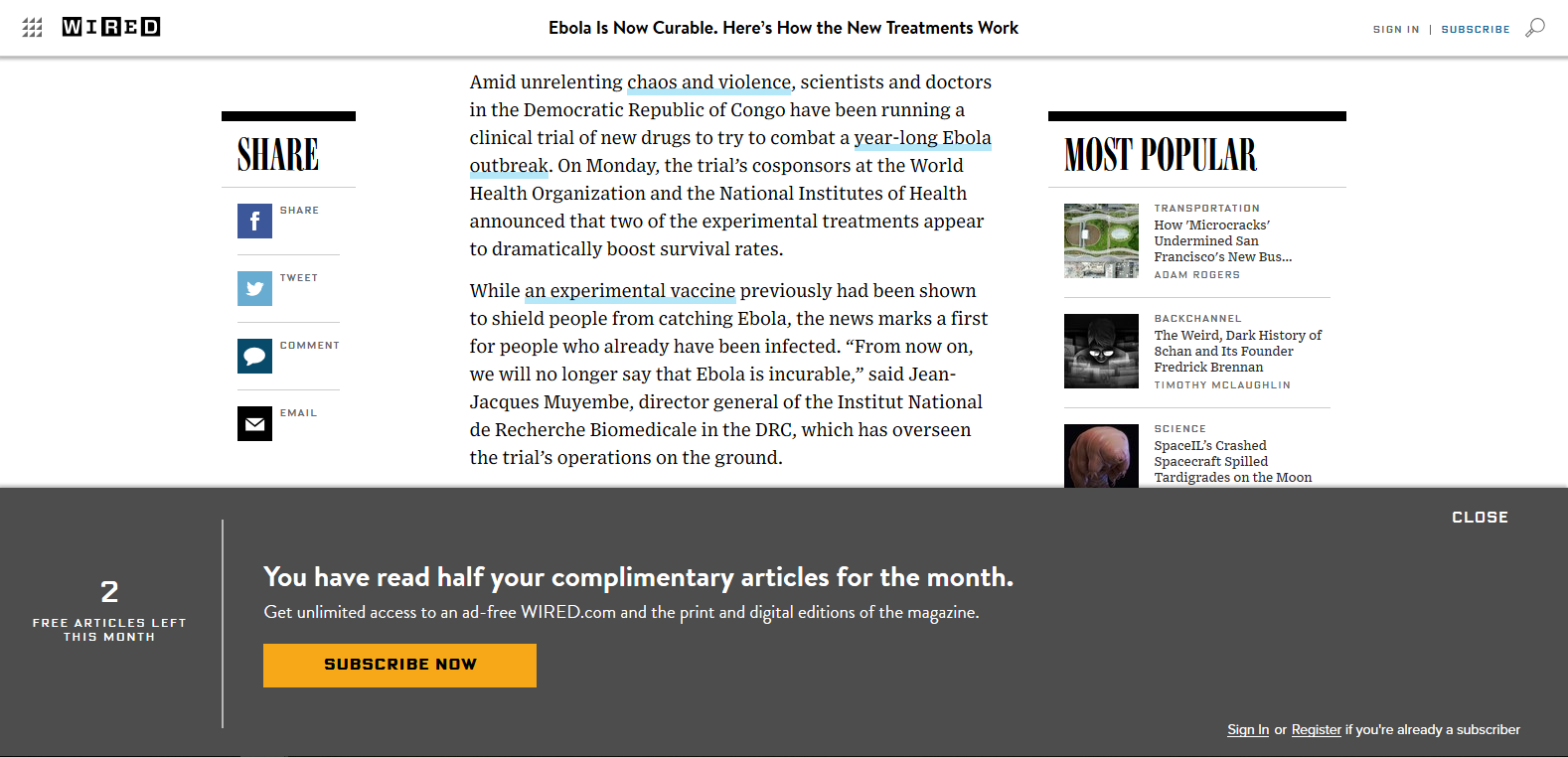
Much-needed Outline.com of the article: https://outline.com/MJaPqX Wired.com is almost literally unreadable. It's a caricature of all that's wrong with modern web design. Is everyone else seeing what I'm seeing? http://u.cubeupload.com/temp9871/wired.png

With JavaScript disabled, the Wired article loads fine and the outline.com article doesn't load at all. I'd say you have that backwards.

Re: Ebola Is Now Curable

#19
post #2

This is awesome that we've seen another horrendous disease go from incurable to curable in my lifetime. While ebola hasn't touched my community like AIDS/HIV has, reading this cracked my RBF and I smiled.

A 6% to 30% fatality rate depending on how early the treatment is not what I would call a cure. However, at best 6% fatality rate is still huge progress.

Re: Ebola Is Now Curable

#20

It's great news, but they're observing a 30% mortality rate for the "cure". Absent medical intervention there is still a nontrivial survival rate (mortality rate of 75-90%). With supporting medical treatment before this new treatment - fluid support, etc - I think it's up to 50%? It sounds like the monoclonal antibody treatment has improved odds of survival from 1:10-1:2 to 2:3. edit: The 6% figure is population rest…

If I were facing a 75-90% chance of dying, I think I’d be pretty happy to reduce that to 6-30%.
Post reply on HN