Live data from Hacker News

What Does a Coder Do If They Can't Type?

nsaphra.github.io

191–200 of 398 posts

Re: What Does a Coder Do If They Can't Type?

#191

This won't help anyone who has lost the use of their hands, but I have some advice for touch typists who use a standard keyboard like a laptop or typical desktop keyboard: don't bend your wrists. Of course most people know about the ergonomic advice to have your keyboard at the right height so your wrists don't have to bend up or down. But I often see people typing with a horizontal bend in their wrists so that their…

Better solution is to ditch the single-block-style keyboard and get a proper ergonomic one that's split into two parts. That allows you to keep your wrists at a natural angle but you also need to change the layout to use columnar staggering so the fingers are only moving vertically.

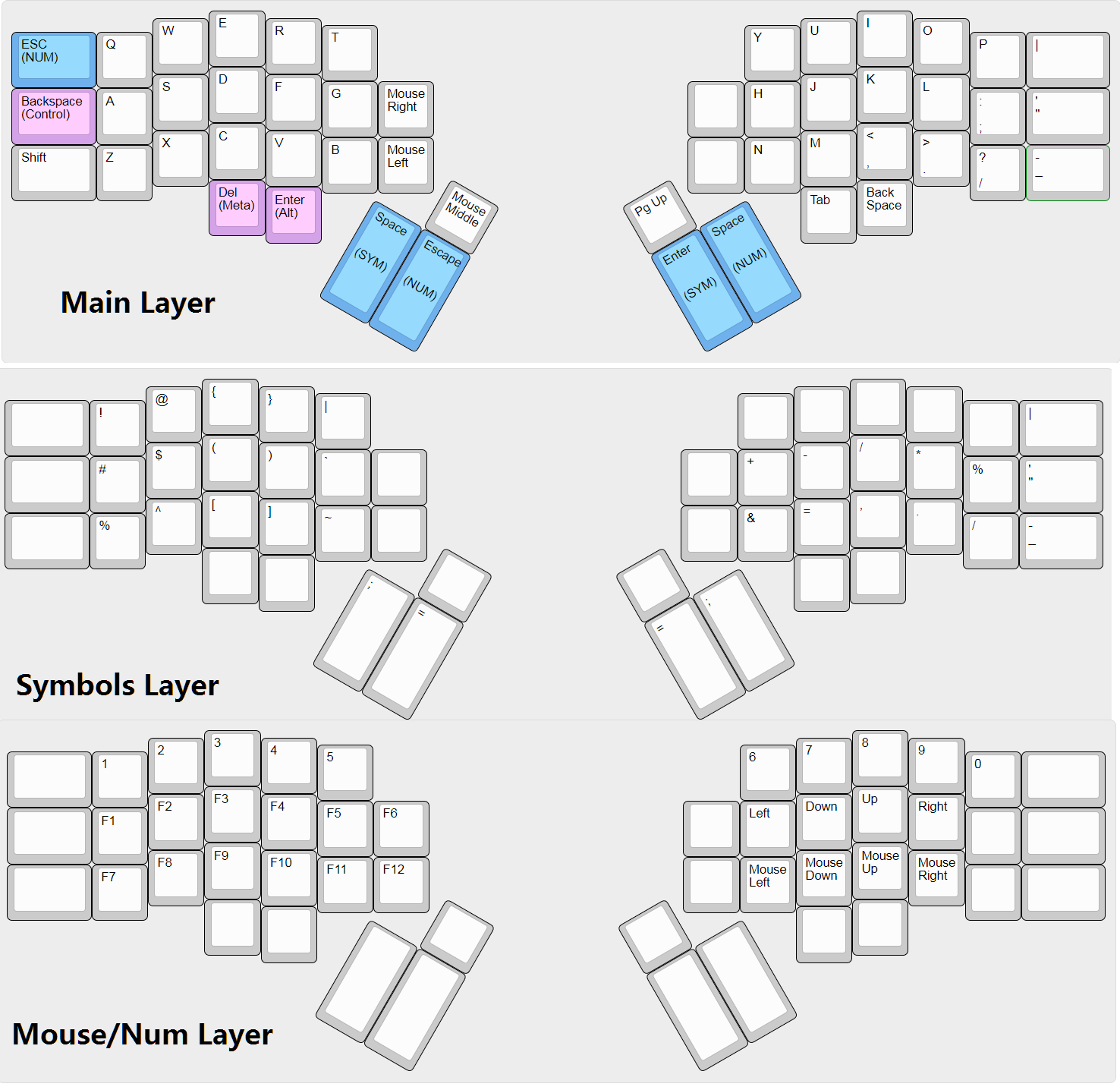
There's many things wrong with traditional keyboards and many solutions that I could write for years about. This one's mine and is focused at programmers/Vim/Linux users [1]. The main takaway is move the fingers less and leverage a programmable layout to overload fingers. Look at how the thumbs are used and the relation to common programming symbols. [2] and I mean it's programmable so if you don't like it, flash it.

[1] https://www.gboards.ca/

[2] https://qmk.fm/keyboards/gergo/keymap.png

Re: What Does a Coder Do If They Can't Type?

#192

I developed an RSI a few years ago, and I had to leave my job. It was devastating to lose both my career and my passion to an injury. Since then, I've been working with a friend on a new voice coding app called Serenade [1] that aims to enable anyone to program by voice. With Serenade, you can speak natural English voice commands like "delete second function" and "add class person". Not only can this be faster than t…

little constructive criticism... no where on the site or in the document does it mention what the supported languages are. After a little bit I saw that this was only for python, but I think it would be better for you cause if you not only said what languages are supported, but maybe also how you can add other languages.

Re: What Does a Coder Do If They Can't Type?

#193
post #191

This won't help anyone who has lost the use of their hands, but I have some advice for touch typists who use a standard keyboard like a laptop or typical desktop keyboard: don't bend your wrists. Of course most people know about the ergonomic advice to have your keyboard at the right height so your wrists don't have to bend up or down. But I often see people typing with a horizontal bend in their wrists so that their…

Better solution is to ditch the single-block-style keyboard and get a proper ergonomic one that's split into two parts. That allows you to keep your wrists at a natural angle but you also need to change the layout to use columnar staggering so the fingers are only moving vertically. There's many things wrong with traditional keyboards and many solutions that I could write for years about. This one's mine and is focus…

AKA ortholinear.

Re: What Does a Coder Do If They Can't Type?

#194

I developed an RSI a few years ago, and I had to leave my job. It was devastating to lose both my career and my passion to an injury. Since then, I've been working with a friend on a new voice coding app called Serenade [1] that aims to enable anyone to program by voice. With Serenade, you can speak natural English voice commands like "delete second function" and "add class person". Not only can this be faster than t…

little constructive criticism... no where on the site or in the document does it mention what the supported languages are. After a little bit I saw that this was only for python, but I think it would be better for you cause if you not only said what languages are supported, but maybe also how you can add other languages.

It's directly on home page:

    Multiple languages.
    Use the same commands across multiple languages: Python, JavaScript, Java, and more on the way.

Re: What Does a Coder Do If They Can't Type?

#195
post #25

This story resonates. A few years back I was dealing with mild pain while coding. I stupidly ignored it for months as it got significantly worse, to the point where it became impossible to type for extended periods. I tried lots of things. My doctor did a nerve conduction study, which apparently ruled out carpal tunnel syndrome, but he wasn't much help beyond that. He gave me some straps that I slept in and wore arou…

>After a little experimentation and observation, it was clear that my recovery was positively correlated with consistency in going to the gym for heavy weightlifting sessions

This was my experience as well. Started getting inflammation and pain on the top of both forearms that made typing for longer than 15 minutes very painful. I was convinced for a while that I had some sort of nerve entrapment that would need surgery to fix.

Ibuprofen helped a little, as did wrapping my forearms in braces, but the only thing that alleviated the pain long term was lifting heavy weights.

Re: What Does a Coder Do If They Can't Type?

#196
Well this problem sounds familiar! I solved it in a different way as voice coding was much more difficult 15 years ago.

I have Ehlers-Danlos Syndrome (Hypermobility Type), and associated nervous system pain. I lost my ability to type in 2002, and began my PhD in 2004 (in applied maths - lots of programming).

I did the whole thing typing with mice, trackballs, and modified versions thereof, mainly using predictive on-screen typing software I wrote. When touch screens became widely available I adapted the software to them and did my typing that way.

Since ~2016 I've finally been able to type useful amounts on two very specific keyboards with low travel and high springyness (Surface Pro keyboard cover and Bluetooth Surface Keyboard; Surface Book keyboard is okay but not as good; HP has some keyboards that might be good but don't sell them individually).

I use dictation software for prose, but haven't tried it for programming, Latex, etc. Talon seems worth investigating though, as there are periods I need to minimise my typing.

Re: What Does a Coder Do If They Can't Type?

#197
post #157

I developed an RSI a few years ago, and I had to leave my job. It was devastating to lose both my career and my passion to an injury. Since then, I've been working with a friend on a new voice coding app called Serenade [1] that aims to enable anyone to program by voice. With Serenade, you can speak natural English voice commands like "delete second function" and "add class person". Not only can this be faster than t…

Definitely interested. I’ll check it out. Same boat, software engineer, my index and middle finger main knuckles on both hands inflame from the slightest use even after years of therapy, doctors visits, etc. Also tendinitis in both elbows/arms. Note to those who are pushing off fixing your ergonomics, don’t. If you feel pain, numbing, tingling; do not ignore it. Listen to your body, don’t be like me.

Can you elaborate on somethings you wish you had done.

I get a bit of pain after half a day of coding, mostly my right pinky after hitting enter multiple times. Also get pain after certain activities like rolling food into a ball for my toddlers.

I’ve joint pains here and there and the doctors have not yet found the cause and think it’s early onset of arthritis and have been told to take pain killers.

I’m 39 by the way!

Edit: added age

Re: What Does a Coder Do If They Can't Type?

#198
Right at the beginning of my career, Symantec was approaching a bunch of little companies for some community outreach project they were doing that I can hardly remember.

Because they sent us a rep with severe RSI and I was so fascinated by her setup we barely talked about the project (and then my boss changed directions like he did 5 times a week).

This was just months before I briefly developed RSI myself and switched to Dvorak. The next time it resurfaced I learned about pinched nerves in the neck and started taking better care of my spine. Now I only get problems when I'm working at a properly shitty desk or in a crap chair.

Anyway.

She was using an early Wacom tablet instead of a mouse, and a pretty complicated macro system. Next job I met a guy who tried a BAT chording keyboard, never liked it, but set it up next to his regular keyboard and with a ton of programming macros for idiomatic code (define function, for loop, if/else if, etc).

Probably around that time I encountered an article about how French CS people were tut tutting about how ubiquitous computers were bad for us because we used to have to think before coding, so you thought about the problem instead of just throwing stuff at the wall to see what sticks.

From all of this and a bunch of other experiences I've sort of developed a thesis it really is worth it to spend at least 10% longer on a task thinking about ways to avoid grunt work and sources of human error. When new programmers ask me how to get better I point out that nobody is going to notice if it took them 4 hours or 4 and a half to do a task. After you think you're done ask yourself what you could do better with another 20 minutes and do it. (eventually you start doing this class of work preemptively, and you add other new things in).

And for those with RSI, this is existential. On any project there are a group of tasks for which it's more important they are done right the first time than that they are done quickly. Throw yourself onto those tasks.

Don't try to be a spaghetti hurler if you are struggling with RSI. Make yourself available to help and mentor junior people (it's amazing what you can learn about a system and about your own programming skills by observing all the bits people struggle with the most).

Michaelangelo is said to have spent a great deal of time in contemplation before starting work. We don't always get to do art but sometimes it's called for.
Re: What Does a Coder Do If They Can't Type?

#199
Question, for anyone with physical typing limitations... How hard would sign language be for you? Is that less/more painful than typing? I'm wondering how practical it'd be to set up a computer that could recognize hand motions and/or sensors.

Also, I wonder how long it'd take me to learn to type with my toes. Apparently people do it!

https://www.google.com/search?q=type+with+toes

Re: What Does a Coder Do If They Can't Type?

#200
post #193
post #191

Earlier quoted context omitted.

Better solution is to ditch the single-block-style keyboard and get a proper ergonomic one that's split into two parts. That allows you to keep your wrists at a natural angle but you also need to change the layout to use columnar staggering so the fingers are only moving vertically. There's many things wrong with traditional keyboards and many solutions that I could write for years about. This one's mine and is focus…

AKA ortholinear.

Yeah Split Ortho with columnar stagger. Those are important features. Another one is the overall height of a board, the lower and lighter the switch the better. One of the current issues I'm having is simple MX switch height + a given profile. Tack on a case and suddenly your wrists are all bent!

On my personal boards I go caseless with Low-Profile Kailh Chocs and very low caps for them. It's not pretty but with 12g switches I haven't had rsi flaring issues in months. This is something I went a bit extreme with Georgi and chording, very comfy but very radical. [1] [2]

Wrist rests can help alleviate this issue, but a badly designed rest will do more harm then good.

[1] https://www.gboards.ca/product/georgi

[2] http://docs.gboards.ca/Unboxing-Georgi

Post reply on HN